
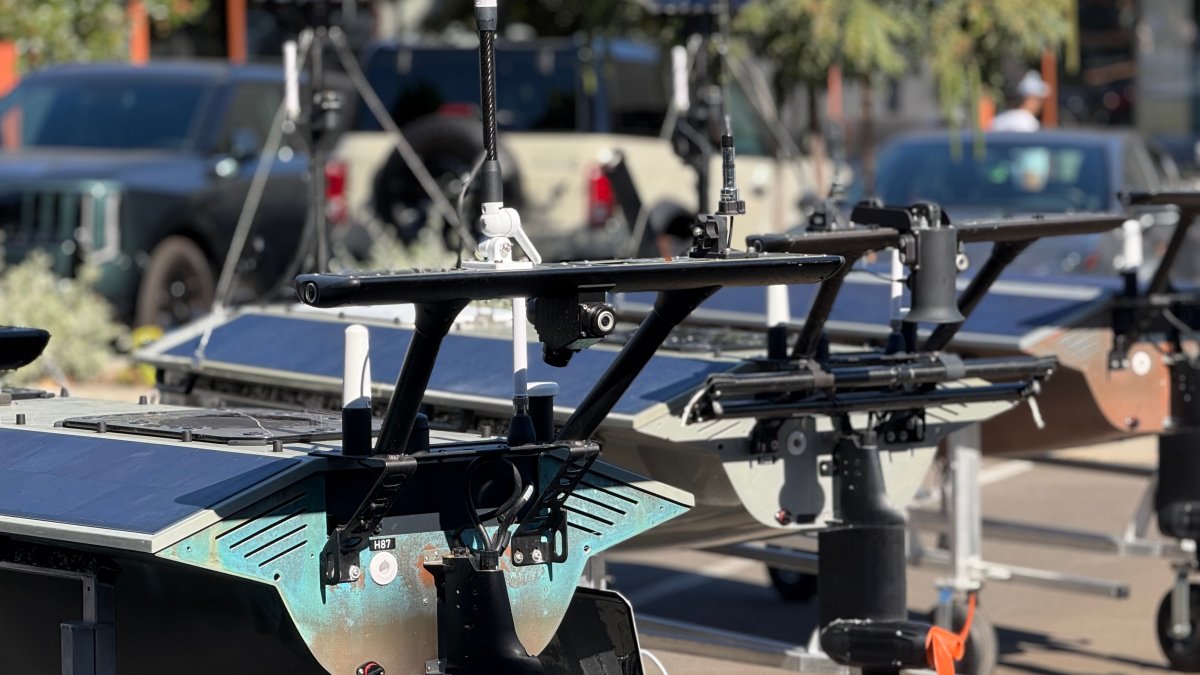
San Diego-based defense technology company Seasats celebrated their new, larger Bay Ho facility Tuesday as they look to expand production of autonomous surface vessels.
The facility is more than 60,000 square feet, about five times the size of the company’s previous building in a nearby business park.
Seasats, which has operated since 2020, recently surpassed 100 employees, most of them in San Diego, and plans to grow its workforce by 50% over the next year.
“The biggest change is a lot more space,” Seasats CEO and Co-Founder, Mike Flanigan, said.
The facility combines production, research and development, testing and live operations for Seasats’ autonomous vessels. Flanigan said this makes the facility “particularly unique” and helpful to have everything under one roof.
One of the company’s core products is Lightfish, an autonomous surface vessel built and tested in San Diego.
“It’s a long endurance vessel, only about 12-ft. long, but it packs a really big punch in terms of the mission it would serve and how long it can go,” Flanigan said.
The vessels have travelled tens of thousands of miles across oceans while gathering data and conducting surveillance. Flanigan said the Department of Defense is one of the company’s biggest adopters, with both the Navy and Marine Corps among its clients.
The technology is intended in part to handle repetitive or time-consuming missions that could otherwise require sailors.
“We want to put people where they’re really valuable and there’s high, important missions that people are really the best, trained sailors are really suited toward,” Flanigan said. “Let’s try to clean up those other tasks that are really costly and wear people down with robots.”
San Diego is home to a multibillion-dollar defense industry. Earlier this year, U.S. Central Command shared unclassified video showing the first use of an autonomous surface vessel in American combat operations overseas. That vessel was made by Saronic, another company with a presence in San Diego.
Flanigan said Seasats’ vessels are designed for longer missions and detection as autonomous technology takes on a growing role in defense operations.
“If we can do something dull and repetitive with a robot,” Flanigan said, “it makes so much sense.”
This story was originally reported for broadcast by NBC San Diego. AI tools helped convert the story to a digital article, and an NBC San Diego journalist edited the article for publication.