
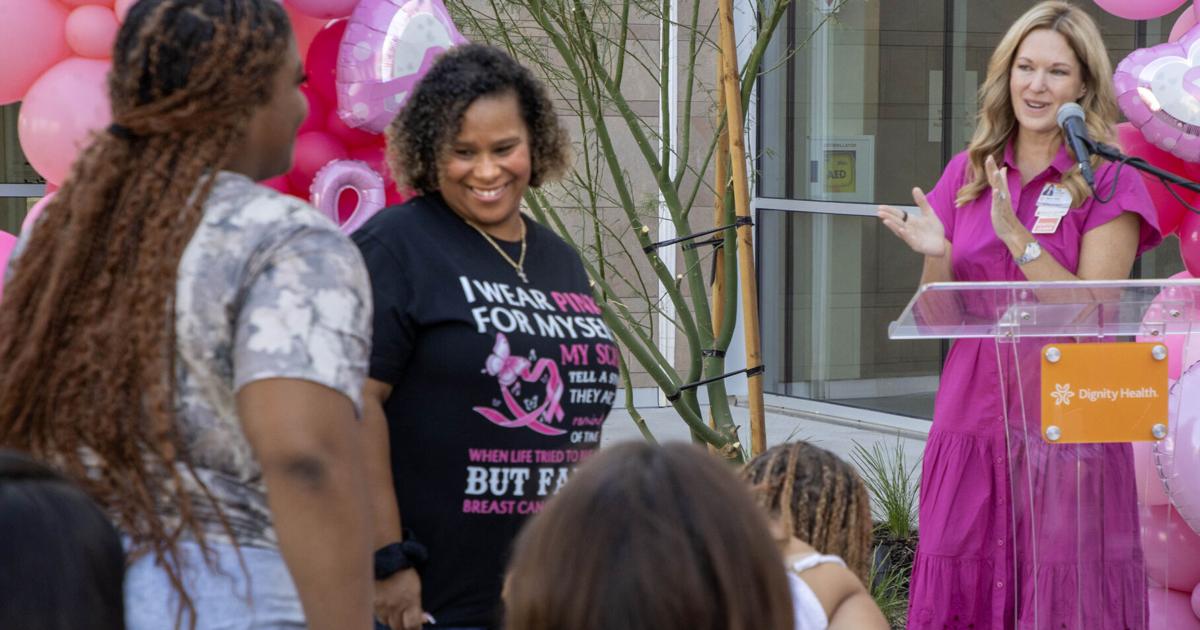
Dignity Health and the Comprehensive Blood & Cancer Center highlighted an advancement in local cancer treatment Tuesday morning.
However, this treatment, called cold capping or scalp cooling, doesn’t help patients beat cancer so much as it may help them maintain their identity, their optimism and their sense of control by keeping their hair when chemotherapy might otherwise cause it to fall out.
At a news conference held just outside the Thomas M. Hardt Tower at Mercy Hospital Southwest, medical professionals, hospital executives and community supporters listened as Toni Harper, vice president of philanthropy, welcomed visitors and members of local news organizations.
“When someone hears the words, ‘You have cancer,’ life changes in an instant,” Harper told the gathering. “Along with the decisions about treatment come deeply personal concerns about family and work, and what will the months ahead bring.
“For many patients, losing their hair is an especially difficult part,” Harper said. “It can affect how they see themselves, and how much of their diagnosis they choose to share. Scalp cooling offers eligible patients another option, as they navigate treatment.”
The Dignity Health Infusion Center at CBCC is the first and only medical facility in Kern County to offer cold capping technology, said Dr. Hemmal Kothary, the chief medical officer for Dignity Health’s Central California Division.
“When patients look in the mirror, cold capping allows them to see themselves and not the disease,” Kothary said. “In a situation where so much feels out of control, (this) technology restores a sense of normalcy and autonomy. It also provides essential privacy, giving individuals the power to choose who they share their diagnosis with.”
“This stuff is pretty darn amazing,” Kothary said of the technology. “It reduces your chance of losing your hair by up to 60 or 70%.”
The therapy can help patients prevent or significantly reduce chemotherapy-induced hair loss. By cooling the scalp during treatment, the technology constricts blood vessels and reduces the amount of chemotherapy drug that reaches the hair follicles.
Dr. Ravi Patel, director of medical oncology and hematology at CBCC, was expected to be at Tuesday’s news conference, but due to a patient care need, he was unable to attend, organizers said. However, Patel was quoted in a news release.
“For many patients, hair loss is one of the most visible and distressing side effects of chemotherapy,” he said. “Studies show that scalp cooling can be highly effective, with many patients retaining a significant percentage of their hair.
“While individual results vary based on the chemotherapy regimen, the impact on a patient’s cancer journey can be profound.”
Cancer patient Tiffany Rowland is only 40, but last summer, the wife, mother and special education teacher received some gut-wrenching news.
“On July 7, I was diagnosed with stage three, triple negative breast cancer,” she told The Californian. “Triple negative is a very aggressive one.”
“It was life-altering,” Rowland said. “You think all the negative things, and then you look it up on the internet, and you think, ‘She said, chemo.’”
So far, Rowland has had 14 chemo treatments, and her hair looks great.
“I’m halfway through my journey, so I’m not even almost done. So there’s the anxiety, there’s the what’s going to happen next.”
“Am I going to see my kids graduate?”
The Dignity Health people didn’t approach her about being their first cold capping patient. It was Rowland who asked about how she might be able to save her hair.
“Because my number one thing is my hair,” she said, laughing. “I wanted my kids to see some kind of normal me. I wanted them to be able to see me, not my cancer, when they looked at me — and I wanted to see me when I looked in the mirror.”
And as a teacher, she was worried her students would be distracted if she lost her hair.
Indeed, Rowland may be more worried about the people around her than she is about herself.
“It alters my life,” she said, “but I feel like I’m a grown up, and I can handle it.”
A year ago, she lost her mom, and her children lost their grandmother.
“So I was like, that’s going to be the worst thought in their head. That’s what I was worried about the most.
“I feel like this was something I could really control.
“Sometimes it’s not even just about the hair,” Rowland said. “It changes the narrative.
“If someone sees you on the street and they can tell you have cancer, it’s like, ‘Oh, my God, I’m so sorry.’ When people see me in here, they’re like, ‘Oh my God, you’re doing great. You still have your hair.’
“So it kind of changes the narrative and it makes me feel better.”