
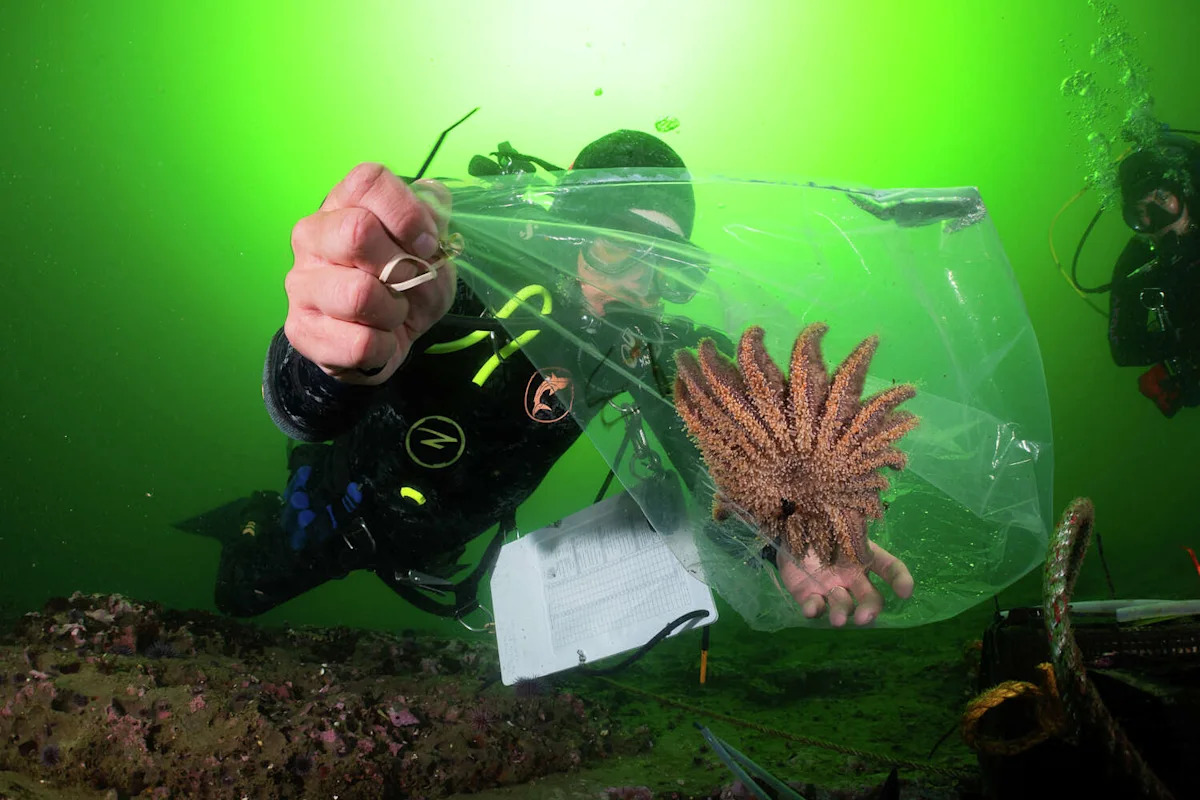
An audacious effort to restore a critically endangered species to the California coast has moved one step closer to fruition after scientists temporarily released more than a dozen lab-reared sunflower stars into Monterey Bay.
Once a common sight for divers, these manhole-sized, many-armed sea stars have not been seen south of the Bay Area since 2018, after a mysterious illness killed around 6 billion individuals along the West Coast of North America.
Set free, the lab-reared animals quickly devoured their preferred prey, sea urchins, which have ballooned out of control in the years since the outbreak. The stars’ successful hunting raises hopes that the animals could one day be set free for good, helping to restore urchin barrens into lush, productive kelp forests.

A sunflower star feeds on urchins during the Sunflower Star Laboratory’s outplanting fieldwork in Monterey Bay, Calif., on June 19, 2026. (Courtesy of Sage Ono)
“This work is the foundation for the upcoming future permanent outplanting in our state,” said Reuven Bank, the executive director of the Sunflower Star Laboratory, which oversaw the research. “What we’ve found really supports the strong restoration potential of sunflower stars and that future outplanting can have a significant positive effect on the environment.”
A deadly disease
An urchin barren covers the shale reef in the Sunflower Star Laboratory’s outplanting site in Monterey Bay, Calif., on June 19, 2026. (Courtesy of Sage Ono)
Between 2013 and 2017, a fast-moving, highly fatal disease known as sea star wasting disease swept up the West Coast, causing widespread death among more than 20 sea star species. Sunflower stars, known scientifically as Pycnopodia helianthoides, were hit particularly hard, declining by roughly 92% across their historical range from Baja California, Mexico, to the Aleutian Islands off Alaska. Today, the species is rarely found south of Puget Sound.
It took years for scientists to untangle the mystery underlying wasting syndrome, and many questions remain to this day, but in 2025, researchers identified the bacterium Vibrio pectenicida as the likely cause.What triggered the outbreak in 2013 remains unknown, yet subsequent research has shown that the bacterium tends to thrive in warmer waters, and there were several notable heat events around that time, including a massive, unprecedented marine heat wave in the Pacific Ocean known as “the Blob.”
Most Read
Science | Multimillion-dollar NorCal wildlife bridge gets unexpected traveler
News
| Virus that can cause polio-like illness rising in Northern Calif.
Crime |
Teen killed in Bay Area hotel may be linked to FBI most wanted suspect
News
| Wife of slain NYT exec alleged disturbing book given to children
Read our stories ad-free on the new SFGATE app.
Without their natural predators, urchin populations have boomed in the years since the outbreak swept through. As urchin numbers have grown, so have their appetites, such that once-lush kelp forests up and down the coast have been devoured, turning them into urchin barrens devoid of other life. In Northern California, as much as 95% of kelp forests are now in decline.

A sunflower star crawls out of a pod during the Sunflower Star Laboratory’s outplanting research in Monterey Bay, Calif., on June 19, 2026. (Courtesy of Sage Ono)

A pile of skeletons from urchins eaten during the Sunflower Star Laboratory’s outplanting research in Monterey Bay, Calif., on Aug. 26, 2026. (Courtesy of Sage Ono)
Kelp forests provide myriad benefits, both ecological and economical – adding more than $250 million each year to California’s economy – and so there’s tremendous interest in restoring them.
The Sunflower Star Laboratory, a conservation nonprofit, started in 2021 with the goal of not just regrowing sunflower star populations but also restoring all the benefits they bring to the ecosystem. Today, the Star Lab partners with academic and conservation groups in its work, such as the Reef Check Foundation; the Monterey Bay Aquarium; Moss Landing Marine Laboratories; the California Department of Fish and Wildlife; California State University, Monterey Bay; the Hopkins Marine Station; and the Monterey-based dive company, Underwater Company.
“Pretty much every group working on marine issues in this part of the world has been involved in one way or another, which we’re very excited and proud of,” Bank said. “None of it could have happened without many of the marine institutions donating their time, their boats, their people to support this effort.”
Hard at work
Manager Andrew Kim receives bagged sunflower stars as part of outplanting fieldwork in Monterey Bay, Calif., on Aug. 26, 2026. (Courtesy of Sage Ono)
Last year, the group transplanted stars into the waters of Monterey Bay in a series of caged experiments to see whether the captive-bred individuals could hack it in the wild. All but one survived their month at sea, and the one that didn’t make it likely died from cannibalism, Kim said. Critically, none of the stars showed any evidence of disease.
This summer, researchers carried out additional experiments to reestablish how sunflower stars will fit into the broader kelp forest ecosystem.
Members of the collaboration outplanted 16 palm-sized sunflower stars in enclosed cages onto an urchin barren in Monterey Bay. Half the animals were given an unlimited supply of starved urchins, mimicking the poor condition of urchins found in barrens devoid of food, while the other half was provided with unlimited, well-fed urchins that might be found in a healthy kelp forest. The stars voraciously consumed the urchins, regardless of whether the urchins were starved or not – when the urchins were of a lower quality, the stars simply ate more of them to compensate, gaining more than 50% of their body mass, on average, over the course of the month.

An endangered, lab-grown sunflower star takes its first steps outside of its cage in Monterey Bay, Calif., on June 19, 2026. (Courtesy of Sage Ono)
At the same time, divers also observed the landscape around the cages to see if the presence of the stars prompted any behavioral changes among the residents of other areas. They found that urchins fled the immediate vicinity of the cage and that such effects were detectable, even dozens of feet away. The urchins’ avoidance also persisted for weeks after the stars were removed.
“We went from seeing up to 60 urchins in a single square meter to basically zero,” Andrew Kim, a co-founder of the Sunflower Star Laboratory and its laboratory manager, told SFGATE. “It was very clear that they didn’t want to be anywhere near where these stars were.”
Lastly, the team released a handful of stars into the reef, following them over the course of two hours to observe their behavior. Divers chaperoning the stars on their walkabouts noted that several of the animals immediately left the cages to explore their surroundings, feeding on any urchins they came across. This portion of the experiment marks the first time a sunflower star has roamed freely in Monterey Bay since 2018, as well as the first time lab-reared stars have been released into California nearshore ecosystems.

An endangered, lab-grown sunflower star chases down an urchin in Monterey Bay, Calif., on June 19, 2026. (Courtesy of Sage Ono)
Collectively, the results show that sunflower stars are apex predators in their environment and that they have the ability to drastically alter the landscape, potentially restoring kelp forests to areas that are today barren.
New arrivals
Sunflower stars are packed up from the Moss Landing Marine Laboratories’ shore lab so that they can be placed in cages in the wild, shown in Monterey Bay, Calif., on June 18, 2026. (Courtesy of Sage Ono)
Bank told SFGATE the group is planning another one to three years’ worth of work before fully reintroducing the species into the wild. Wasting syndrome remains a concern, and the caged feeding experiment conducted earlier this summer was ended a month early after two individuals began to show symptoms consistent with the disease, including lethargy and the loss of limbs. Notably, the area was once again experiencing abnormally high temperatures.
The animals were quickly removed from the ocean and brought back to the lab, where subsequent tests by the California Department of Fish and Wildlife confirmed the presence of Vibrio in one individual, as well as in the ambient environment where the experiments were held. The confirmation marks the first documented case of the natural transmission of this pathogen in California waters, although Kim notes that the test has not been widely vetted or adopted by other researchers.
“Even still, having a seemingly accurate test for this virus has been a game changer,” Kim said, adding that the team continues to monitor different species of sea stars in the wild to identify where the virus may be lurking in isolated pockets.

A Sunflower Star Laboratory diver observes the behavior of an uncaged sunflower star during fieldwork in Monterey Bay, Calif., on Sept. 15, 2026. (Courtesy of Patrick Webster)

Lab manager Andrew Kim touches the podia of an outplanted sunflower star in Monterey Bay, Calif., on June 18, 2026. (Courtesy of Sage Ono)
In addition to the risk of sea stars falling ill, there’s also the added consideration that the majority of the individuals in captivity today stem from a single cohort spawned on Valentine’s Day in 2024 at the Birch Aquarium in La Jolla.
“We need to make sure that the stars we’re putting out there are not from a single cross and that they’re not full siblings,” he said. “Otherwise, we end up with a really genetically weak population.”
Here too, though, the group is making progress. In January of this year, the mother of the Valentine’s Day cohort spawned again, and scientists were able to fertilize her eggs with sperm collected from three males, creating a new cohort dubbed the Kelp-Pop Urchin Hunters after the widely popular film, “KPop Demon Hunters.” And several months ago, eggs from a female at the Heal the Bay Aquarium in Santa Monica were used to create four new lineages, collectively named the Chicken Fingers cohort in reference to the female’s unique texture.

A flipped sunflower star eats an urchin during the Sunflower Star Laboratory’s outplanting fieldwork in Monterey Bay, Calif., on June 19, 2026. (Courtesy of Sage Ono)
Moving forward, members of the collaboration will continue to raise the young for future experiments and work together toward the ultimate goal of reintroduction. The Star Lab already has a few sites in Central and Northern California that it’s considering. First, it’ll need to thoroughly characterize them so that it can better assess the changes that happen when the stars are reintroduced.
“We’ve got people preparing for that work,” Bank told SFGATE. “It’s definitely an all-hands-on-deck moment.”
More Science News
– Sea turtle lays eggs in Calif. for first time in recorded history
– Super rare tropical bird swoops over California. Experts fear a trend.
– New fault capable of massive earthquakes discovered in California
– What the ‘extraordinary’ new El Niño forecast means for California
Sign up for daily SFGATE breaking news alerts here.
This article originally published at These predators may soon restore California’s battered kelp forests.