
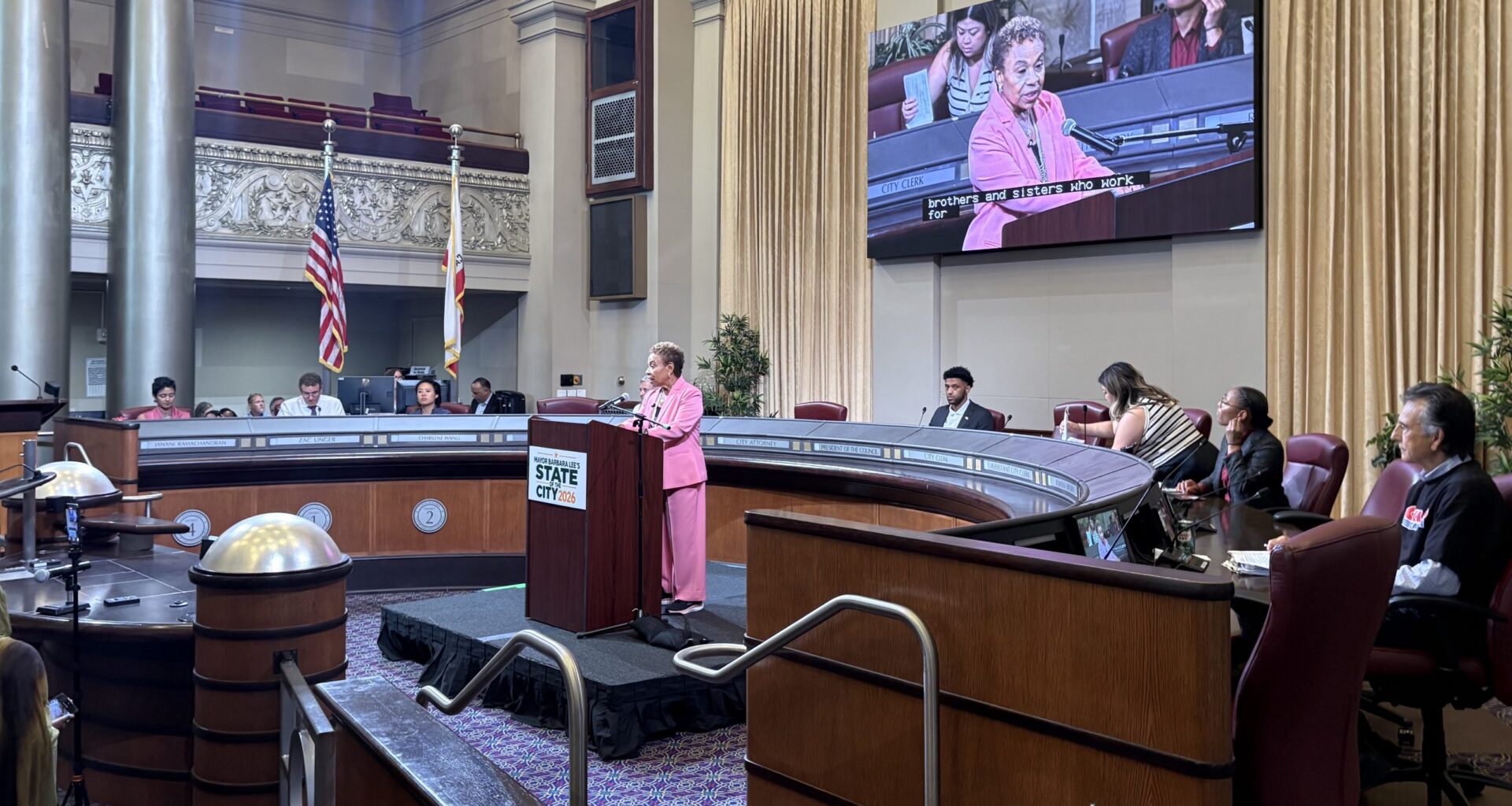
In her second State of the City speech, this one coinciding with her campaign for reelection, Mayor Barbara Lee made the case that Oakland has made significant progress on crime, housing, and business. But the city also needs to “tell the truth” to the public about work that remains, she said.
Her speech was bookended by a picket and forceful comments by city workers who are threatening to strike over what they describe as an unwillingness by the administration to grant cost-of-living increases or fill hundreds of vacant jobs.
As soon as she took the mic, Lee addressed the unions.
“We are working very, very hard, not just to get a contract but to get a fair contract. Every city worker deserves this, and I know the City Council and myself are working constantly to that end,” she said.
Lee’s 35-minute address was packed with statistics, including the recent historic drop in homicides and the plunge in other violent crime. Oakland’s chiefs of police and violence prevention sat in the front row of the audience and received accolades from the mayor. MACRO, the non-police emergency response system, was also busy, Lee said, and answered 7,000 calls last year, rarely bringing in law enforcement.
Applause thundered throughout the council chamber when Lee mentioned the Oakland Police Department’s exit from federal oversight.
“The responsibility is ours now,” she said, echoing commitments she’s made in previous addresses. “Constitutional policing must remain our standard. Accountability and civilian oversight must remain our standard. Community trust must be our standard.”
Highlighting the reopening or renovation of key city facilities — Tyrone Carney Park, the Mosswood Community Center, and the Brookfield library branch — the mayor veered off script for a moment.
“It gives our young people, especially, hope. It gives our residents the trust that we need to build — that, yes, we’re doing this together, and yes, we’re spending your tax dollars the way you want.”
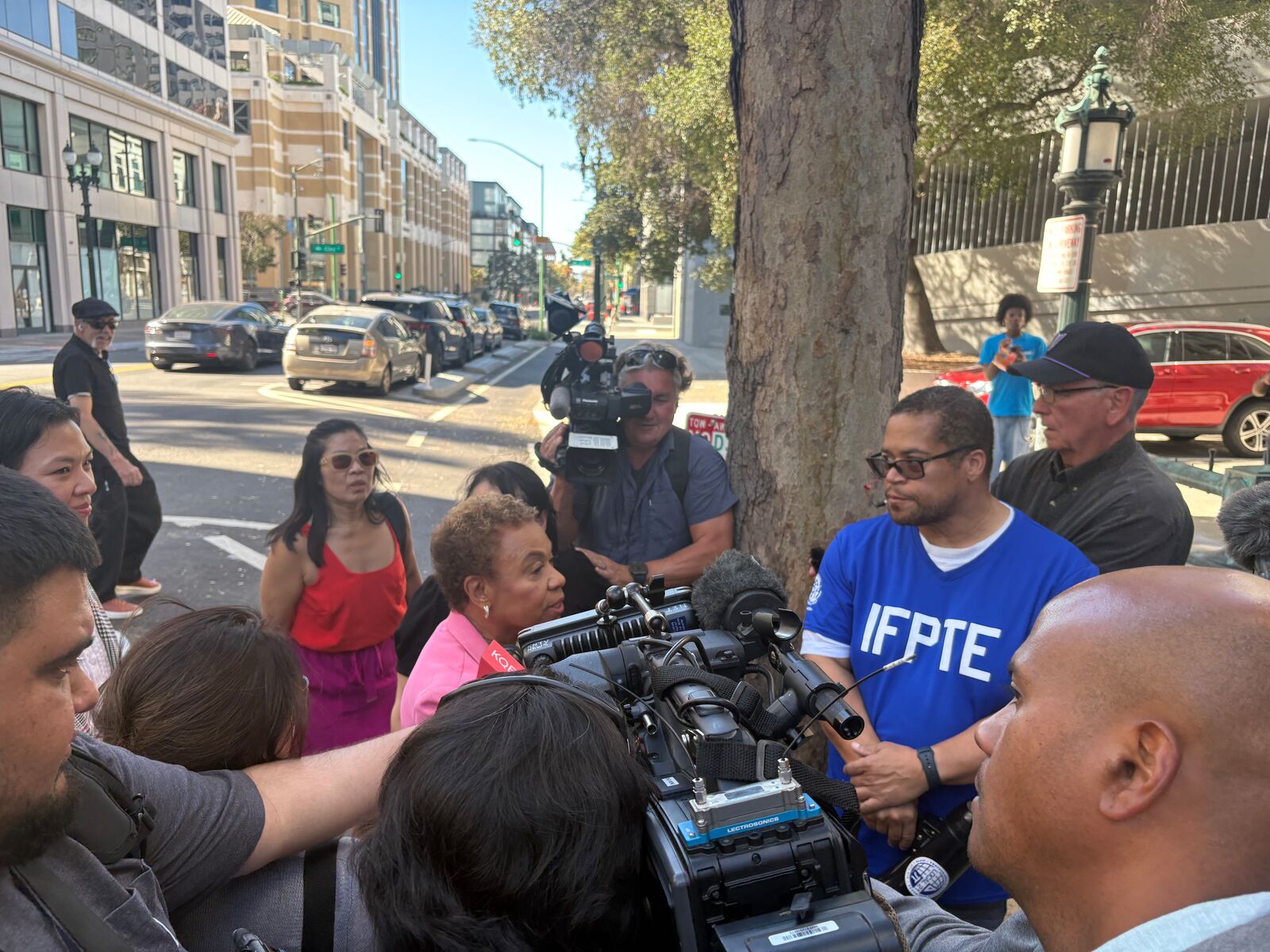 Lee speaks briefly with IFPTE Local 21’s Julian Ware as she arrives at City Hall for her speech. Credit: Natalie Orenstein/The Oaklandside
She heaped praise on her administration and other elected officials for their work on illegal dumping, including the $9.2 million in private investment she secured to address trash heaps and the legislation she and Councilmember Zac Unger wrote to boost fines for people caught dumping.
Dumping is one of several topics Lee’s speech covered where the gains she highlighted are paired with ongoing challenges. For example, a recent independent city audit found numerous flaws with Oakland’s approach to illegal dumping, and seemingly nobody’s been criminally charged for the act, despite pledges by the mayor to work with the district attorney on this.
Lee also spoke about significant progress on housing and homelessness. A report released this spring found that homelessness has dropped by an estimated 20% since 2024. Oakland has opened more than 1,300 new affordable housing units in the past two years and has 1,500 more coming, Lee said.
Also in the past year, the City Council passed a controversial policy allowing city crews to crack down harder on encampments, in some specific cases closing them without offering residents other shelter.
In her remarks Tuesday, Lee tried to balance her obligation to unhoused people with her responsibility to the housed constituents living and working near camps.
“We should never have to choose between compassion for people experiencing homelessness, and the health and safety of our neighborhoods,” Lee said. “We can’t solve homelessness by simply moving people from one street to another…When we resolve an encampment, there should be somewhere safer for people to go and a strategy for keeping that neighborhood healthy after.”
She touted the new city office she launched focused on homelessness and an action plan it’s released.
The mayor also acknowledged the economic realities that threaten any ambitious goals of Oakland’s.
“We continue to fight, quite frankly, for every single dollar Oakland deserves, from the county, state, and, yes, what’s left of the federal government,” Lee said.
“Oakland has many challenges,” she said toward the end of her speech. “We tell the kids about them. We don’t sweep them under the rug, and then we get to work, because Oakland also has something else. We have strength. We have creativity. We have history.”
On a personal note, she spoke about her aunt and uncle, the Murrells, who were prolific property owners in Oakland in the 1950s despite many Black people being barred from homeownership then. In real estate or property management dealings, her uncle would pretend to be the maintenance worker and his accountant would pretend to be the owner. The Murrells started the first Black-owned lending institution in the city, she said.
Her message: Oakland residents have always fought to succeed against incredible odds.
Saying she’s working to make the city more affordable for all residents, the mayor mentioned buying her first home in Oakland’s Maxwell Park neighborhood for a cool $19,000, when she was on public assistance. These days, according to Redfin, houses cost around $750,000 in the same location, and $1 million was typical a couple of years ago.
City employees say Oakland hasn’t offered them an acceptable deal yet
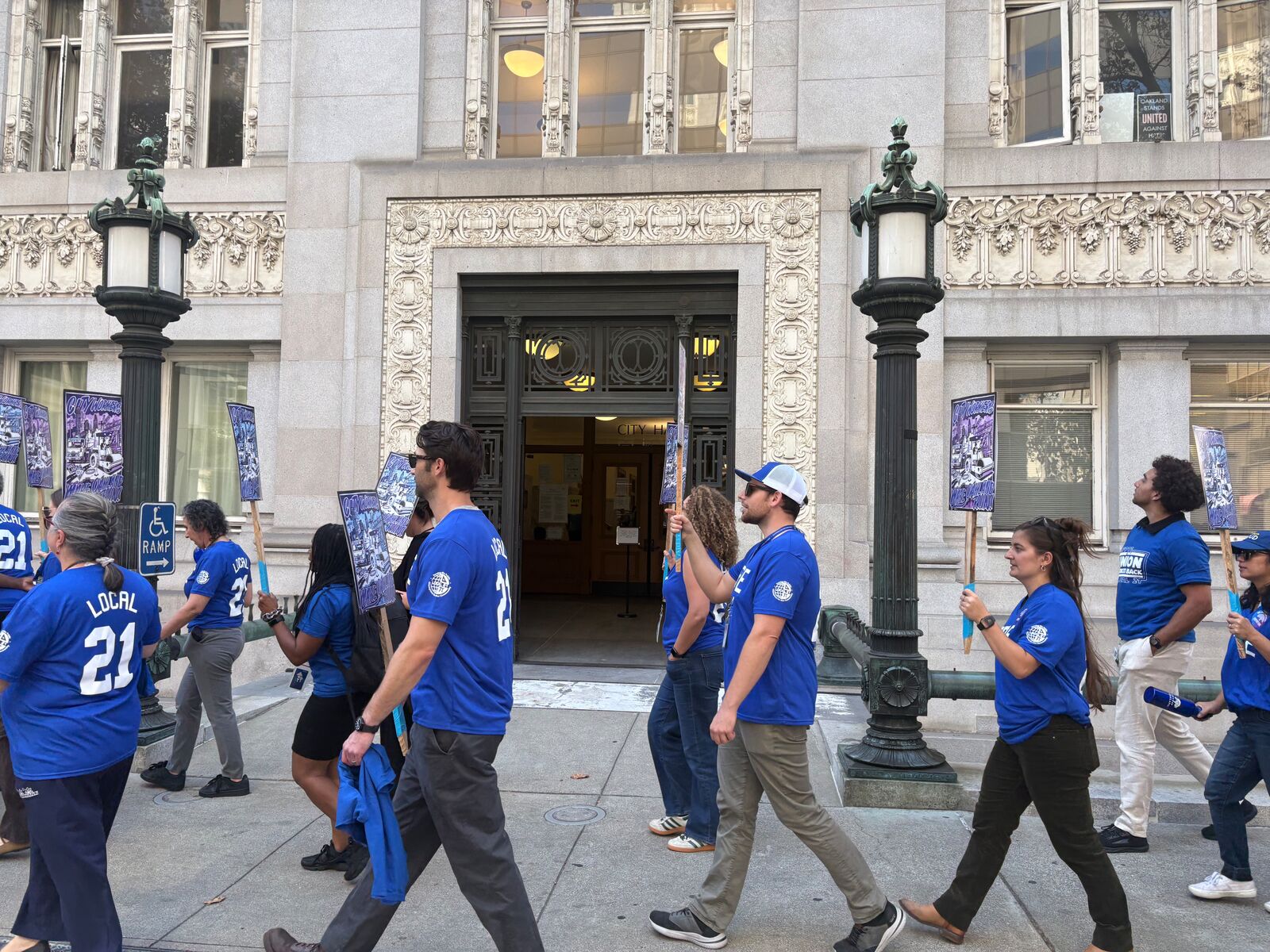 Workers with IFPTE Local 21 hold an “informational picket” along 14th Street before the meeting. Credit: Natalie Orenstein/The Oaklandside
When Lee arrived at City Hall, she encountered picketing city workers from the International Federation of Professional and Technical Engineers (IFPTE) Local 21. She quickly spoke with them and pledged to work for a fair contract before heading toward the council meeting.
After her speech, several employees with IFPTE and other city unions said they were unmoved by what they heard.
“I want to talk about the promises you guys like to make,” said Public Works staffer Amber Kennedy, in a public comment during Tuesday’s meeting. “How we’re going to pave streets, how we’re going to make safer streets, how we’re going to clean up illegal dumping. Who does that work?”
According to Kennedy, during the six months that IFPTE has been at the bargaining table with the city administration, “not a single offer has come across the table that wouldn’t leave all these workers relatively more poor next year than they are right now.”
While the mayor pledged in her speech to continue working toward the Measure NN benchmark of 700 police officers in Oakland (the city currently has 601), the workers said staffing up other departments should be met with the same urgency.
“Do you know how many arboricultural inspectors it takes to maintain our city trees?” asked a transportation worker, Chase Fowler. “How many civil engineers it takes to maintain our aging infrastructure and streets? How many planners it takes to fully staff our front counter. Where is your enthusiasm and passion for the basic public services that we offer as a city?”
Lee has generally enjoyed support from labor unions. In her campaign for reelection, she’s been endorsed by IFPTE Local 21 and all other major city unions, aside from the police union.
In an interview before the meeting, Local 21 Vice President for Oakland Julian Ware told The Oaklandside that the union wants the city to fill vacancies in the Human Resources Department first, to enable speedier hiring for positions across the city. Many are already budgeted for but have been sitting empty.
IFPTE Local 21 is also pushing for guardrails around artificial intelligence use in city work, he said.
Ware said Tuesday’s worker rally was meant to communicate that the “state of the city” is different depending on whom you ask. The union plans to hold a strike authorization vote later this month, he said.
“*” indicates required fields