
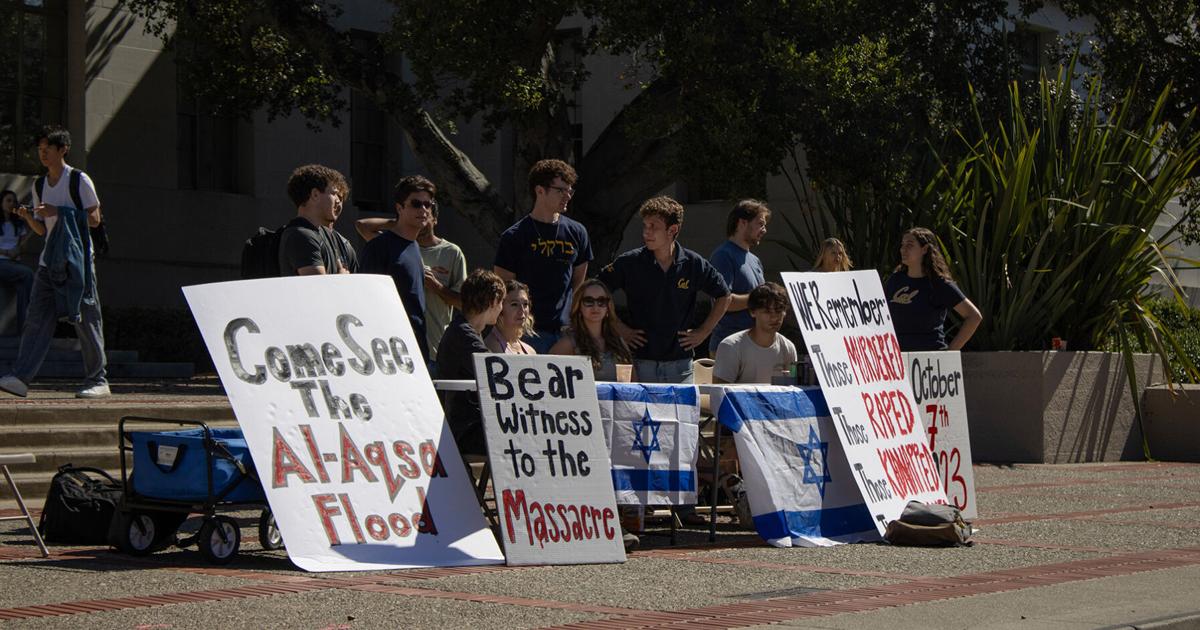
UC Berkeley Jewish, pro-Israel and pro-Palestinian groups flocked to Sproul Plaza to commemorate the three-year anniversary of Hamas’ Oct. 7, 2023 attack, which killed about 1,200 people in Israel, and Israel’s subsequent genocide in Gaza. Israel has killed about 70,000 people in Gaza since Oct. 7, according to Amnesty International.
Beginning at about 9 a.m., groups including UC Berkeley Chabad and Students Supporting Israel tabled on the steps of Sproul Hall, setting up an Israeli flag and sign reading “bear witness to the massacre.” Pro-Palestinian groups set up tables on Upper Sproul Plaza, many adorned in keffiyehs. Group members hung a string of Palestinian flags from a nearby tree.
Pro-Palestinian groups raised funds for the Sameer Project, a humanitarian organization working in Gaza. Organizers told The Daily Californian that they raised about $1,000 while tabling.
Organizers sold print issues of the protest parody newspaper the New York War Crimes for $7 each.
“There’s a very large pro-Palestine community in the Berkeley community, the Bay Area community, but specifically here at UC Berkeley as well,” said Yusuf, a campus Ph.D. student and member of Students for Justice in Palestine. “We’re calling attention to many American institutions’ complicity and contributing to the military-industrial complex that is hand-in-hand in Israel’s role in the crusade against Gaza, the West Bank, and the Palestine territories as a whole.”
Yusuf also drew attention to the UC Berkeley Foundation, which declined to divest from weapons manufacturing in 2024.
Chabad and SSI, which reserved the space on the steps of Sproul Hall in advance, aimed to draw attention to the atrocities of Oct. 7.
“When our people walk through this campus, what they see is people are supporting the brutalization of my family. That’s what they see when they walk by and they chose October 7 to come out here,” said Dan Gotesdyner, president of SSI. “They chose this day of all days when we are mourning our dead to come out here and counter us, counter our mourning.”
At about 2:50 p.m., UCPD arrived at SJP’s table after speaking briefly with organizers. UCPD removed their loudspeaker, which had been playing drone sounds and audio from a number of videos throughout the day.
UCPD proceeded to take the loudspeaker to the Sproul Hall UCPD station.
“They were asking who owned the speaker. We responded. They were asking us more questions. I was particularly confused because I’ve been doing this for a while. I’ve been tabling for a while. Usually there’s a protocol. Someone from administration, from event services, would usually facilitate the conversation,” Yusuf said. “But this is the first time police came up and were a direct part of the process.”
UC Berkeley’s Time, Place, and Manner restrictions include specific rules for amplified sound. According to these rules, any use of amplified sound outdoors must be approved by UC Berkeley Event Services, building coordinators of surrounding buildings and the specific campus department managing the facility.
Time and date restrictions also apply. During times of instruction, amplified sound is only permitted during two periods of the day: between noon and 1 p.m., and between 5 p.m. and 7 p.m., seven days a week.
“It’s important to take in consideration the humanity of every single person, and in the Jewish tradition, we believe that one life is like an entire universe. So one person dying is like killing an entire potential universe of what could have been,” Shaya Keyvanfar, student president of campus’s Chabad.
Keyvanfar said she was concerned with how some groups were “weaponizing” Oct. 7 and that she wants both sides to understand each other with an open mind.
“We’re on this campus, thousands and thousands of miles away from Israel and Gaza, where this conflict is playing out and affecting people in real time,” Keyvanfar said. “If we can’t even try to come to peace with each other on this campus, then how can we ever expect for anything to get better over there?”
Pro-Palestinian organizations also emphasized their push for peace and for voices to be heard.
“I think I’ve gotten some pushback and such. Of course, it’s a controversial day,” said Ethan Flores, member of STEM4Palestine. “But I think in general, we’re here for humanity. We’re here for humanitarian aid.”
Flores highlighted how his organization aimed to link STEM disciplines with political issues, helping students stay principled even if they are working for large corporations.
“We want to help (the) world around us,” Flores said. “And that’s why we’re trying to welcome an entire field that’s disconnected from politics into politics, in order to make them feel welcome and know that they have a voice only when they exercise it.”
Bears for Palestine held an evening vigil at the Campanile, attended by about 65 people. Organizers hung Palestinian flags from trees on the Campanile Esplanade and arranged candles and flowers around banners reading “every martyr is a universe.”
UC Berkeley student Abdulaziz Alandejani said he thinks it’s “beautiful that people stand up for what they believe in.”
“I haven’t seen a lot of conflict and that’s a beautiful thing on such a controversial day,” Alandejani said.