
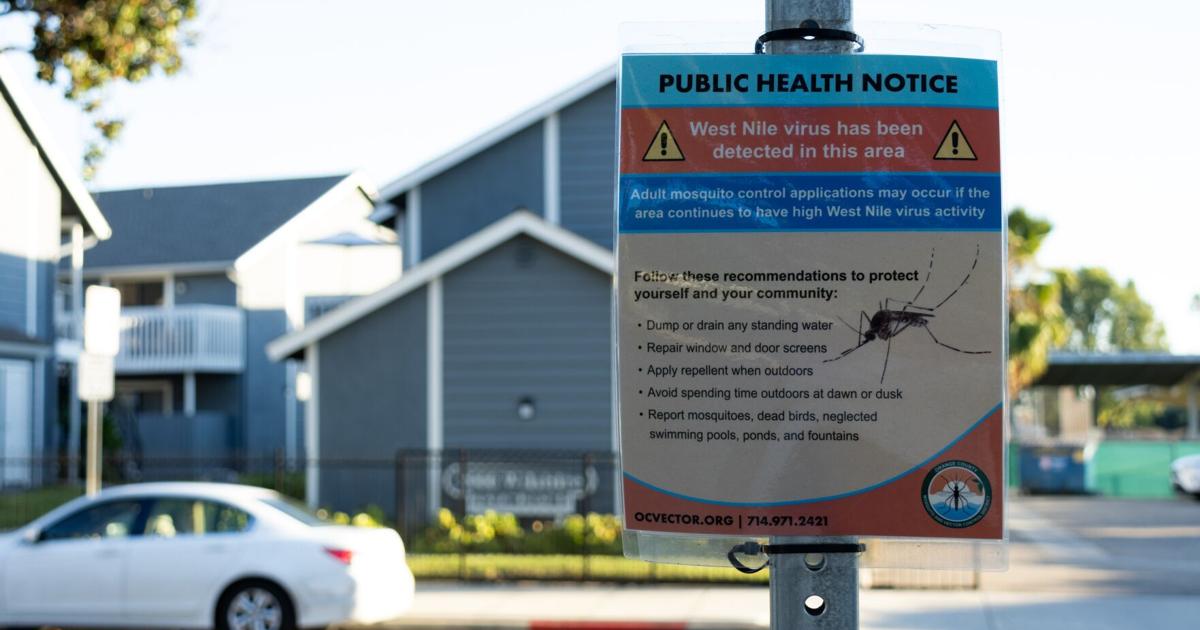
Orange County health officials confirmed on Oct. 1 the death of four people associated with West Nile virus (WNV), with Fullerton and Anaheim recording the highest numbers of positive mosquito samples.
While California’s WNV’s season typically occurs during summer and fall, officials warned in August that this year could bring a particularly active WNV season.
According to the Orange County Health Care Agency, there were three human cases of WNV with zero deaths reported this time last year. As of Oct. 7, that number has climbed to 43 human cases.
Dr. Christopher Zimmerman, deputy medical director for Communicable Disease Control at OC Health, stated that he expects to see cases through the end of the month, though the exact timeline for cases is dependent on environmental conditions.
According to reports from the Orange County Mosquito and Vector Control District (OCMVD), the district responsible for controlling disease-carrying animals such as insects and rats, there are currently 15 cities in the county with reported human cases of WNV. Costa Mesa and Fullerton each have three reported cases, while Anaheim has the highest at 10.
There are also 850 total positive mosquito samples for WNV as of Oct. 6. Of those samples, 175 were from Anaheim and 142 from Fullerton.
Brian Brannon, public information officer for the OCMVD, said population density and older infrastructure may contribute to the higher mosquito numbers in these areas.
According to OC Health, 80% of infected individuals are asymptomatic, meaning reported cases may underestimate the number of people infected.
Adults over 50 and immunocompromised individuals are at higher risk of severe illness from WNV, however, the majority of those infected do not develop symptoms.
Symptoms of WNV can include body aches, fatigue, headaches and fever. In more severe cases, the virus can cause neuroinvasive disease, with symptoms including severe headaches, neck stiffness, vision loss and confusion.
“The symptoms that we (OC Health) are most concerned about are what’s called neuroinvasive diseases,” Zimmerman said. “Those are the things that, whether you think it’s West Nile or not, should require urgent medical assessment.”
For Cal State Fullerton graduate student and Anaheim resident Isabel Bargas, the number of mosquito bites she has received this year has made her apprehensive about going outside.
“I used to run by the Santa Ana River by Angel Stadium, and I got torn up by mosquitoes,” Bargas said. “After that, I heard there was a lot of West Nile virus cases, so I just stopped running and try to run inside now.”
Bargas said that while she is aware of efforts to reduce mosquito populations in the area, and has taken safety measures herself, such as applying more bug repellent, she remains wary.
OC Health recommends eliminating standing water from properties, limiting outside activity and using Environmental Protection Agency-registered insect repellents containing DEET, picaridin, IR3535 or oil of lemon eucalyptus to prevent getting bitten.
There are currently no treatments or licensed vaccines for WNV in humans.
“The thing to do is to protect yourself; prevention is the business that we’re in,” Zimmerman said. “We provide these messages so that people can take measures to protect themselves from getting sick.”
Residents can visit OC Health’s WNV portal every Thursday for the latest case figures and updates in the county.