
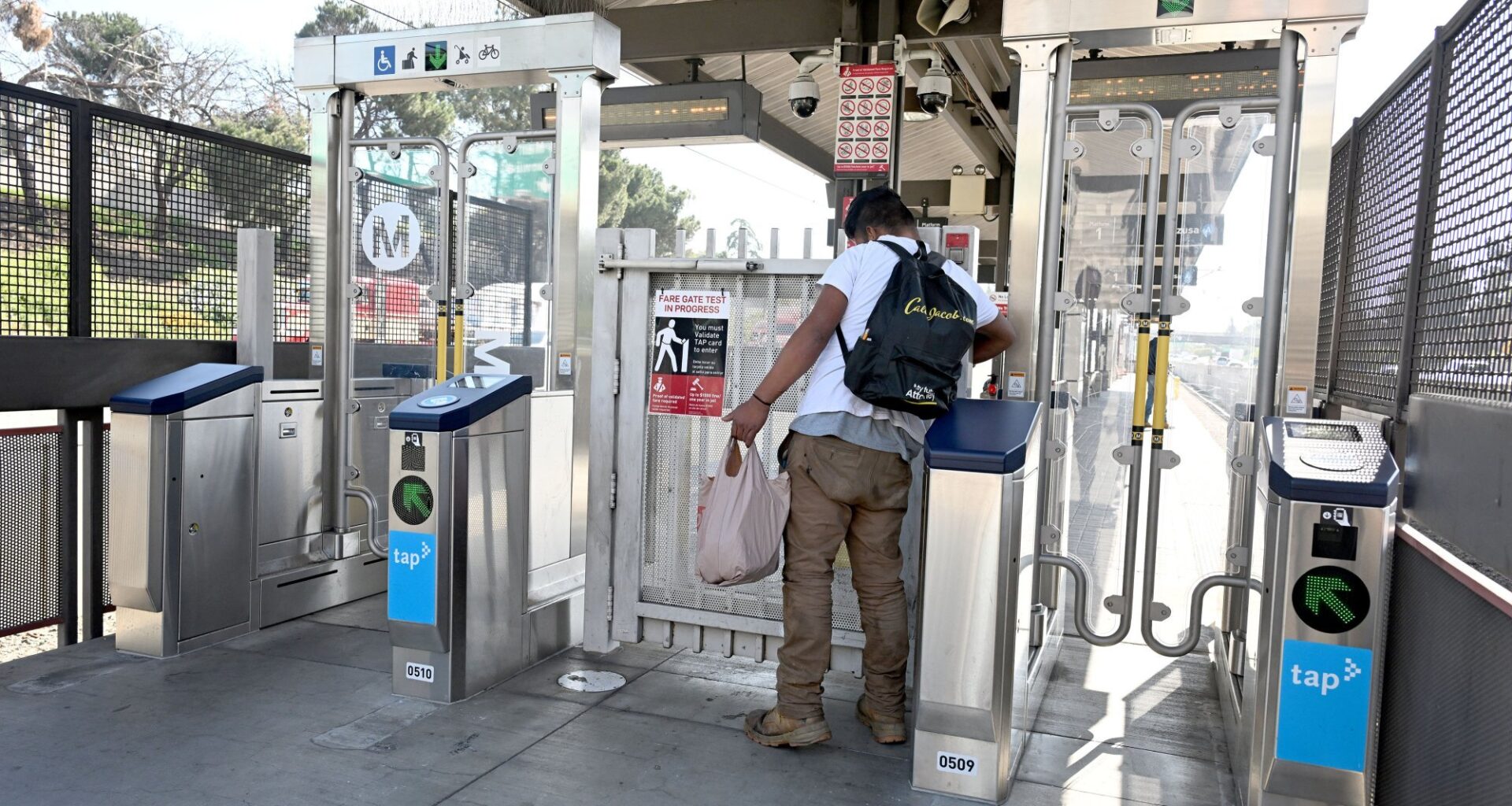
If you ride LA Metro, you’ve probably seen the new 6 ft tall plexiglass paddle faregates installed in the last year at 27 rail stations across the county. Metro has spent months touting the effectiveness of the paddle gates, pointing to an impressive-sounding 480% revenue increase at one station. But what conspicuously hasn’t been made public is the fare evasion rate before and after installation — that is, until we record requested the fare data and calculated it ourselves. Our calculations show a roughly 36% reduction in fare evasion rates at upgraded stations. We believe it’s still enough to justify installation, but nowhere near enough to substitute for officer-based enforcement.
In June 2026 (right after LAFD let Metro close all the gates), LA Metro’s paddle gated stations had an unweighted average fare evasion rate of 34%. When excluding newly opened stations, the evasion rate at paddle gated stations fell from 57% to 37% after installation (a 36% reduction). So while the new faregates are clearly having an impact, most of last year’s fare evaders are still getting through. Part of the problem is the emergency swing gates, but the nine stations without swing gates still have a 29% evasion rate. This is because walking through behind other riders entering or exiting is trivially easy. For safety, the gates won’t close if held open and often become stuck open when riders hold them.
As we revealed in the LA Daily News last fall, fare evasion skyrocketed to its current level after 2018 when LA Metro phased out regular onboard fare checks. After a year of rider advocacy, LA Metro has now agreed to bring back limited enforcement on select lines. We support the faregate upgrades as a supplement to this renewed enforcement effort. But we don’t believe paddle gates can ever supplant the need for human enforcement, as was argued in a widely circulated Atlantic article in April. Here’s why.
First, paddle gates can’t be installed on most street level stations, which represent at least 35 of LA Metro’s 113 rail stations. They also can’t be installed on buses, which represent 75% of Metro’s ridership. Second, a 34% (or even 29%) evasion rate is still far too high. And while Metro has pointed to the success of faregate upgrades on other systems like BART, in 2025, BART issued 29 times as many proof-of-payment citations per million boardings as LA Metro (267 vs. 9.2). Human officers are doing the real work, not plexiglass.
LA Metro will soon release an audit studying the new faregates’ impact on crime and fare compliance, and we hope that it will confront (instead of glossing over) the paddle gates’ serious limitations. We believe that instead of settling for a 29%+ evasion rate, it’s time for Metro to pivot back to the one system that actually worked: random onboard fare checks with civil citations for non-payment. You can learn more about our plan to implement such a system at enforcethefares.org.
Alex Davis is a transit advocate with a professional background in transit service planning and administration. Brian Aggrey is a transit advocate, engineer, and frequent LA Metro user. Jinyao DeSandies is a college student and transit advocate.