
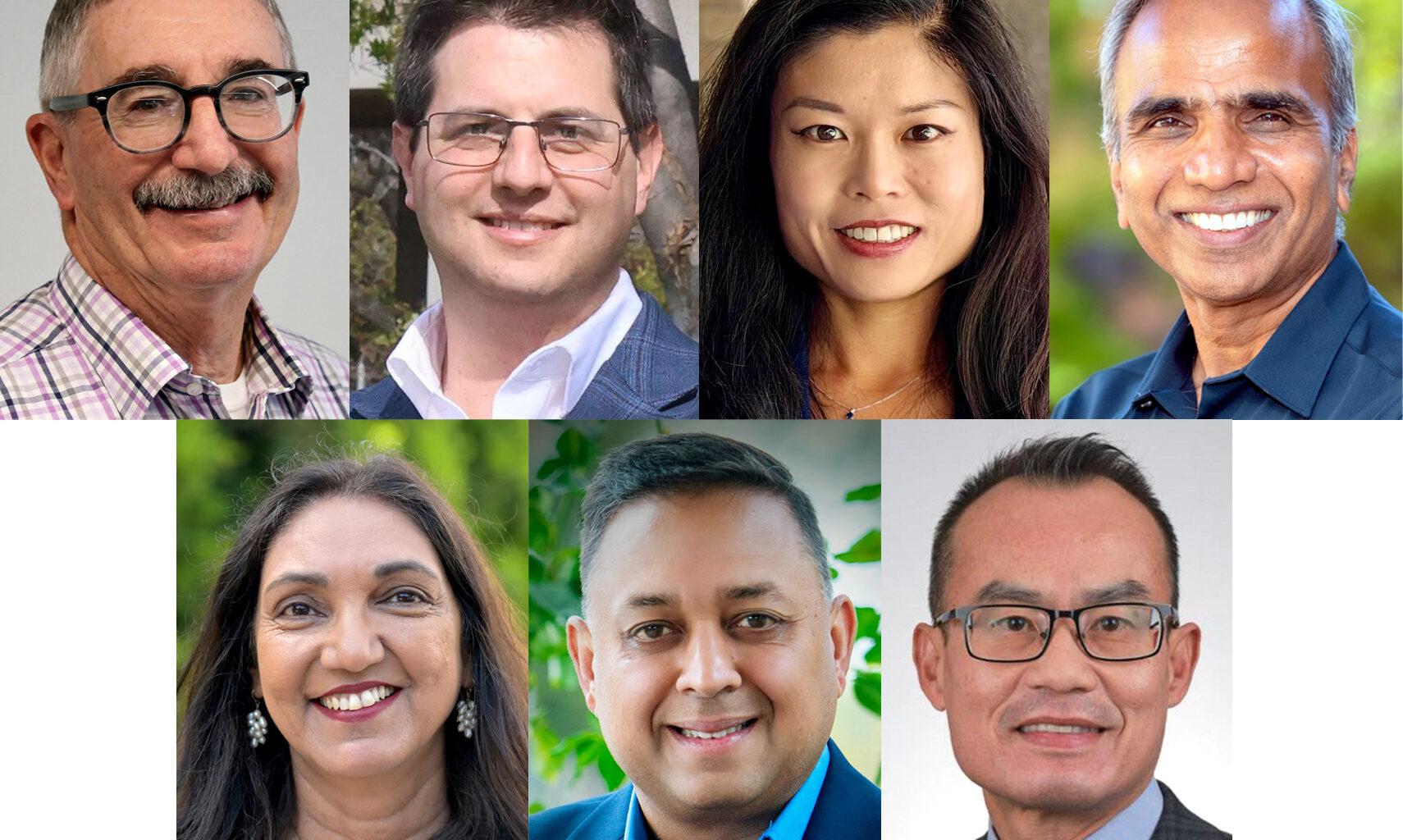
As Cupertino voters choose from a crowded field of city council candidates in November, they face a race that has come to be defined by competing political factions and a slate of three candidates who have opted to run together.
Three seats out of five are up for reelection, opening the possibility to remake the city council majority or solidify the current leanings on the dais.
Currently, the City Council has been defined by two broad groups, with councilmembers Liang Chao, Ray Wang and Kitty Moore frequently voting in concert, while J.R. Fruen and Sheila Mohan more often vote in the minority.
This year, Chao and Mohan will leave the City Council while Fruen seeks re-election.
Those who take office will face a panoply of issues: from a murky financial forecast exacerbated by the loss of millions in tax revenue from Apple and a multimillion hike in its contract with the County Sheriff, to a city hall marred by two civil grand jury reports and turnover in city staff, to the perennial Bay Area issues of housing affordability and school closures.
Seeking to confront these issues, eight candidates are vying for the three available seats. But in an unusual political move that has come to define the race, three have chosen to run as a slate. The slate, dubbed “Cupertino Together,” shares a central political platform, website, and funding and is asking those who would vote for one candidate to vote for all three in a political gambit meant to capture the majority of City Council seats. Meanwhile, three other candidates have joined in an alliance that would preserve the political leanings of the current majority, which leaves two outliers who have presented themselves as independent thinkers.
Cupertino Together
In the Cupertino Together slate are Fruen, 47, a current councilmember and chief of staff for San Jose City Councilmember Rosemary Kamei; Seema Lindskog, 60, a planning commissioner and marketing executive; and John Tang, 56, a water utility engineer and former Cupertino Chamber president.
The slate says they are offering a shared vision of economic development, well-planned housing and regional partnership and an alternative to the current majority they assert has failed to move the city forward.
“We need to have the courage to plan things differently,” said Fruen. “You either change and adapt or you die.”
Key to that change is a 10-year economic growth plan focused on attracting businesses to the city and diversifying its revenue.
“The city … it’s a fiscal mess … We’re basically trying to stop the bleeding rather than grow,” said Lindskog of the current economic planning for the city. “I want to make it the innovative, thriving, optimistic, can-do city that it should be.”
As part of that vision, she touted her efforts to streamline permitting to help small businesses.
Part of that economic plan is to negotiate a deal to complete a fraught development project at the site of the former Vallco shopping mall. The development has been over a decade in the making and was opposed and later bogged down in a lawsuit from Better Cupertino, an organization founded by Chao. Before joining city council, Moore assisted with the lawsuit, maintaining that the project did not meet certain legal requirements. The slate argues that the delay has cost the city tens of millions of dollars in lost revenue, based on estimates from Cupertino city staff.
The three candidates also highlighted a need to address issues of combative relationships between council and staff — which became the subject of a civil grand jury report. “We need to trust staff … The way that staff was being treated was not in line with good governance,” said Tang. They also maintain that the city needs to rebuild partnerships with other jurisdictions throughout the region, arguing that previous city leaders had burned bridges.
While other candidates questioned whether someone running on a slate could be truly independent, all three candidates noted that they had their individual stances but held a shared vision for the city.
Additionally, Fruen painted the slate as a political necessity – the only way to secure the majority on the council was for all three to succeed in their campaign. “I want to be able to keep my promise to voters … so having a majority really, really matters,” he said. “The way that you get the things that you care about is if you vote for all three of us because we can’t really guarantee it otherwise.”
“Residents First”
Running against the slate are three candidates associated with the current City Council majority, each endorsed by current council members Wang and Chao. The three candidates share volunteers and their signs appear together in clusters around the city, but they rejected the formal designation of a “slate” and argued that they hold distinct policy positions. Even so, their platforms share common threads.
The alliance is made up of Santosh Rao, 52, a planning commissioner and technology executive; Tracy Kosolcharoen, 40, a planning commissioner with a career in finance and marketing; and Gopal Kumarappan, 58, a member of the parks and rec and library commission with a career in technology.
The group says they are united in putting “residents first.”
“We actually have a need for representation, for resident-focused leaders that are going to take the time to listen to the community and represent what they need … to bring them in earlier on decisions,” said Kosolcharoen. “We don’t have any other outside interests, and our agenda is based on what residents locally want.”
While each of the candidates expressed the desire to bring business to Cupertino, compared to the Cupertino Together slate, they were more focused on scrutinizing the current budget.
“I believe that we are in an unsustainable situation… We need to bring fiscal discipline to the city,” said Rao, arguing that the city needed to reduce its contracts with outside consultants and contractors and “stop penalizing our residents” with additional fees and tax proposals.
Kumarappan suggested taking that scrutiny further with a quarterly budget dashboard to let residents “see where each dollar goes” and an analysis of projects involving the city’s major facilities. He added that he wanted to streamline permitting using technology such as AI.
Rao added that he ran on a “pro-business” platform that was distinct from his opponents, arguing that “my opponents have no understanding of free-market enterprise.” In particular, he argued that the delay in the development at the former Vallco mall site had more to do with post-COVID markets than the City Council.
All three maintained that being an alliance rather than a formal slate afforded them greater independence. “Our residents have shown that they want independent leaders,” said Kosolcharoen. “I really believe that the role of a council member is to be a neutral arbiter of issues.”
The Outliers
Finally, two candidates have placed themselves outside of the dueling factions. In some ways, both outliers have defined themselves by their independence from the existing political coalitions.
“Primarily you have these two different groups. I’m offering sort of a bridge,” said Mark Fantozzi, 75, who added that there was a need to “mitigate and eliminate” the divisions in the city. “I look at things from a more practical, problem-solving point of view.”
Fantozzi, an engineer and former member of the bicycle pedestrian commission, argued that one of his main roles on the City Council would be to lobby against “state mandates and over-regulation,” in particular those pushed by housing groups seeking to “usurp local control.” He noted that he wanted to reduce the impacts of development and diversify revenue sources.
He also argued that his experience with development and infrastructure as an engineer and his perspective as a relative outsider could serve as a boon for the city. “Doesn’t it make sense to have a different set of eyes on these issues? A new set of eyes can see things that other folks have missed,” he said.
Candidate JZ Wang, who declined to share her age, said she could play a similar role in the council as an independent thinker. “It’s divided,” said Wang of the City Council. “I’m running on common ground and common sense.”
She is perhaps best known in Cupertino public life for a history of suing the city of Cupertino. Wang said she was not concerned that the litigation would get in the way of her role at the council, but was instead proof that “I stand up for things.”
For more information on the candidates and where they stand on issues affecting Cupertino, see their websites, linked online when available, their candidate statements on the city’s website under “Cupertino Elections Info.”