
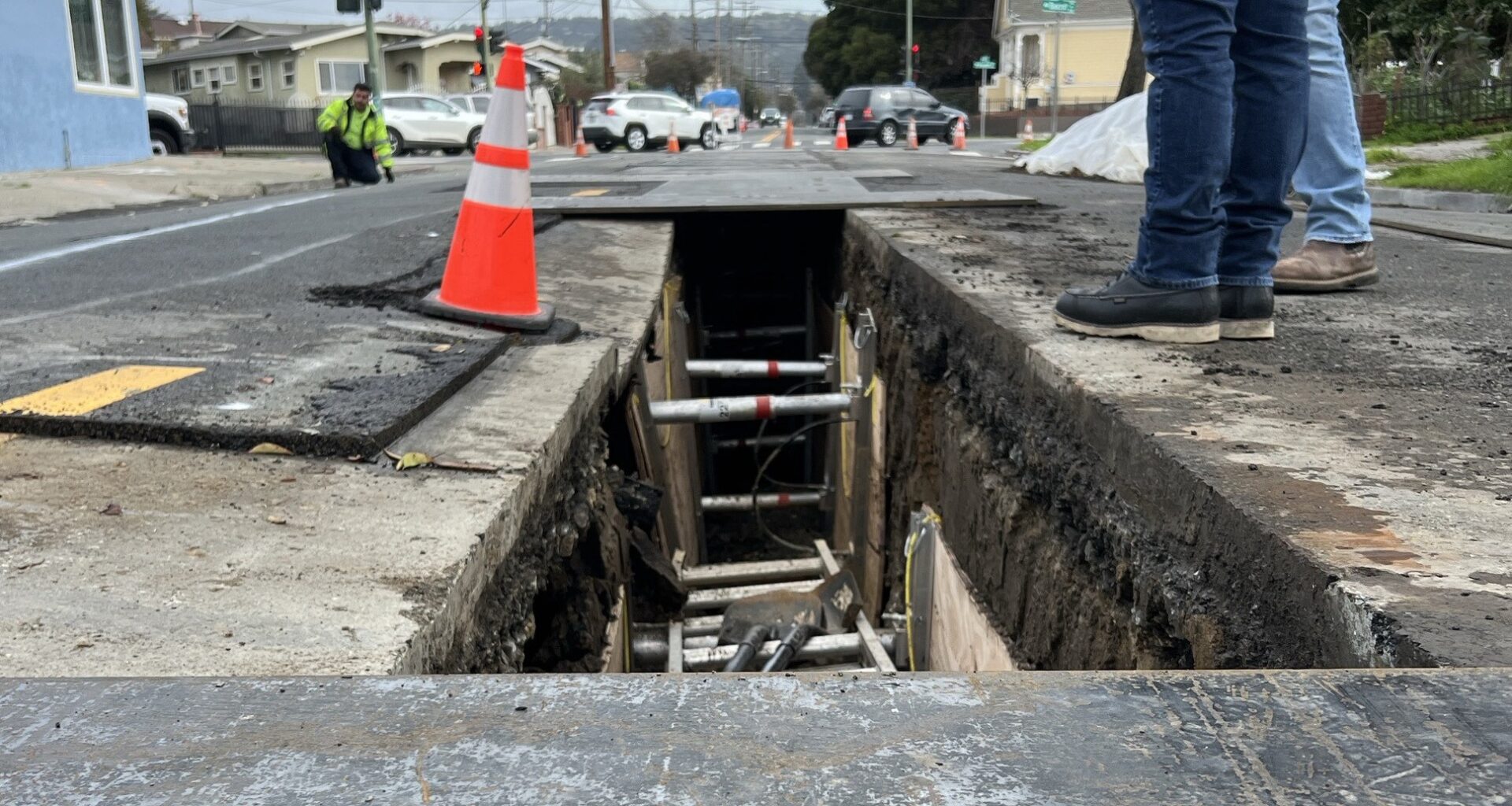
OAKLAND — Oakland has a multi-billion dollar problem buried underneath its streets.
Much of the city’s dilapidated stormwater drainage system requires equipment upgrades or replacement across miles of 85-year-old pipes, pumps and equipment, according to a Sept. 10 city report. If left unfixed, the city’s poorest neighborhoods in West Oakland and East Oakland face heightened risks of flooding, sinkholes and landslides.
To fund the work needed across the city’s 400-mile stormwater network, Oakland is considering a Proposition 218 property-related storm-drainage fee, which would require a simple majority of approval from property owners. However, as each year passes, the cost for repairs will increase, and flooding and system failures will grow, according to the report. The impacts could compound as climate change increases the likelihood of 100-year or 500-year storms.
 A potentially historic El Niño this winter could offer a glimpse of the stresses the system will increasingly face.
“During El Niño years — especially the 2026–2027 season, which is expected to bring larger and more frequent storms — these vulnerabilities are magnified,” said Terri Fashing, the Stormwater and Drain manager for the city of Oakland. “Sedimentation, clogging, trash accumulation, high tides that move into the storm drainage system and rising groundwater all reduce the system’s ability to keep up with storm intensity.”
During an atmospheric river on Dec. 31, 2022, the Oakland Zoo was forced to close due to severe flash flooding and a massive 10-foot-deep sinkhole at the entrance after water and debris had overloaded a critical culvert pipe.
With the Oakland hills running along the city’s northeast spine, winter downpours race toward San Francisco Bay and cause regular, devastating flooding to Oakland’s neighborhoods. On Feb 12, 1925, the Oakland Tribune published a full-page spread of one storm’s damages.
“Storm drains along Grand avenue, intended to carry flood waters into Lake Merritt, were spouting fountains of yellow, muddy water, some of them shooting water four feet into the air,” the Tribune reported at the time. Authorities rescued more than 30 families from flood waters — including the “salvage” of one woman’s pair of false teeth.
The city’s early culverts of natural waterways, like Temescal and San Leandro creeks, had provided a rudimentary drainage system and established its street grid system. But the system proved inadequate amid the city’s post-World War II boom and development into a major trading hub on the West Coast.
With ongoing flooding issues, the state legislature intervened in 1949 and formed the Alameda County Flood Control & Water Conservation District to create a modern stormwater drainage system. The district raised nearly $7 million through a special bond election in 1953, according to court records. Over the next few decades, the city’s modern system was created — a complex mix of natural creeks, underground culverted creeks, inlets and pipes, channels, pump stations, trash capture systems and green stormwater infrastructure, according to Fashing.
 Oakland, CA November 26, 1926 – Two boys put a boat on Grand Avenue to get around town after a terrific downpour flooded basements and suspended traffic. Lake Merritt frequently flooded during heavy rains before the installment of a flood control station in the 1960s. (Oakland Tribune Photo)
“In hillside areas, small public and private systems collect rapid, erosive storm runoff, while flatter shoreline neighborhoods rely on pipes and open channels to move water toward the Bay,” Fashing said. “Low‑lying areas such as West Oakland and Downtown depend heavily on pump stations and tide gates to discharge stormwater, making these neighborhoods particularly sensitive to heavy rainfall.”
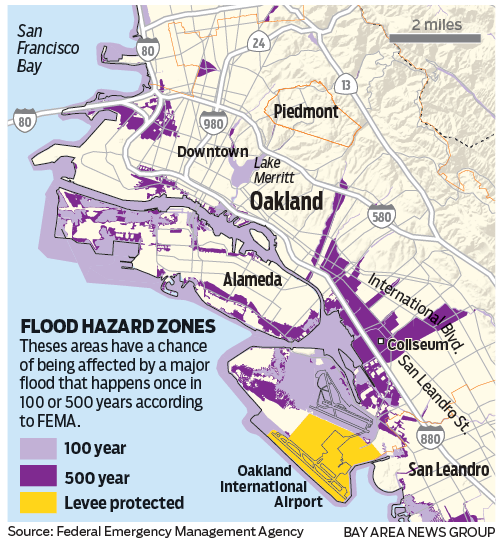
According to Federal Emergency Management Agency flood maps, major storms threaten to inundate significant portions of West Oakland, Jack London Square and East Oakland, particularly around the Oakland Coliseum. More than 500 structures would be at-risk during a once-in-a-100 year precipitation event, while more than 6,000 would be threatened during a once-in-500-year storm.
But cracks have begun to show in the system.
A strengthening El Niño could put Oakland’s aging drainage system to the test this winter. The National Oceanic and Atmospheric Administration says there is a 75% chance the event will reach a historic intensity exceeding previous El Niños dating to 1950, though its effects on California rainfall are not guaranteed.
El Niño systems develop when surface waters in the central and eastern equatorial Pacific become unusually warm, weakening trade winds and altering atmospheric circulation in ways that can shift weather patterns around the world, according to Daniel Cayan, a research meteorologist at the Scripps Institution of Oceanography at the University of California, San Diego.
“One key difference between climate change in future decades and 2026’s very strong El Niño is that, because of continued greenhouse warming, climate change will generate higher winter and early spring runoff and an atmospheric river in that warm future is more likely to cause a flood,” Cayan said.
The city launched its Storm Drainage Master Plan in 2020 to identify needs of the deteriorating system. Though the study is only 75% complete, it found an estimated 30%-40% of the system requires rehabilitation or replacement across the city’s 400 miles of pipes, four pump stations and 80 miles of creeks and waterways.
An estimated $1.26 billion is needed to complete 15 high-priority and 24 medium-priority pipe capacity improvement projects to address the most deteriorated portions of the system, according to the Public Works Department.
“While physical construction may take a few months, the full process can last a year or longer,” Fashing said. “Replacing a single section of drainage pipe requires extensive inspection, design, utility coordination, procurement, permitting, contracting, environmental and traffic management, excavation, installation, testing, backfilling, and restoration.”
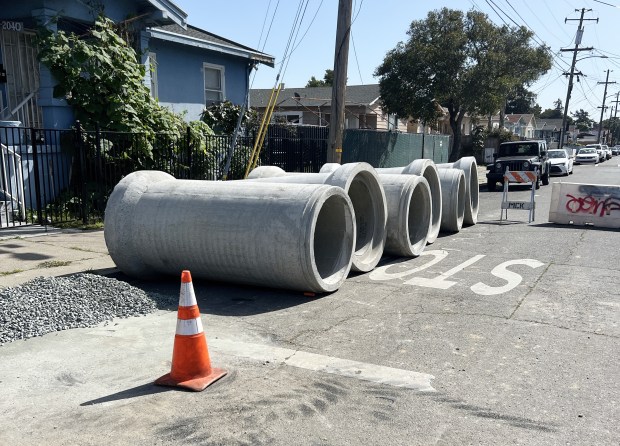 City of Oakland public works crews repair a 55th Avenue storm drain between Bancroft Avenue and Harmon Avenue in 2023. (City of Oakland)
A minimum of $24 million a year is expected for regulatory water quality compliance testing, plus capital and programmatic costs to control waterway pollutants. An estimated $16.3 million per year is needed to shift from a reactive to a preventative approach for storm drainage operations and maintenance, according to the report.
“A full citywide rehabilitation effort, projected at $3.6 billion, would take at least 70 to 80 years to complete, whereas the currently proposed $1.26 billion program is expected to span 30–50 years,” Fashing said.
According to the Storm Drainage Master Plan, the city would create a funding mechanism modeled after property taxes in Alameda and Berkeley, which charge $78 and $42 per year respectively. Drafted for 2029, Oakland’s effort could provide up to $15 million annually for pipe repair and flood abatement. The city will seek additional funding through bonds and grants, and staff are developing a funding strategy as part of the master plan.
If the city’s effort fails, the city will need to manage the decline of the system with reactive fixes, running the risk of being held legally responsible for future flooding damage, according to the report.
“The City could continue with the status quo,” the report states. “However, the City would incur additional liability as the storm drainage system’s repairs will increase in cost and difficulty, flooding and other system failures will increase, and these impacts will be compounded as storms become more intense due to the impacts of climate change.”