
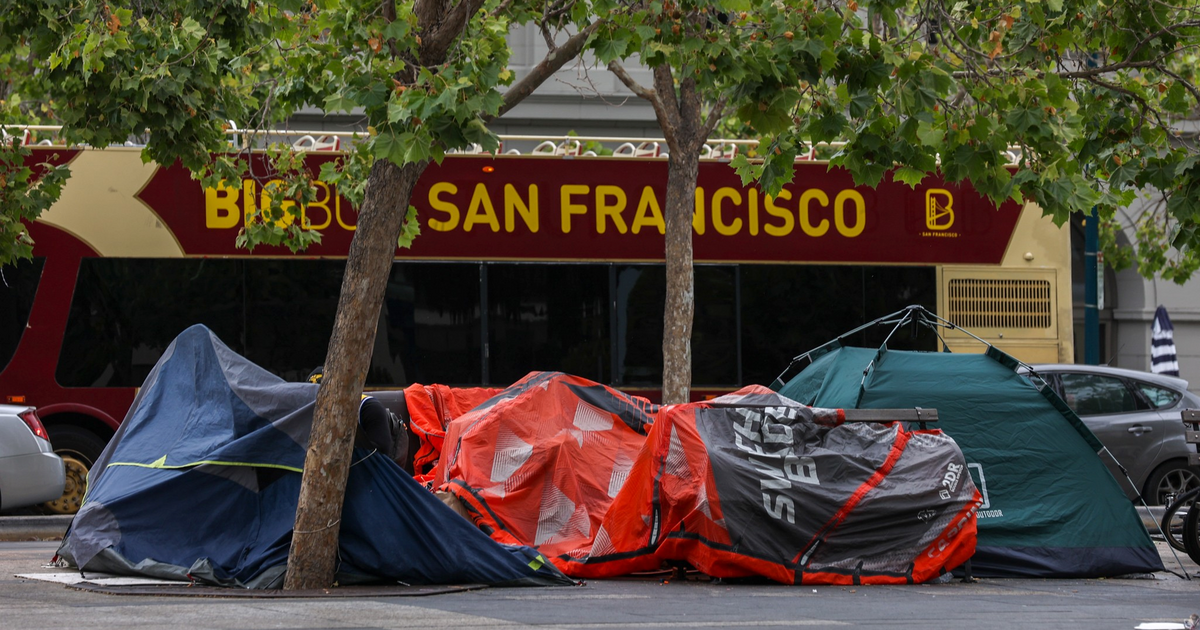
Street conditions in San Francisco have a habit of resisting easy narrative arcs.
Even as the city sees a drop in vehicle encampments and a rise in drug arrests, the broader picture remains mixed. After four straight quarters of encouraging metrics, two new surveys show citywide tent encampments on the rise and more sightings of feces in one of the city’s most beleaguered neighborhoods for the second year running.
Reducing filth and tents is central to Mayor Daniel Lurie’s push to restore San Francisco’s national reputation, which took a beating during the pandemic over encampments, public drug markets, retail vacancies, and a bipping epidemic. New store openings and glass-free sidewalks in Union Square lend credence to San Francisco’s rebound, but worsening sanitation in the Tenderloin — home to the city’s highest concentration of children — muddies that trend.
Lurie said in a social media video Tuesday that street conditions remain a “huge concern,” while pointing to efforts to expand treatment beds and increase police presence. Under his administration, the city has stepped up low-level drug arrests, expanded its street ambassador programs and intensified enforcement against pitching tents on public property.
“I know we have more work to do,” Lurie said, “and we’ll keep at it.”
 Mayor Daniel Lurie staked much of his early tenure on cleaning up streets. | Source: Morgan Ellis/The Standard
It’s difficult to objectively measure the state of San Francisco streets. But for years, the city has evaluated them with two routine surveys: a quarterly tally of tents and inhabited vehicles and an annual evaluation of street cleanliness based on the presence of litter, dumped items, graffiti, and feces.
The annual Street & Sidewalk Maintenance Standards Report, produced by the controller’s office and published Wednesday, highlighted “the most consistently worsening metric” in the Tenderloin: sightings of human and animal feces.
The report evaluated conditions by sending surveyors out twice in the last fiscal year to each walk one- to two-block routes. In the Tenderloin, surveyors observed feces during 81% of those evaluations, typically finding three to four instances per route. That’s up from two years prior, when feces appeared in 54% of evaluations, averaging two instances per route.
The tent count tells a similar story. Reducing it has been a focus of Lurie’s administration, and in early June, his office touted a record-low tent tally alongside the city’s biannual point-in-time survey, which showed unsheltered homelessness at a 15-year low. The mayor declared that the findings show “clearly that our new strategies are working.” But the latest survey, conducted in September, highlights how fragile those gains can be.
The number of tents and makeshift structures rose for the first time in a year, up 29% from 115 in May to 148 in September. Driven in part by spikes in SoMa, Inner Richmond, and Potrero Hill, the increase broke four consecutive quarters of decline. Even with the uptick, the overall tent count remains 12% lower than the 168 recorded in September 2025, according to city data.
While the Tenderloin struggled with sanitation, SoMa — another neighborhood long defined by open-air drug use and homelessness — recently saw an uptick in tents. The number counted there rose from four in May to 13 in September, tying SoMa with the Central Waterfront for the highest concentration of tents in San Francisco.
The increase in SoMa is striking given that the city in May opened a sobering center there, led by law enforcement, in an effort to redirect people off the streets and into care. But as The Standard recently reported, the RESET Center is operating below 30% capacity, and the city has struggled to track outcomes. Several people who spoke with The Standard after visiting the center said they immediately ended up back on the sidewalk.
 An annual city report found an increase in feces sightings in the Tenderloin. | Source: RJ Mickelson/The Standard
For local business owners and advocates, the fluctuating numbers reflect a disconnect on the ground.
Tadd Cortell, owner of three businesses near Sixth Street, noted that while conditions have noticeably improved since Lurie took office in early 2025, the neighborhood “desperately needs help.”
“You can’t coast now,” Cortell said of the mayor. “Make it clean and safe — and it wouldn’t hurt if you were to say, ‘Go to SoMa, it has this cool shit.’”
Alex Ludlum, executive director of the SoMa West Community Benefit District, said tent tallies miss the metric neighbors care about most: public drug use.
“A quarterly count of people smoking hard drugs on the street would be much more useful data than a quarterly count of people sleeping on the street,” he said.
It is inherently difficult to quantify the prevalence of public drug use beyond arrest figures and 311 reports, especially given how often people who are cited or arrested return to the street. The Board of Supervisors planned to take up the issue Thursday afternoon in a hearing dedicated to evaluating conditions related to San Francisco’s open-air drug markets.
Even as public drug use, tent spikes, and street feces remain pain points, other city metrics showed signs of relief.
The number of vehicles presumed to have people living in them fell from 315 in May to 249 in September, versus the 489 counted a year ago. The city credits new parking restrictions on large vehicles — and an accompanying program to move hundreds of RV dwellers into shelter and housing — for much of the drop. The number of large vehicles like RVs and campers fell from 404 in September 2025 to 193 in the latest count.
Other Tenderloin street cleanliness metrics were also flat or down. Surveyors found large dumped items on half of the evaluations in the Tenderloin in fiscal 2025, an average of two per visit; in 2026, the figure fell to 1.2. Graffiti turned up on nearly every visit over the past three years, though the average fell from 75 tags per visit to 46.