
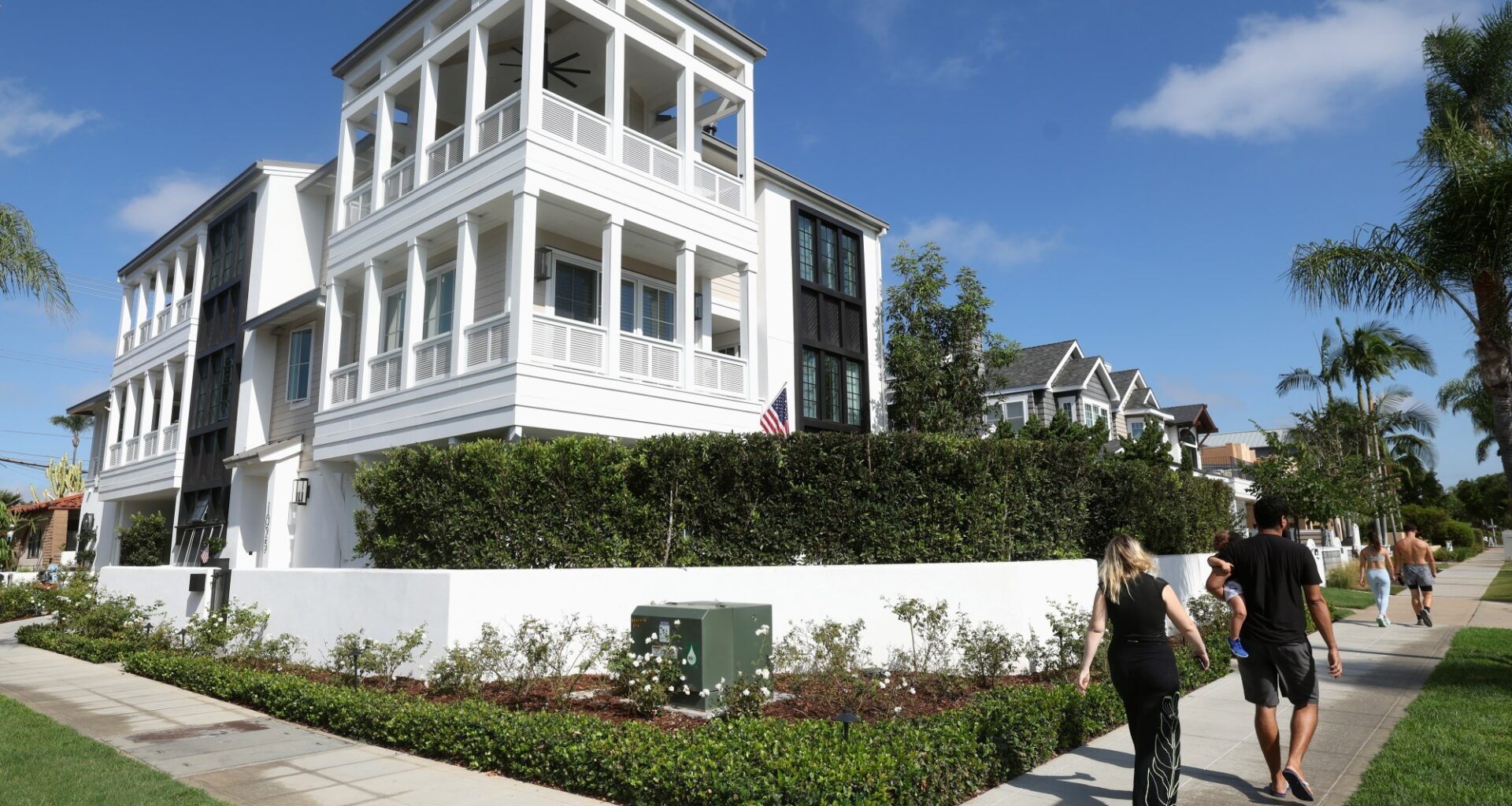
Coronado is known for its lack of density with mostly single-family homes and few tall buildings, but a November ballot measure looks to make a minor change.
Voters will decide on Measure D, a plan to permit residential four-story structures up to 42 feet on its busy Orange Avenue, up from a three-story cap in place since the 1970s. It’s a very small change compared to nearby San Diego, which has up-zoned entire neighborhoods.
The measure was put on the Nov. 3 ballot by the City Council in May to comply with state law. Coronado was one of several communities targeted by Gov. Gavin Newsom and the state housing authority in the past four years for a lack of new housing. Measure D is one part of the city’s requirements to acquiesce to the state by creating space for new housing.
Council members at the May meeting emphasized that they were only putting the measure on the ballot to be compliant with state law and no one voiced any words of support. Mayor John Duncan said at the meeting that the settlement with the state was the best they could get for the city, even though there was frustration expressed by residents after the fact.
“It’s just one of those things where we have a job to do,” he said of Measure D, “and it can be difficult at times, and can be hard to explain at times. (But) we do what we feel is the right thing and best for Coronado.”
Measure D would only affect a residential area of Orange Avenue, between Second and Eighth avenues. The area is known for its many apartments, Spreckels Park, a gas station, the Coronado Police Department and a few small hotels. There are very few lots along the area where a four-story building could go — which is perhaps why it doesn’t seem to be a major issue.
The San Diego Union-Tribune walked the stretch of road covered by the measure and could find no signs for or against the measure (despite other signs for city council candidates). Coronado residents and business owners in the area when asked by a reporter about the measure, were unaware of it.
There are no public groups in support of the measure and just one against, the Coronado Republican Club. The organization has spent $1,597 on lawn signs against Measure D, said financial disclosures, and wrote the only official letter in opposition (no argument in favor was submitted).
“For over fifty-four years, Coronado voters sought to protect the village character of our city,” wrote Kevin Shaeffer, co-chair of the club. “Measure D asks residents to give that protection away.”
He argued that the state housing requirements for Coronado were incorrect and increasing density would not fit the character of Orange Avenue.
Measure D needs a simple majority to pass, or more than 50%. Coronado officials said they couldn’t just change the zoning without a public vote because of a previous measure to limit density. Since the law was originally passed by voters, California requires another ballot measure to change it.
Coronado voters in 1972 approved what was known as Proposition R, with a vote of 3,471 to 1,516, which limited new residential buildings to three stories. It was seen as a reaction to increasing density and concerns of residents who feared a loss of ocean views. There was a companion measure, Prop. S, which exempted the Coronado Shores condo development from the law.
A total of 1,241 registered voters signed the petition to get Prop. R on the ballot. Coronado City Councilmember Robin Goodenough (who also served two terms as mayor) was among lawmakers who pushed for the measure.
“I don’t want the center of Coronado to be surrounded by high-rises in the future,” Goodenough told the “Evening Tribune” in May 1972. “That would uglify the city and destroy everyone’s view.”
Coronado Shores had already built three 15-story buildings at the time of the vote. It now has 10. The proposition shielding it from high-rise limits passed narrowly — 2,547 to 2,387.
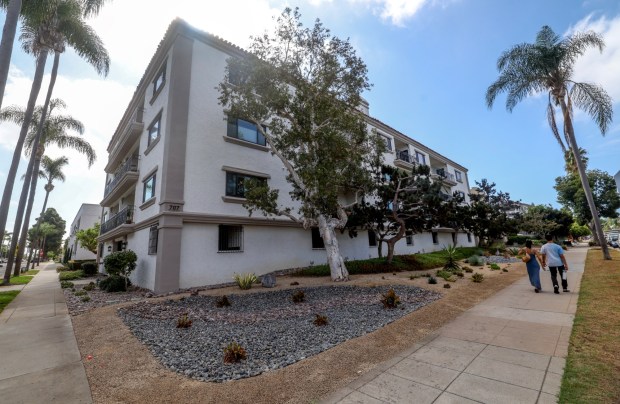 A three-story apartment building on Orange Avenue in an area a ballot measure looks to increase density. (Hayne Palmour IV / For The San Diego Union-Tribune)
The latest measure covers a relatively small area, 14.8 acres, and is not a requirement that any developer actually builds anything. It was a state agency, the Department of Housing and Community Development, that told Coronado its three-story limit constituted a constraint on development. Coronado City Attorney Johanna Canlas wrote in her impartial analysis of Measure D that the state agency expressed a 42-foot limit was preferred to avoid constraining density.
Nathan Moeder, a San Diego-based housing analyst, argued that Measure D wouldn’t do anything if it passed. Most of Orange Avenue covered by the proposal already has many three-story apartment buildings and, he said, it would not be financially feasible to tear them down and go up four stories.
“This is just an exercise by the city that will not go anywhere,” Moeder said. “This is just so ridiculous.”
He said the only way it might make financial sense for a developer is if they tear down a three-story apartment building and build six stories — but even that risks just breaking even or losing money.
Moeder, who has consulted on hundreds of projects throughout San Diego County, said the developer would likely need to go higher than six stories for it to make sense, but there’s another problem: California law requires anything over six floors to be steel and concrete construction. To make that cost worth it, Moeder said the building would need to be 10 to 12 stories.
There are a smattering of single-family homes along the area in question but, even then, Moeder said a teardown and build-up would make little sense. There have only been two single-family home sales along the stretch of Orange Avenue in the past three years, for $4 million and $4.4 million. He said the cost to purchase and build would not be worth it for a developer. Moreover, the lot sizes are small, and it would be difficult to build anything dense.
Coronado, and all California cities, are required to identify land for housing development. It isn’t a requirement that something is actually built, just that an area is identified. The state can’t force developers to build.
Moeder said the problem with state mandates for housing is they often don’t consider if any of it would make financial sense for a developer.
“We’ll revisit this in five or six years on the next housing cycle,” he said, “when the state comes and realizes Coronado didn’t build anything. Then, it’s up to the state to say if they will really lay down the hammer and get more forceful.”
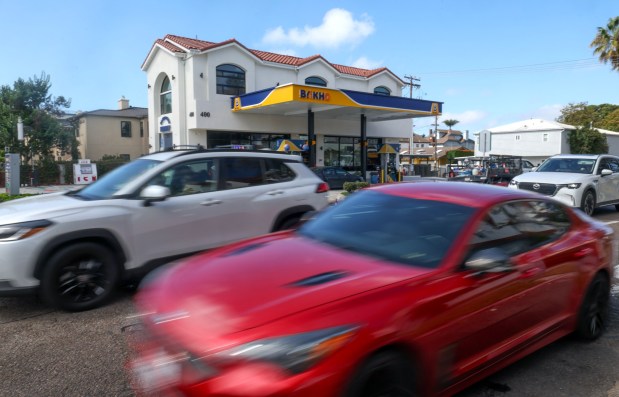 A gas station on Fourth Street at the intersection with Orange Avenue in Coronado in late September. (Hayne Palmour IV / For The San Diego Union-Tribune)
Coronado was supposed to identify land for new housing in 2021 but fought the requirement, ultimately failing in its legal challenges. The state threatened legal action if the city did not comply. In 2023, Coronado reached an agreement with the state to eventually create space for 912 homes.
As part of its settlement, Coronado identified several locations for some new housing (but not all that is required): 116 units in the retail area on B Avenue that includes a Smart & Final store; 300 units of military housing on Tulagi Road near the Silver Strand; and 134 units at a site owned by the Coronado Unified School District on Sixth Street.
Construction has been lackluster. Coronado sent a progress report to the state in March that said 36 housing units had been built in 2025: 19 single-family homes, nine accessory dwelling units and eight units spread out among duplex-style houses. No subsidized housing was built.