
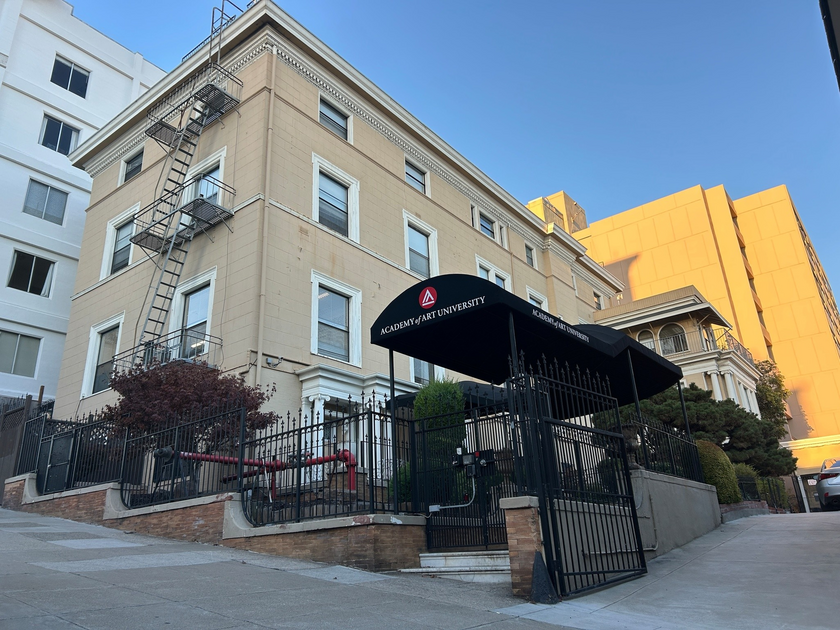
Just steps away from Lafayette Park, the four-story beige building in Pacific Heights once known as Coco Chanel Residence Hall was specifically designated as a space for women’s empowerment (opens in new tab). The students who lived there studied fashion, fine art, metalworking, or drama at the Academy of Art University, which owns the building.
Now it’s a short-term home for founders, hosting about 20 startup entrepreneurs, researchers, and academics for three-month residencies as they try to build the next tech unicorn or make a paradigm-shifting discovery. Around 20% are women, above the startup industry average (opens in new tab). A sunroom is crowded with robotics equipment. What was an upstairs dorm is now a video studio.
For two years, the Academy of Art University has been leasing three of its buildings to The Residency, a 996-style founder residency and research lab with four locations in San Francisco. Each of the buildings — 1916 Octavia St., 2209 Van Ness Ave., and 1153 Bush St. — was named in a 2016 lawsuit by the city that accused the Academy of Art University of illegally converting housing to university buildings.
The Residency describes itself (opens in new tab) as a housing and coworking space, “so you can go full time on your ambitions.”
The Academy of Art University declined to comment. In a previous exchange, a spokesperson said the school is pursuing “leadership in creative AI opportunities.” That includes “adding AI fluency to the existing curriculum.”
In 2016, the city sued the for-profit university for illegally converting buildings it bought into dorms, which San Francisco argued depleted the stock of affordable housing. Now, several of those buildings have become live-work spaces filled with AI newcomers looking to make billions building the next big thing.
The complaint listed 22 buildings, including the three now leased to The Residency. The university settled for $58 million and agreed to upgrade and permit 34 properties. LLCs tied to 1916 Octavia St., 2209 Van Ness Ave., and 1153 Bush St. were implicated in the settlement terms.
Another property named in the lawsuit was the Commodore Hotel, at 825 Sutter St. In 2025, the hotel was sold (opens in new tab) and rebranded as the Superhero Hotel (opens in new tab), which is marketed toward startup founders and includes bundles for access to Frontier Tower.
The Residency prepares its short-term tenants for a demo day during their ninth week and hosts three cohorts each year. The cost starts at around $2,000 per month or 2% equity in the companies, depending on the program. Residents are urged to work on Sundays but are encouraged to take Saturdays off. It fosters a “healthier environment, because they need their breaks,” said Neftali Velez, chief people officer at The Residency.
“We have a big footprint in San Francisco. We’re looking at The Residency as a campus based on the proximity of the homes,” Velez said.
At the Octavia Street property, there are two cold-plunge pools in the backyard, and visitors are instructed to take their shoes off at the door. A main dining room has a brick fireplace, and the solid wood banisters on the staircase recall a different era.
A poster displaying the organization’s value is hung on the wall of the entryway, as are two panels explaining research by Richard Hamming, a mathematician and pioneering computer scientist. One panel explains the concept of “full immersion”: living a life consumed by focused work.
“Our mission is to create an alternative to college so that ambitious people of any age can go out there and change the world,” Nick Linck, founder of The Residency, said in a promotional video (opens in new tab) for the program.