
San Francisco’s school board will vote Tuesday on how to replace the lottery it uses to assign students to elementary schools. If your child is starting kindergarten or transitional kindergarten in fall 2028 or later, the new system will determine which schools you can apply to and the odds of acceptance.
How does it work now?
Today, families rank as many schools as they like anywhere in the city, and an algorithm assigns seats using tiebreakers. One of the most powerful is CTIP1, known as the “golden ticket,” which automatically gives students from 20% of the city with historically low test scores priority at any school they list, ahead of families who live nearby.
Nothing is guaranteed. In recent years, 96% of applicants in the main round were assigned a school on their list, and 67% got their first choice, according to an analysis of the district’s applications by Stanford researchers.
The district has been trying to replace the lottery for years, ever since 2018, when the Board voted to scrap the lottery because it hadn’t reduced socioeconomic segregation as intended. The district has missed its deadlines to replace it ever since. A zone-based system, which the board adopted in 2020, was never put in place.
What are school leaders deciding between now?
On Tuesday, the board narrowed its options for a new lottery system from three to two. It dropped Option A, which would have grouped three to five nearby schools into small zones and guaranteed families a seat at one of them.
The remaining two options would guarantee families a seat at their neighborhood school — the one assigned to their home address — but only C would guarantee that seat even if a family applies late. The district plans to redraw attendance boundaries, the lines that determine which neighborhood school each address is assigned to under either option.
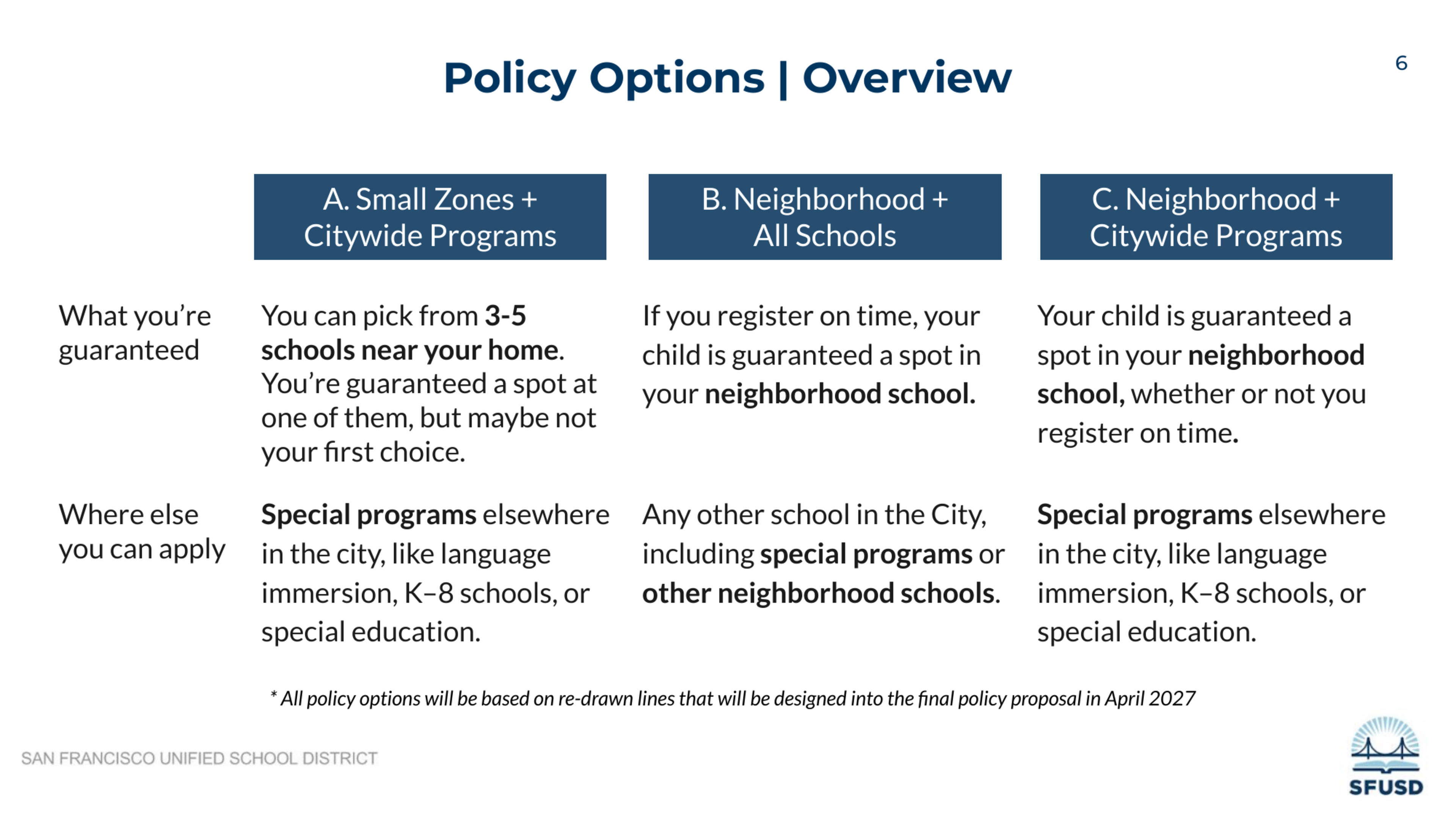 The three assignment options SFUSD staff presented to the school board. The board dropped Option A. | Source: SFUSD
Option B offers more choice. Families who apply on time would get a guaranteed neighborhood seat and could also apply to any other school in the city.
Option C offers more certainty but less choice. Families would be guaranteed their neighborhood school even if they miss the deadline, but the only other schools they could apply to are citywide programs, such as language immersion and K-8 schools. Staff rated it the easiest to carry out, because less choice makes assignments and waitlists simpler.
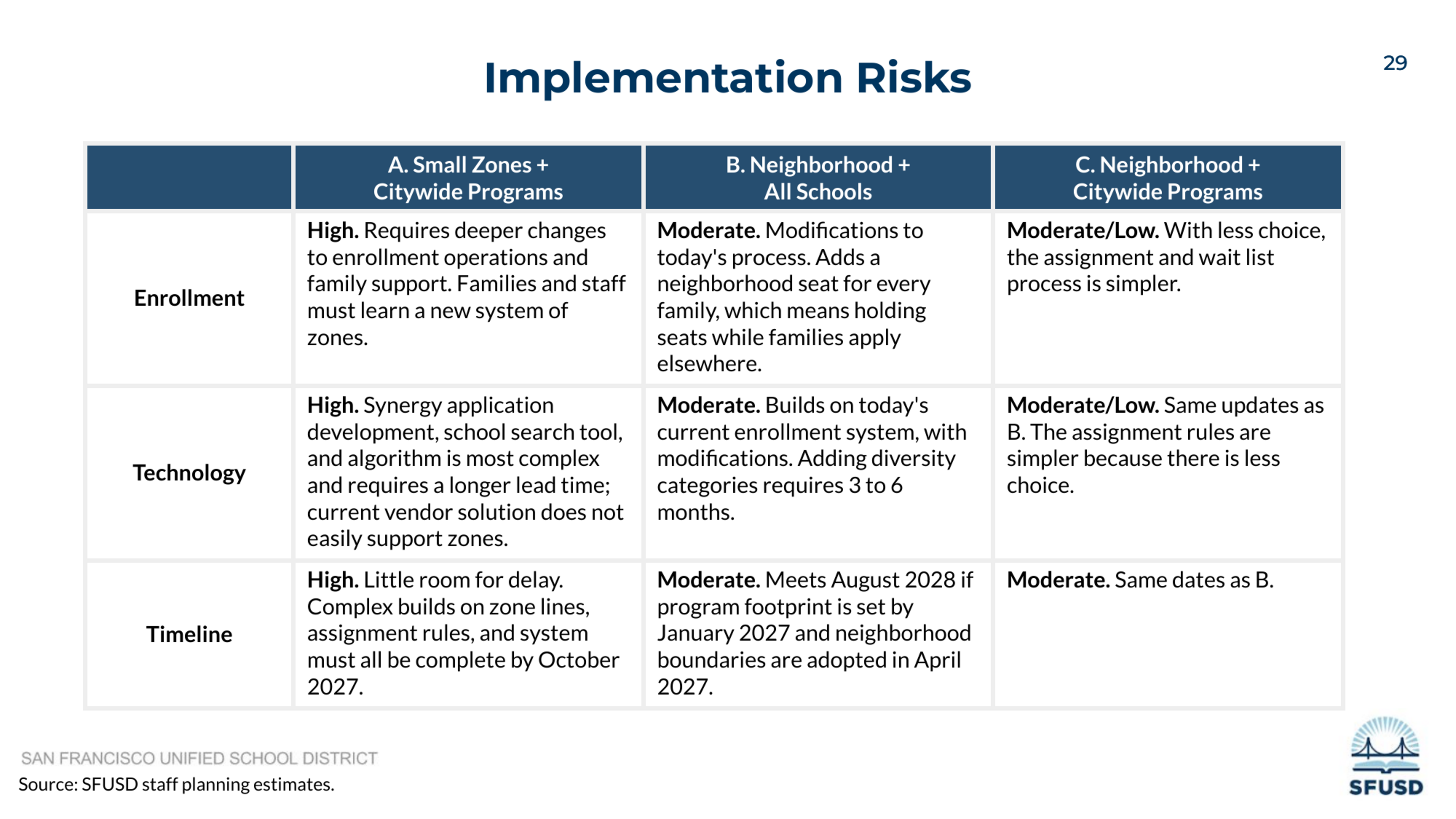 Staff’s risk ratings for each option. Option A has since been dropped. | Source: SFUSDWhat are the concerns with each option?
Some commissioners worried that B would feel like the current lottery, wherein families rank a list of schools and wait, giving the impression of uncertainty. Staff said the application could make the neighborhood school the default. Under that approach, families would enter their address, accept their neighborhood school and be done, and only those who want another option would rank more schools. That design has yet to be decided.
Under B, seats not claimed in the main round can go to families from elsewhere, so a late applicant’s neighborhood school could fill up. Of the roughly 370 families that apply late each year, 7 in 10 live near schools that aren’t in high demand and would be fine under either option, staffers estimate.
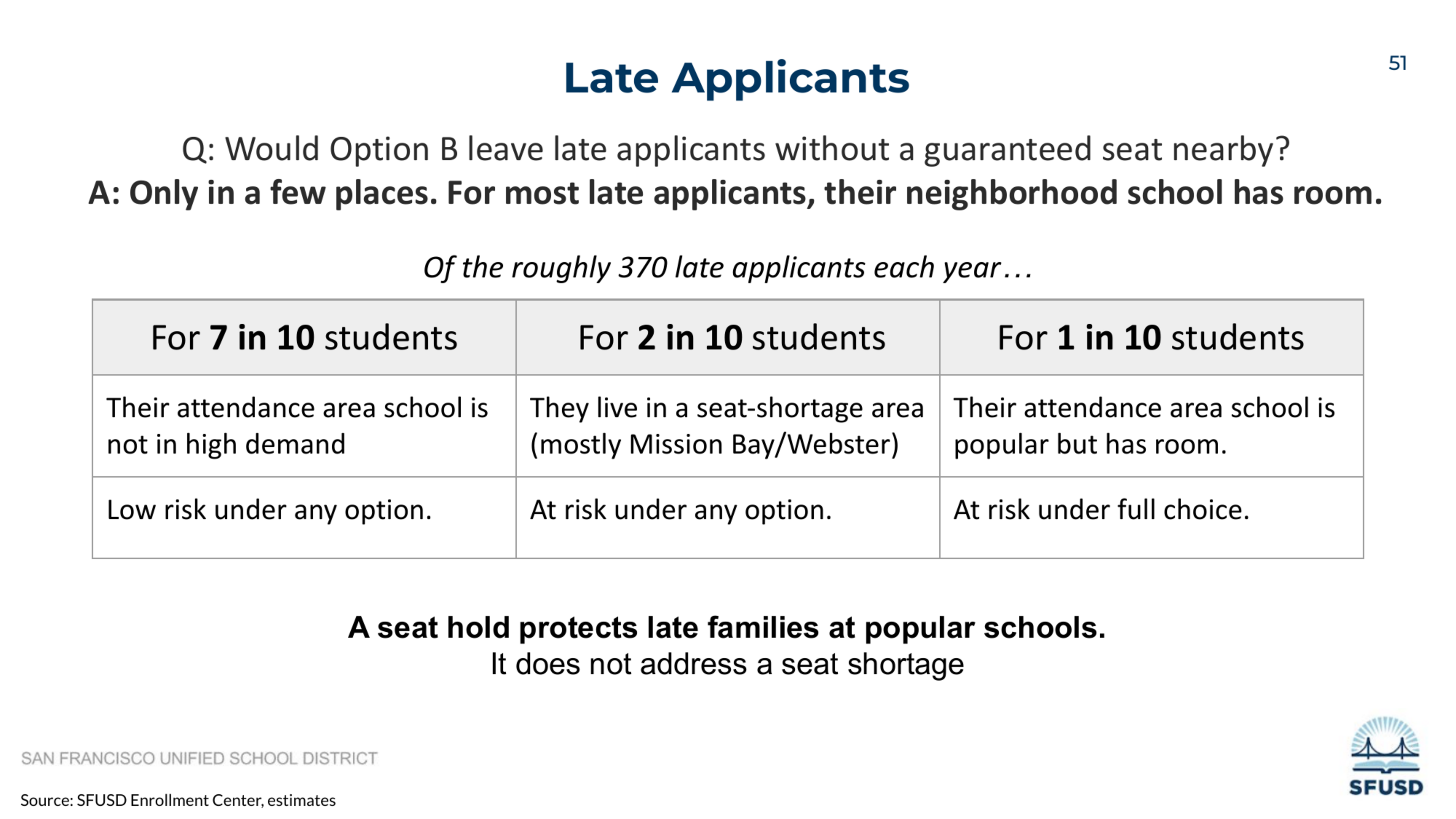 How the options would affect the roughly 370 families that apply late each year. | Source: SFUSD
Simulations by Stanford researchers show that C would keep more students closer to home. Under C, 48% would attend a school within half a mile, compared with 40% under B and 35% today. B would raise the share of families getting their first choice from 67% to 70%, if the district adds diversity categories to assignments. Under C, it would fall to 54%.
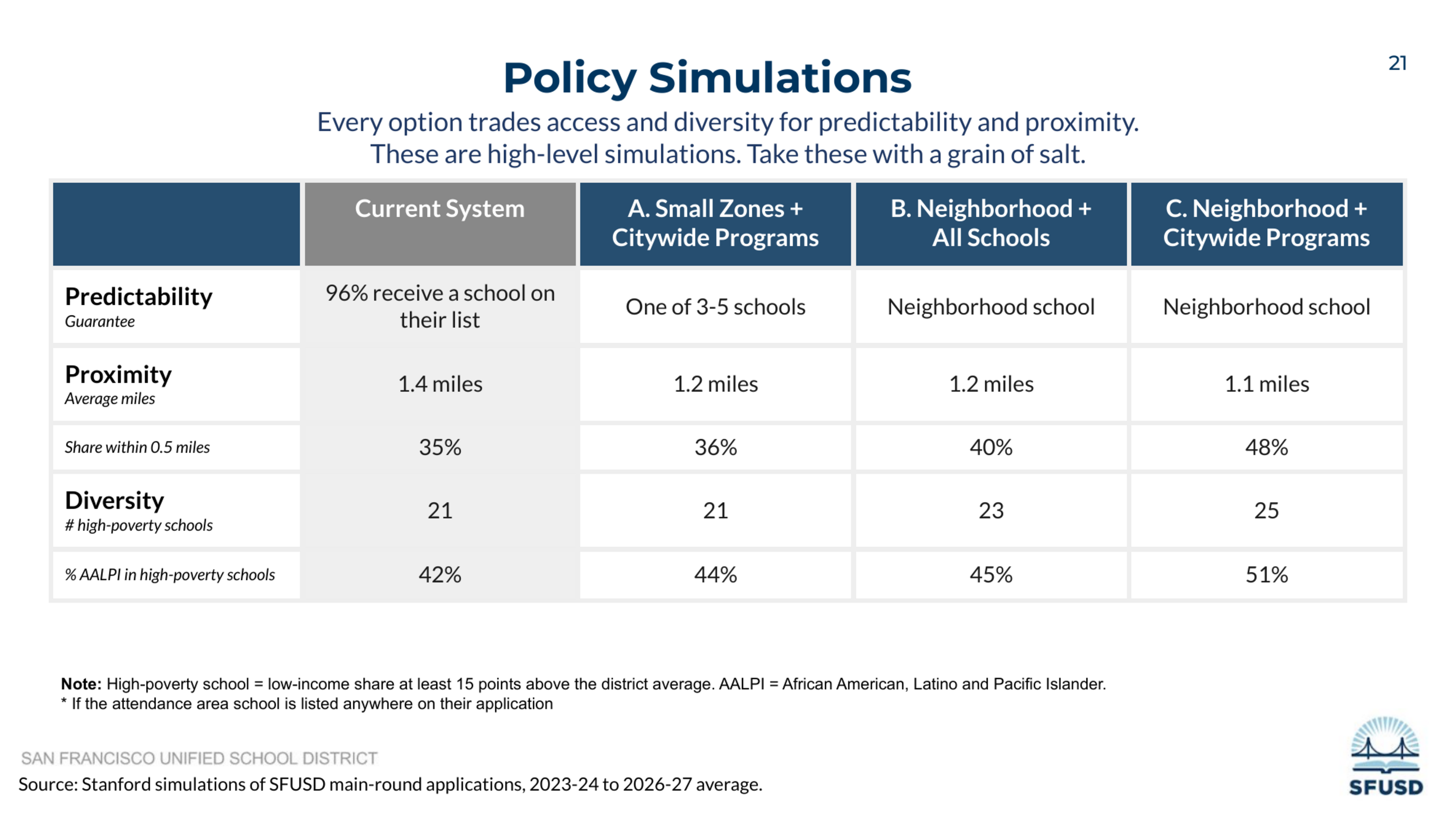 Stanford simulations of how each option would affect distance, diversity, and predictability. Option A has been dropped. | Source: SFUSDWhat do parents say they want?
Families that weighed in prefer B. In a district survey of 2,725 families, 71% said B was likely to meet their needs, compared with 48% for C, which rated lowest in every region, income group, and racial group.
The survey also asked what a nearby school would need for families to enroll. The top answers were that the child would feel safe every day (49%), better reading and math teaching (43%), and stable teaching staff over multiple years (41%).
Are there enough seats under the new systems?
Either option depends on neighborhood schools having room, and many don’t. Staff project that by 2033, 19 of 58 attendance areas will be short by about 320 kindergarten seats combined. The biggest gap is around Mission Bay and Webster. Although SFUSD as a whole has roughly 14,000 available seats, some neighborhoods have more families than available classrooms.
Redrawing boundaries would close about half the gap, leaving roughly 165 seats short. To close the rest, the district would need to convert two to three citywide K-8 schools into neighborhood schools or move or convert four to eight language programs.
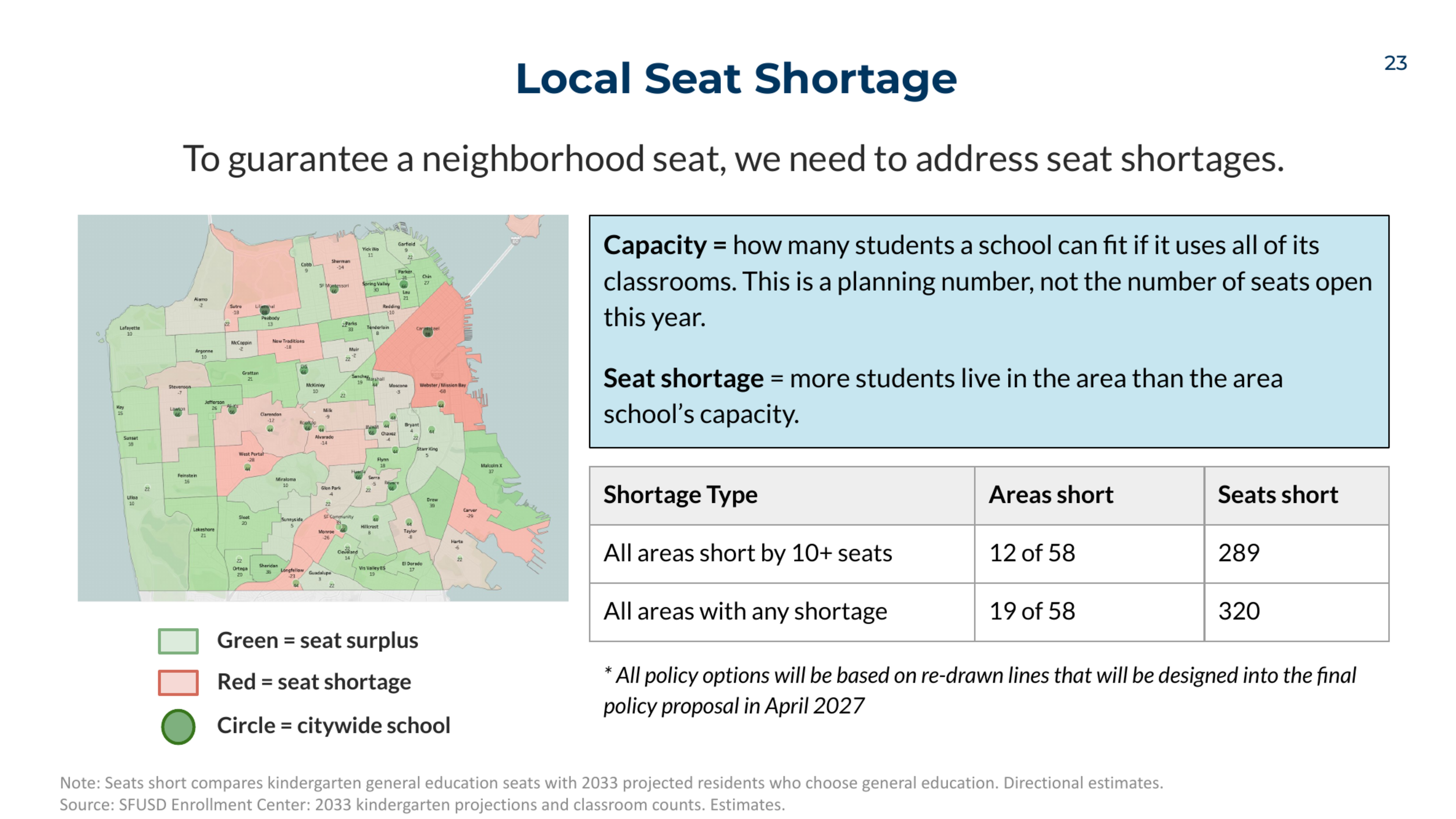 Red areas have more projected kindergartners than general-education seats, based on 2033 projections and current attendance lines. | Source: SFUSD
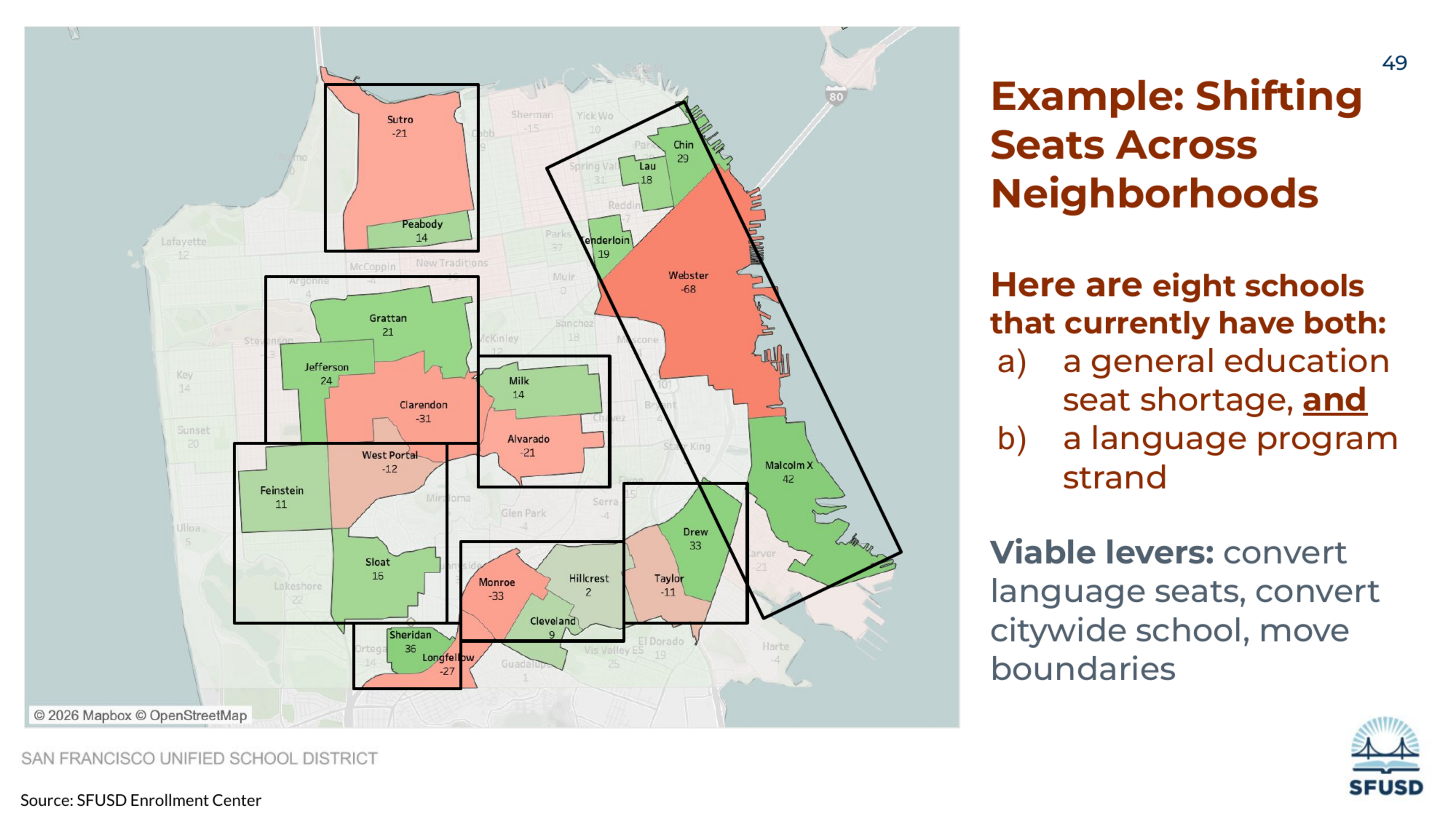 Eight schools have both a general-education seat shortage and a language program. District staff listed converting language seats, converting a citywide school, or moving boundaries as possible fixes. | Source: SFUSDHow would this affect diversity?
Both options would concentrate more students of color in high-poverty schools. The share of Black, Latino, and Pacific Islander students attending high-poverty schools would rise from 42% today to 45% under B and 51% under C. For Black students, the first-choice rate would hold at about 87% under B but would fall from 86% today to 49% under C.
Commissioners worried that families in the southeast could keep leaving their neighborhood schools for open seats elsewhere, resulting in under-enrolled schools. Under the district’s plan, any school closures or mergers would come no earlier than 2029-30.
What’s left to figure out?
Much remains undecided. The district’s presentation didn’t address what happens to CTIP1. Staff said tiebreakers, sibling preference, new boundaries, and where programs go would all be worked out after the board picks an option.
A vote will be taken at Tuesday’s Board meeting to implement either Option B or C. They are scheduled to review a draft policy in February and vote on a final policy April 13. Families applying for kindergarten this fall will use the current lottery. The first students affected would apply in fall 2027 for the 2028-29 school year. Students already enrolled won’t be moved.
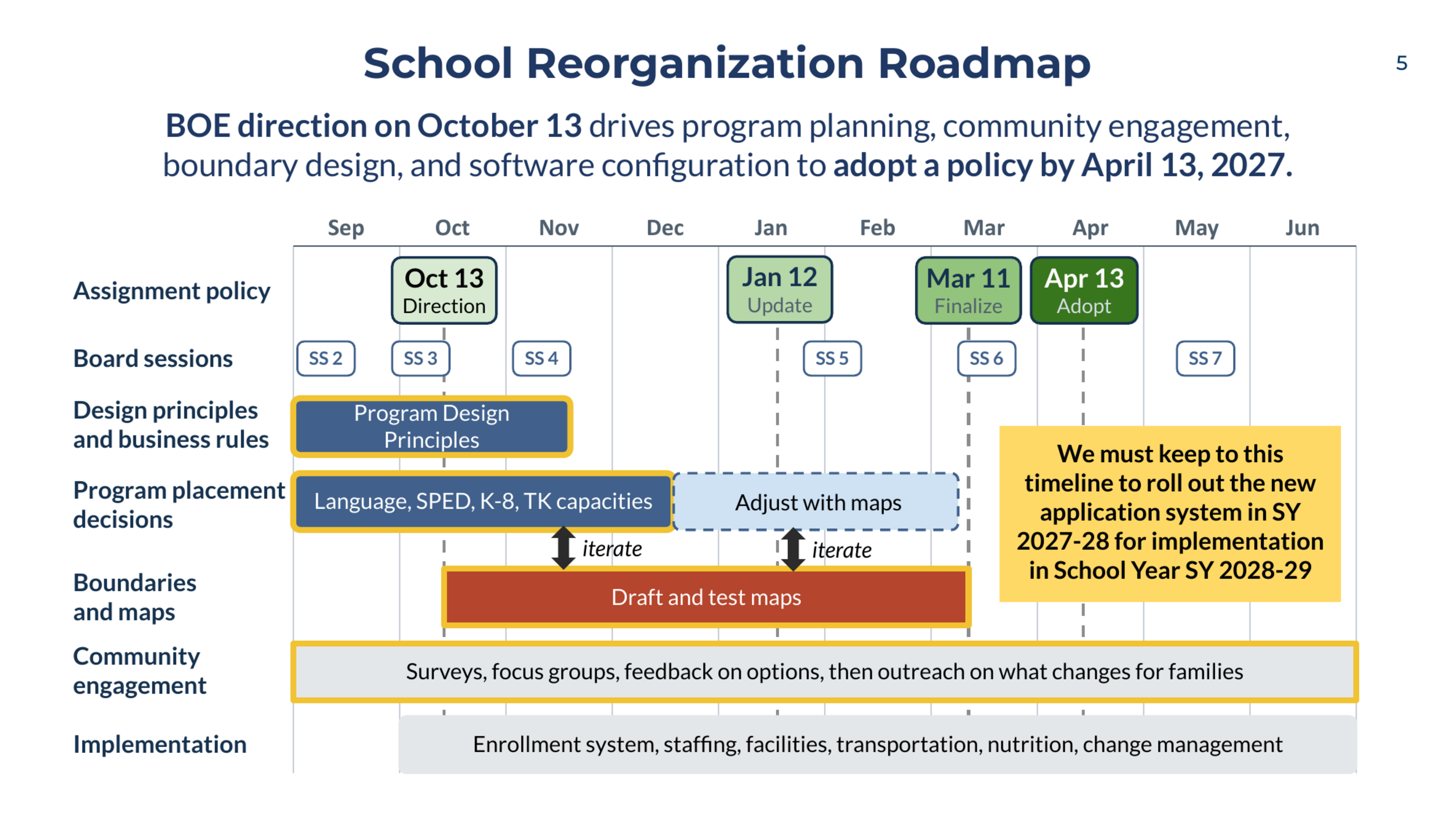 SFUSD’s timeline for the new assignment policy, which would take effect in the 2028-29 school year. | Source: SFUSD