
It’s clear by now that President Donald Trump has changed the course of San Diego politics and given the local GOP problems that may last for years to come.
Until Trump started meddling, San Diego had a Republican congressional incumbent cruising toward re-election in a solidly red district. Now the region has neither.
And there’s a chance that after the November election, San Diego won’t have a Republican member in the House of Representatives for the first time in more than 75 years. All because of Trump.
Whether or not Trump’s GOP holds on to the House majority, or regardless of whether Republican Jim Desmond is elected to replace the retiring Rep. Darrell Issa, the configuration of the region’s congressional districts will put Republicans at a greater disadvantage than before — at least for the next couple of election cycles.
For years, San Diego County’s districts (some of which include portions of Orange, Riverside and Imperial counties) included one solidly Republican seat and one Democratic-leaning swing seat. Now the former, the 48th Congressional District, has been turned into the latter.
That is the direct result of Trump launching the states’ redistricting wars in Texas. (We’ll get to the damage to Republicans from Trump’s rambling on Iran potentially attacking San Diego and things like Medicare cuts in a bit.)
California would not have embarked on a mid-decade redistricting scheme to boost Democrats if Texas had not done it first to gain Republican seats. Issa again would have been a lock to win another term in the 48th District as it existed.
No, Trump did not draw the lines of the new 48th. But the state’s nonpartisan redistricting commission did some years ago and made the East County-centric 48th Republican, which followed the region’s geography and political demographics.
California’s voter-approved redistricting proposal scrapped the existing maps and took the commission out of the picture, theoretically on a temporary basis. Should the commission get back into action after the 2030 census — by no means guaranteed — there would be a good chance San Diego would get a Republican district back.
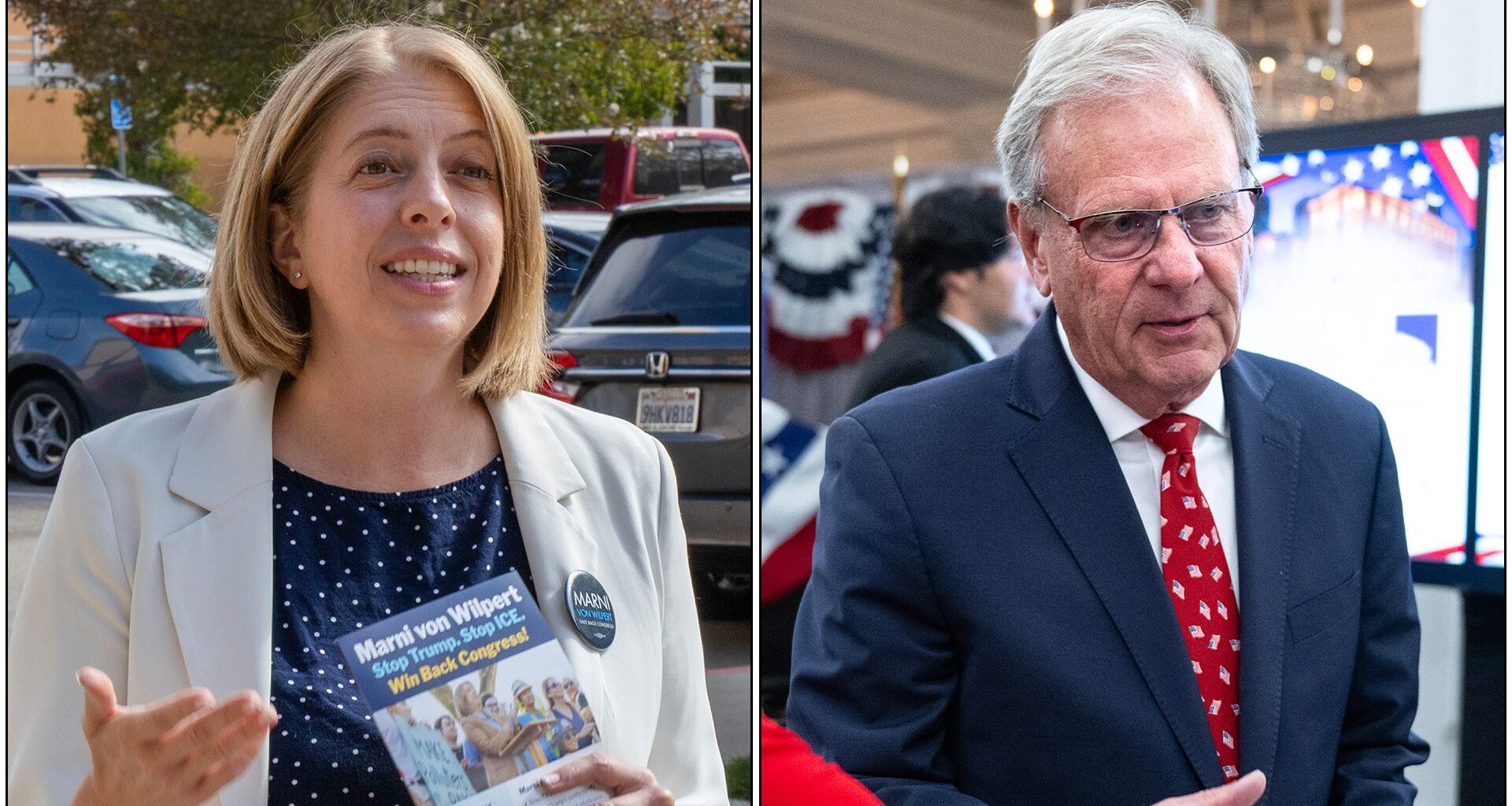
Meanwhile, county Supervisor Desmond is battling San Diego City Councilmember Marni von Wilpert in the now-purple 48th, the makeup of which apparently convinced incumbent and staunch Trump supporter Issa to call it quits. Desmond has been trying to avoid talking about Trump, but the president has made that impossible.
Even if he wins, Desmond will be a top Democratic target in future elections. (A victorious von Wilpert certainly would face a serious Republican challenge to break the Democrats’ hold on all five San Diego districts.)
Trump is a double-edged sword for Desmond, though the negative side of the blade appears to be getting sharper. The president’s endorsement of the supervisor brings more resources to his campaign. But a mere association with Trump can be a liability in areas of California that aren’t deeply Republican.
Further, Trump’s cuts to healthcare and other programs are widely unpopular. Democrats, including von Wilpert, are hitting that issue hard, as they did when Trump and Republicans tried to end the Affordable Care Act before the 2018 Democratic blue wave midterm election.
The Trump effect has also had impact on down-ballot local elections for years. Former San Diego Mayor Kevin Faulconer was considered a major contender to unseat county Supervisor Terra Lawson-Remer in 2024, but his earlier flip from a mild Trump critic to supporter became a focus of the campaign and cost him.
There were plenty of reasons why Lawson-Remer prevailed, but few would have predicted a 14-point blowout.
As far back as 2018, support for Trump proved detrimental. San Diego City Council incumbent Lorie Zapf was somewhat blindsided by attacks tying her to Trump and was resoundingly defeated for re-election.
That tactic at the very local level, relatively new then, has become commonplace in a region that has become dominated by Democrats.
In the current campaign for that same council district, Deputy City Attorney Nicole Crosby, a Democrat, is trying to make Trump an issue against opponent Richard Bailey. The transplanted former Coronado mayor and past supporter of the president changed his voter registration from Republican to independent early this year after he moved to Point Loma.
This isn’t to say such elections necessarily hinge on voter feelings about Trump. But who he is, what he does and what he says are factors.
There’s been plenty of discussions and interpretations about what Trump meant in Nebraska on Monday when he said of Iran: “Let them take out Los Angeles; let them take out San Diego. That’s — this is a very small price to pay…”
Even some neutral fact-checkers, including CNN’s Daniel Dale, concluded that the president, in his convoluted way, was actually suggesting higher gas prices were the “small price to pay” for the ongoing war, as opposed to Iran attacking Los Angeles or San Diego.
Not everyone buys that, and the early outraged responses were mostly from Democrats. Desmond, a Navy veteran, issued one as well. “No American family should ever be treated as collateral damage,” he said in a statement.
The controversy stretched on through the week. On Wednesday, Trump continued to talk about it, apparently trying to clarify his earlier remarks.
Even in the most benign interpretation, the Monday speech was another rambling and at times almost unintelligible jag that furthered questions about Trump’s mental capacity, let alone his political acumen.
The potential political damage for Desmond might be greater than for Republicans running elsewhere. San Diego is the principal homeport of the U.S. Pacific Fleet. The military is deeply rooted in the region’s history and its population.
Support for a strong defense has long been an advantage for Republicans here.
A Republican president who can’t talk coherently about an already unpopular war he started makes it less of one.