
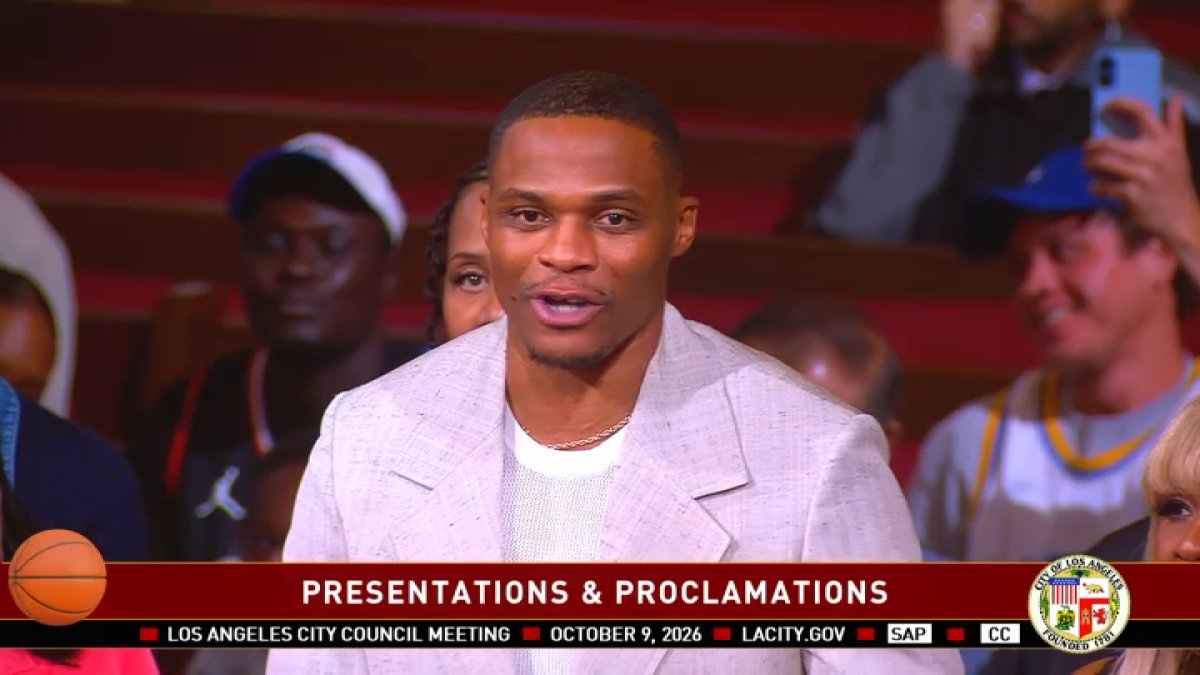
A hometown hero who came back and gave back to the community that raised him: that’s how retired NBA star Russell Westbrook was described Friday when the Los Angeles City Council honored him.
The LA native was presented with a certificate during a ceremony at LA City Hall. Councilmember Heather Hutt, who introduced Westbrook, emphasized the special recognition was not just for his accomplished career but also for his work through the Russell Westbrook Why Not? Foundation.
“Russell Westbrook is Los Angeles through and through,” Hutt said. “Some people just play basketball, but some change what the game means to the city. Today, we’re celebrating someone who did both.”
Hutt also highlighted Westbrook’s efforts to improve educational opportunities for children in South Los Angeles.
“Ask families in South LA about Russell Westbrook, they won’t talk about stats. They’ll talk about the reading room he built at 75th Street Elementary, the same school he walked into as a little boy,” Hutt said.
Westbrook, who was joined by his mother and other family members at the ceremony, credited his parents with instilling in him the importance of helping others and explained his ability to give back started when he was young.
“I was always seeing my mom, my dad give, give, give, give, give so much, and as a young child, I didn’t really understand how or why … because we didn’t have much growing up,” Westbrook said.
He also reflected on the importance of his accomplishments beyond basketball.
“When I’m done playing, I always told myself legacy is something that, it’s not what you do on the court, it’s what you do with the platform,” Westbrook said.
Westbrook, 37, announced his retirement Aug. 12 after 18 NBA seasons, ending a career that included nine All-Star selections, the 2016-17 NBA Most Valuable Player award and a place in the league’s record books as its all-time leader in triple-doubles.
Westbrook finished his career with 209 regular-season triple-doubles, surpassing the previous record of 181 held by Oscar Robertson. He also became the first player since Robertson to average a triple-double over an entire season, accomplishing the feat in 2016-17 and repeating it three more times.
A triple-double occurs when a player records double-digit totals in three statistical categories, typically points, rebounds and assists, in a single game.
The former UCLA standout grew up in Los Angeles and attended Leuzinger High School in Lawndale before playing two seasons for the Bruins, helping the team reach consecutive Final Four appearances in 2007 and 2008.
He was selected fourth overall in the 2008 NBA Draft by the Seattle SuperSonics, who relocated to Oklahoma City and became the Thunder before his rookie season.
Westbrook spent his first 11 NBA seasons with the Oklahoma City Thunder before playing for the Houston Rockets, Washington Wizards, Lakers, Clippers, Denver Nuggets and Sacramento Kings.
He spent the 2025-26 season with Sacramento, his final NBA team, averaging 15.2 points, 6.7 assists and 5.4 rebounds in 64 games.
Westbrook won two NBA scoring titles, led the league in assists three times and was named to the NBA’s 75th anniversary team. He also won a gold medal with the U.S. basketball team at the 2012 London Olympics.
Beyond basketball, Westbrook established his Why Not? Foundation in 2012 to support underserved communities, particularly in Los Angeles and Southern California.
The foundation focuses on educational opportunities, workforce development and access to mental health resources, encouraging young people to pursue their goals and overcome obstacles.
In 2015, Westbrook returned to 75th Street Elementary School in South Los Angeles, which he attended as a child, to open a reading room and donate books through his foundation’s literacy initiative.
Westbrook has also supported youth basketball programs in Southern California, including camps and other activities aimed at providing opportunities for children.
His ties to UCLA have also continued beyond his playing career. In 2015, he made what the university described at the time as the largest donation it had received from a former basketball player to support construction of the Mo Ostin Basketball Center.
The men’s basketball practice court at the facility was named in his honor.