
An advisory issued Thursday by the National Weather Service’s Climate Prediction center says that it expects “a strong-to-very strong El Niño likely through January-March 2027.”
But this isn’t the first time the United States has seen what is known as a historically strong El Niño event. There have been at least 11 prior periods going back nearly seven decades — to before Interstate 8 was built through Mission Valley and to the same year UC San Diego first opened to undergraduates in La Jolla.
The National Oceanic and Atmospheric Administration (NOAA) measures these events with what it calls its Oceanic Niño Index; the higher the measurement, the stronger the El Nino. The organization’s data going back to the 1950s found that the following years saw stronger-than-normal El Niño measurements: 1957-58, 1963-64, 1965-66, 1972-73, 1982-83, 1986-87, 1991-92, 1997-98, 2002-03, 2009-10 and 2015-16.
And it looks like this year will continue the trend. Here’s a look at some El Niño snapshots from the past few decades, according to news reports from The San Diego Union-Tribune archives.
1997-98
May 29, 1997: “Local fishermen this week reported their biggest haul of squid since 1990, when crowds of calamari came north with the warm Pacific current known as El Niño.”
Oct. 3, 1997: “Although malevolent prospects of El Niño are feared this winter, local lifeguards say the global climatic effect already has been a factor in recent drownings. … In a little over a month, there have been five drownings off county beaches that would-be rescuers attributed to rip currents — a surprisingly high number.”
Oct. 16, 1997: “El Niño has brought the best fishing season we’ve had in 25 years,” reports Bob Fletcher, president of the San Diego-based Sportfishing Association of California. “It’s been a sportfishing bonanza.”
Feb. 9, 1998: “An overnight storm that concentrated its force early yesterday on the county’s midsection sent creeks and rivers over their banks, flooded intersections, threatened homes and battered the shoreline before making its deadly pass through Baja California. … The San Diego Lifeguard Service made at least 16 river rescues, and homes in Santee Lakes and Lakeside were evacuated as a precaution. But no serious injuries were reported in the county.”
Feb. 10, 1998: “Sea World broke its one-day record Sunday when its staff rescued 11 sea lions from local beaches and brought them to the park’s rehabilitation center. The previous one-day rescue total was nine sea lions.”
Feb. 20, 1998: “Filled to the brim by the recent El Niño storms, Lake Hodges Dam has begun spilling over in a majestic waterfall that some motorists and passers-by are unable to resist.”
Feb. 23, 1998: “So far, the Aztecs have struggled through nine largely damp games (their record is 4-5) and have had to cancel six because of rain and/or wet grounds. ‘In all my (27-year San Diego State) career, I’ve never seen anything like this,” said coach Jim Dietz, whose season has been awash in El Niño rains.’”
Feb. 25, 1998: “El Nino earned its notorious reputation yesterday with a punishing storm that thrashed San Diego County from shoreline to mountains. … Two hundred people from a mobile home park and two recreational vehicle parks in Oceanside were evacuated as floodwaters rose. Throughout the county, an estimated 50 other residents fled homes that were flooded by overwhelmed storm drains or damaged by fallen trees.”
Feb. 28, 1998: “City officials are worried that more than 200 feet of sea wall in Pacific Beach could collapse onto the sand after it pulled away from the boardwalk yesterday.”
March 2, 1998: “A red pickup truck swallowed by a Kearny Mesa sinkhole last week was unearthed by Caltrans workers yesterday. The huge sinkhole opened during El Niño-influenced rains last Monday, growing during the week into an enormous pit that measures about 550 feet from north to south, about 35 feet wide and 65 feet deep at Interstate 15 and Balboa Avenue.”
March 29, 1998: “National Weather Service spotters reported that hail fell yesterday in Rancho Bernardo and Escondido and at the Wild Animal Park, which is just south of Escondido. Other reports said hail clattered on Horton Plaza and other spots downtown and elsewhere.”
July 4, 1998: Across Southern California — from San Luis Obispo to the border — El Niño of 1997-98 dumped 231% of normal rainfall, according to the National Weather Service.
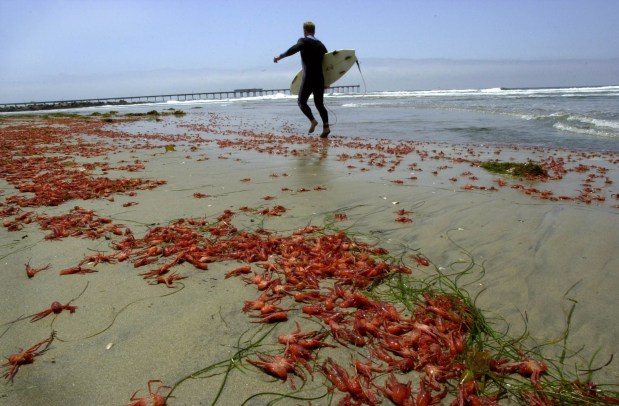 Dead pelagic crabs cover the shore in the Ocean Beach neighborhood of San Diego on Tuesday, May 7, 2002. The creatures, more commonly known as tuna crabs, might be evidence that an El Nino event is brewing. (John R. McCutchen / The San Diego Union-Tribune)
2002-03
May 7, 2002: “Thousands of pelagic red crabs washed up along San Diego’s beaches yesterday, a phenomenon that provides more evidence that another El Niño event may be brewing.”
July 20, 2002: “Now 2-foot jumbo squid are washing up by the dozens along the shore from Imperial Beach to Encinitas. … While scientists aren’t certain what’s causing the sea creatures to beach themselves along Southern California this summer, El Niño is a leading suspect.”
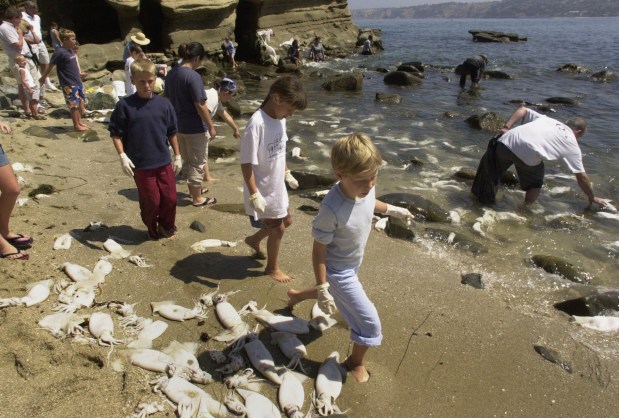 Children walked by some of the jumbo flying squid that covered the beaches of La Jolla Cove, Friday July 26, 2002. (Don Kohlbauer / UT file)
Dec. 29, 2002: “A tropical sea turtle that drifted more than 1,400 miles north of its normal range is being treated for hypothermia and malnutrition at SeaWorld.”
March 5, 2003: “El Niño has played hide and seek; we’ve had very wet periods mixed with unusually long dry periods. November and December were sopping; January was bone dry; and last month was the 10th wettest February in city history.”
2009-10
Jan. 10, 2010: “In the end, 2009 went down as yet another drought year, with below-normal rainfall in every month but two.”
March 9, 2010: “A particularly damaging mix of high tides and high surf and a growing number of winter storms have stripped the sand from much of Imperial Beach, resulting in an emergency situation for … neighbors on Ocean Lane. They have asked the city to permit them to temporarily protect their condos with special 6-by-6-foot sandbags.”
April 27, 2010: “A long succession of storms since winter has stripped large amounts of sand from the county’s coastline, creating unusually dangerous swimming conditions that could bedevil beachgoers well into the summer. … This winter and spring, El Niño-driven storms with powerful winds have denuded the beaches far more than in most years.”
2015-16
Jan. 3, 2015: “People who saw ice on their roofs and snow on nearby hills this week might find it hard to believe, but San Diego just finished its warmest year on record.”
Feb. 19, 2015: “Far more sea lion pups are stranding on California beaches than usual this year, officials with the National Oceanic and Atmospheric Administration said Wednesday.”
Sept. 16, 2015: “The remnants of Hurricane Linda brought record rainfall to San Diego County on Tuesday, easing the region’s wildfire danger while contributing to the temporary closure of Interstate 15.”
Dec. 12, 2015: “SeaWorld has rescued an unprecedented 973 sea lions this year. The previous record was 474, set in 1983 when the ocean was also warmed by El Niño.”
Jan. 10, 2016: “Today eight families along Cabaret Street are struggling to rebuild their lives after the storm drain gave way and pushed millions of gallons of water through their homes and property.”
Jan. 22, 2016: “The Del Mar City Council declared a local state of emergency this week after a bluff collapsed during powerful El Niño storms earlier this month, forcing the city to close a busy section of Camino Del Mar.”
Jan. 28, 2016: “Lifeguards at Swami’s Beach warned beachgoers Wednesday to stay away from the bluffs after several tons of debris collapsed onto the beach this past weekend.”
Jan. 31, 2016: “Oceanside beaches have gotten noticeably smaller over the past few months after being battered by huge waves and some early El Niño storms, and officials say they’re working on ways to replenish some of the sand.”
 Workers remove a tree that fell due to a storm at Ft. Rosecrans National Cemetery in San Diego on Monday, Feb. 1, 2016. Powerful winds lashed Southern California on Monday at the tail end of a winter storm that also brought heavy rain and mountain snow. (John Gibbins/The San Diego Union-Tribune via AP)
Feb. 1, 2016: “A fierce storm brought heavy rain and wild winds to San Diego on Sunday, toppling trees — including one that killed a motorist in Pacific Beach — causing power outages and postponing until today the completion of the Farmers Insurance Open at Torrey Pines.”