
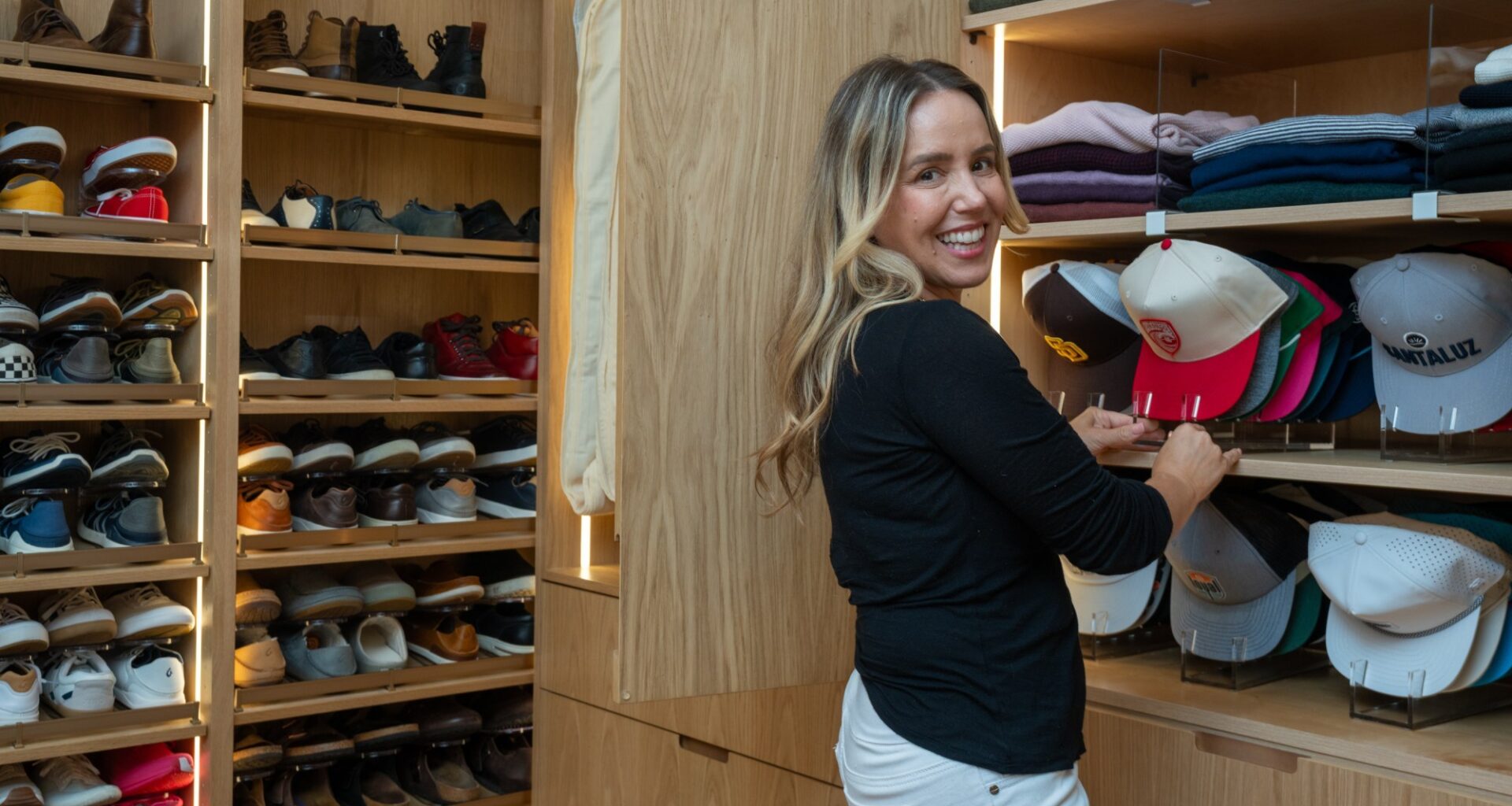
For The Union-Tribune
When it comes to home organization, it’s the little things that can make all the difference, especially in the bedroom. The socks. The underwear. The shoes. The handbags. The belts. The watches and jewelry. The cap collection. And, yes, don’t forget all the devices and their accessories.
You may have Marie Kondo’d your sweaters and tees, your skirts and slacks and even your jammies. But how easily can you find matching socks or shoes? Where are those earrings that your BFF gave you for your zero-ending birthday or the sunglasses you bought on your last vacation?
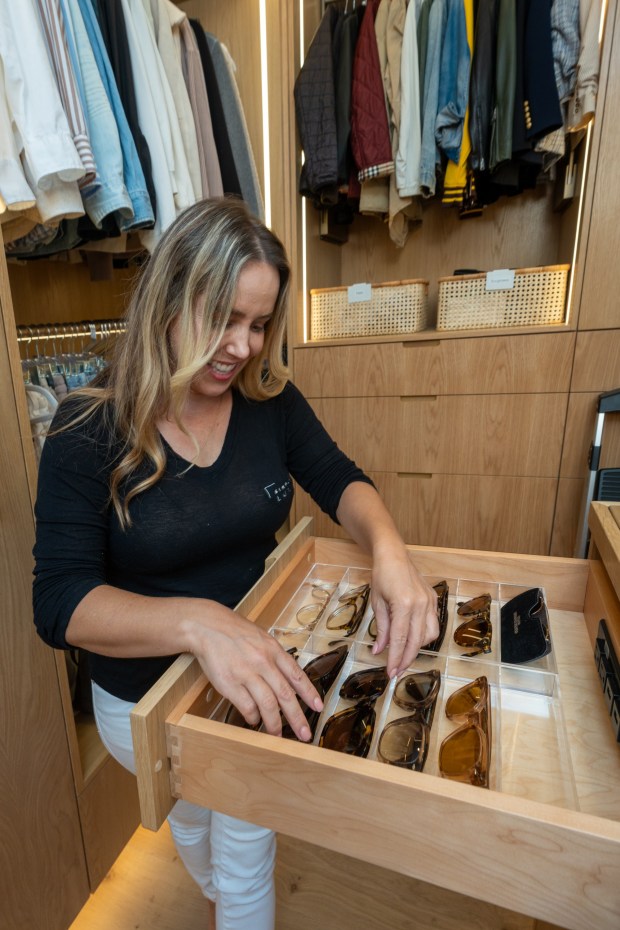 Smaller accessories like sunglasses may not be in the original closet design, but that can change, Toft says. Reassess what you really use and organize for what you need, not some idealized Pinterest photo. (Val Dostalek)
Accessories, too, need to be organized. It just makes your busy life easier. So, here’s advice from a professional organizer in San Diego County as well as experts at California Closets, The Container Store and Ikea.
Ryen Toft, owner and founder of Simply Luxe Organizing, acknowledged that accessories are usually where the little things start to take over.
“They’re smaller, there are often a lot of them and, unlike clothing, most closets aren’t really designed with a natural home for handbags, belts, scarves, jewelry, hats, sunglasses, etc.,” she explained.
“The biggest frustration we hear is usually, ‘I know I have it, but I can’t find it’ or they forget what they own altogether. And once you can’t easily see or access something, you tend not to use it. That’s when people start buying duplicates or wearing the same few things over and over.”
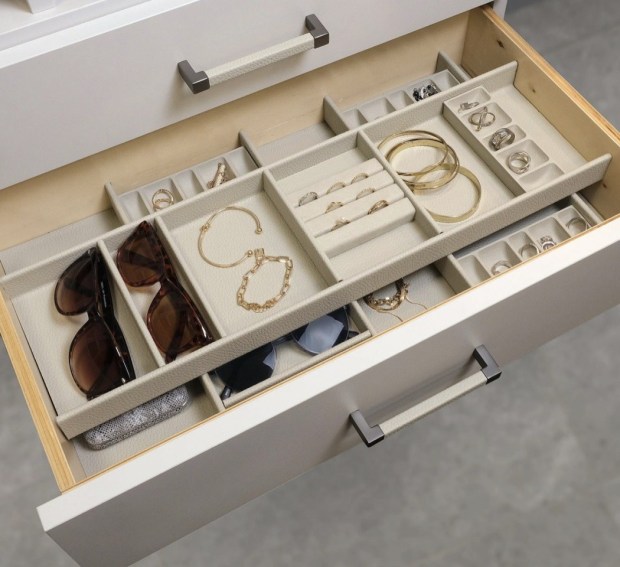 Accessory and jewelry trays like these from California Closets protect and organize smaller items inside a drawer. Simply slide the top tray to one side to reach items below. (California Closets)
California Closets design consultant Katie Swinburne agreed. “One of my favorite things I always tell my clients is, you wear what you see, right? If you don’t see it, you don’t remember it.”
Does that sound like you? If so, Toft suggested that before you start buying organizers, first identify what exactly you’re organizing. The products are the last step, not the first.
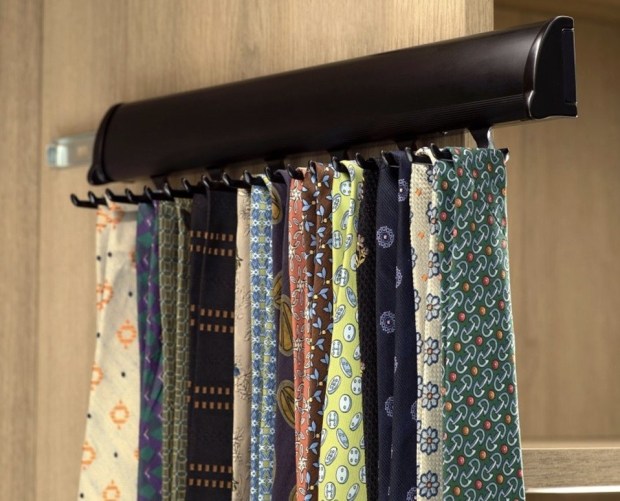 California Closets’ pull-out tie racks make it easy to decide on style picks for the day (California Closets)
“First, remove everything so you can actually see what you have,” she advised. “Then reassess. What do you wear? What do you love? What no longer fits your life or personal style? Are there duplicates? Is something damaged and you’ve been telling yourself for three years you’re going to repair it? Only then do you reimagine the space and bring in organizing products.”
Toft also emphasized that you’re organizing for yourself — your habits — not some idealized Pinterest photo. Ask yourself what you reach for every day as opposed to what you only wear for special occasions. What you use most should get the easier, most accessible real estate, she pointed out.
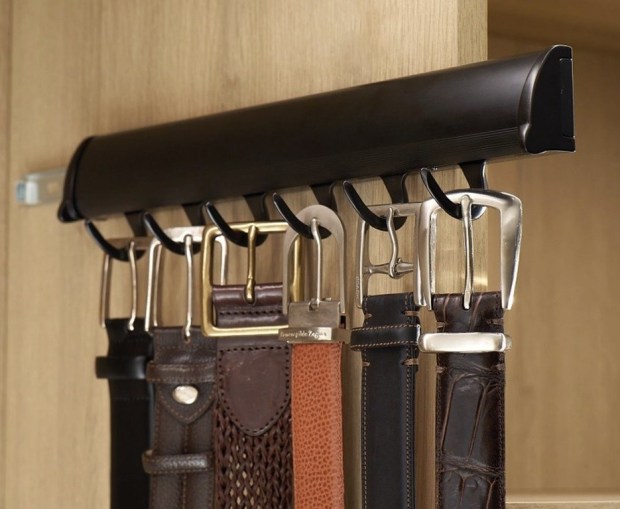 A pull-out rack from California Closets also tidies hanging belts in a slim profile. (California Closets)
“One of the biggest mistakes people make is buying organizers first,” she added. “A beautiful set of matching bins isn’t going to solve the problem if you haven’t figured out what actually needs to live there.”
Rafael Barrera, store manager of The Container Store in San Diego, has found that from there, it’s helpful for customers to come in with measurements — of the size of drawers they want to buy dividers for or spaces they have for shoes or belts or the like — as well as photos of the whole of what they’re interested in corralling.
“I think one of the challenges that we have is that customers come in with a very specific idea because maybe they’ve seen it on Instagram, or they just like dream up the solution perfectly, and it may not work out that way based on their dimensions,” he noted. “You know, things on the picture are different so it might not match perfectly.”
Basically, the more information you bring in, including images of your dresser or closet drawers and what you’d like to fill them with, the better the advice you’ll get for a solution. And, said Barrera, the reverse is true.
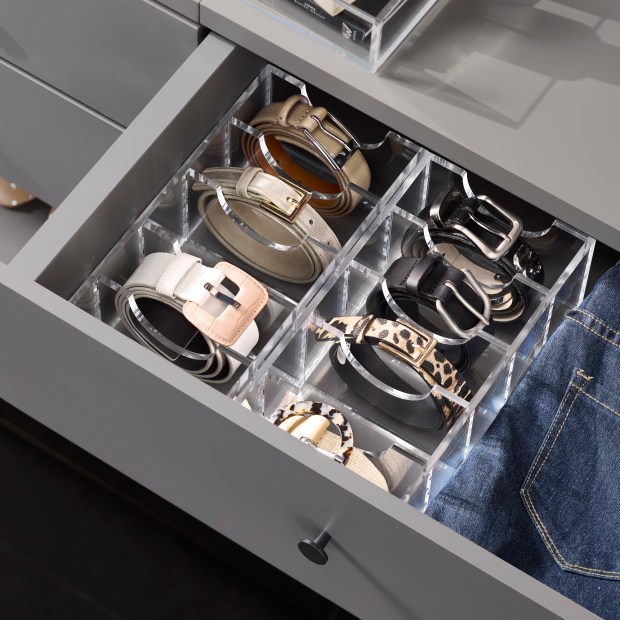 Even simple belts can look elevated when they’re stored in The Container Store’s Luxe Acrylic Belt Storage. (Jesus Prieto / The Container Store)
“We even encourage customers to take pictures of stuff in the store if they’re an option. Take a picture of that, because then when you’re at home and you’ve got your stuff, then you could be like, let me look at that and see if that’ll end up working out too. And it helps that all of our tags have the dimensions.”
At Ikea, they’re selling the furniture and the organizers. It can be helpful to see their visions for a well-organized closet and dresser. Just remember, they won’t have nearly as much stuff in their organizers as you likely have at home, but they can give you ideas for how you can sort what you have. For instance, their Skubb dividers in dresser drawers can help divide undergarments. Their felt Komplement boxes and dividers can hold socks, bras, scarves, ties and belts. They have one that can go in a long but shallow drawer for rings and other pieces of jewelry.
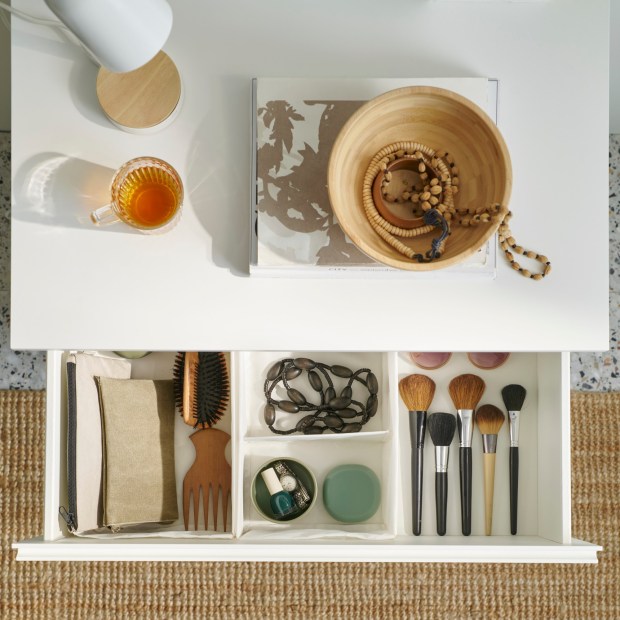 The Skubb Storage Series Wardrobe Boxes are a modular set from Ikea can be used to corral all sorts of accessories, including hair fasteners, jewelry and more. (Ikea)
One item that seems to bedevil so many people, if the variety of types of organizers is any indication, is shoes. If your shoe collection has outgrown your closet or if you have clothes that hang so long you can’t easily see the shoes on the floor of your closet — and you think your only solution is one of those organizers that hang behind your door with rows of pockets, you’d be surprised at what’s now available.
At Ikea, they have a closet with pull-out drawers in which you can put almost a dozen pairs of shoes. They also have a variety of what look like thin dressers but the drawers angle down and reveal shoe organizers.
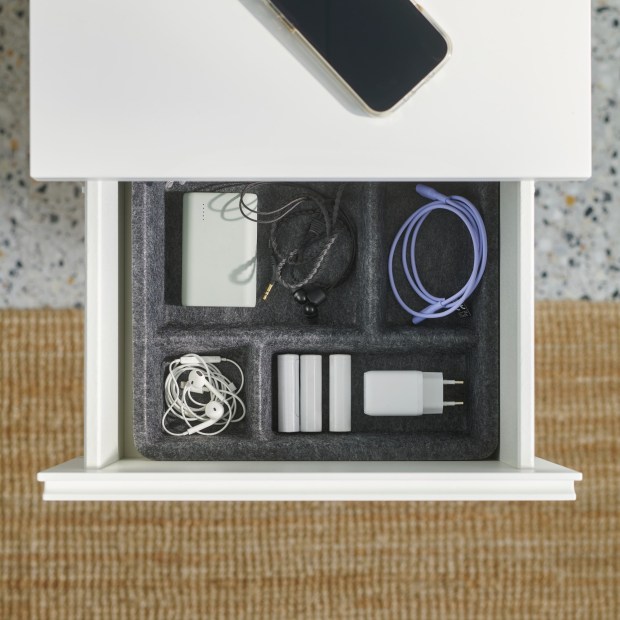 Charging cords, earbuds, watches and other delicate items have a smart landing place with Ikea’s Raggisar stackable tray. Its pressed felt compartments protect and sort the things you need at hand. (Ikea)
“You could even put this in the entryway because it’s so thin, and then you put like bowls on top for your keys and sunglasses,” explained Zoe Loffreda, Ikea’s local marketing leader. “It’s not just storage, it can really be more like an accent to the home.”
I’ve seen similar types of dresserlike shoe storage on Amazon and Wayfair, as well.
At The Container Store, Barrera pointed out different sized stackable acrylic boxes with drop-front little doors. They keep your shoes from collecting dust and, unlike cardboard shoeboxes, you can see what you have and you don’t have to move boxes above what you want to reach for. And as for the over-the-door shoe organizer, you don’t have to get pockets; you can get them with tiers — basically, shoe racks you install on the door.
And, of course, there are a variety of under-the-bed storage options at most stores, including Ikea and The Container Store.
Toft likes to look up before taking up more floor space.
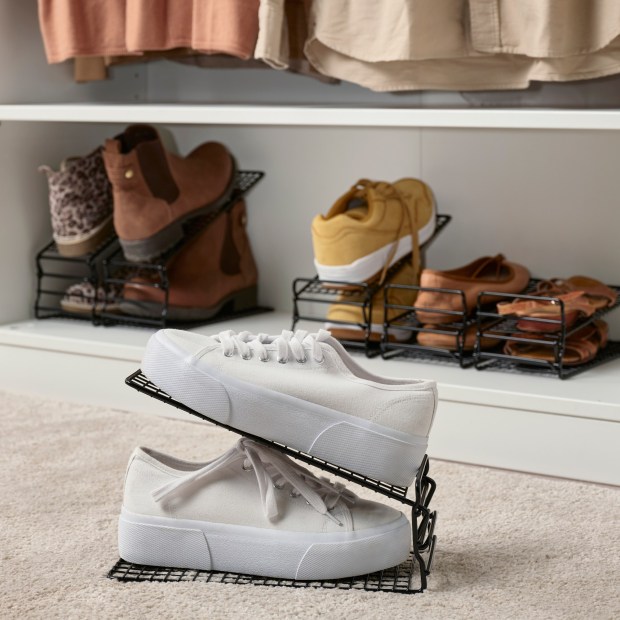 One space-saving option for stackable shoe storage is Ikea’s Skostall’s Shoe Organizer, which places one atop the mate. The incline of the top shelf is easy to adjust to accommodate varied shoe heights. (Ikea)
“People tend to underutilize vertical space in closets,” she said. “If you have adjustable shelving, bringing shelves closer together can sometimes create an entire additional row or two for shoes. Stackable shoe shelves can also work really well because you’re taking advantage of the height you already have rather than spreading shoes across the floor.”
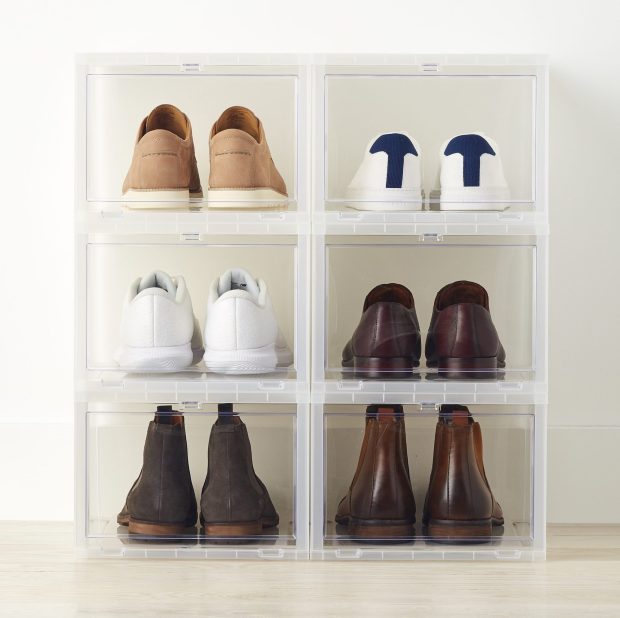 The Drop-Front Shoe Box at The Container Store makes sure your shoes are always free of dust and clearly visible.
(R.J. Hinkle / The Container Store)
And again, how often do you wear different pairs of shoes?
“I also think it’s important to question whether every shoe needs prime closet real estate,” she added. “Your everyday shoes should be easy to grab. Special occasion shoes, seasonal shoes or pairs you rarely wear can live higher up or in another designated space or area. And if the shoe collection simply doesn’t fit, no organizer is going to magically create square footage. Sometimes, editing the collection is the best organizing tool there is.”
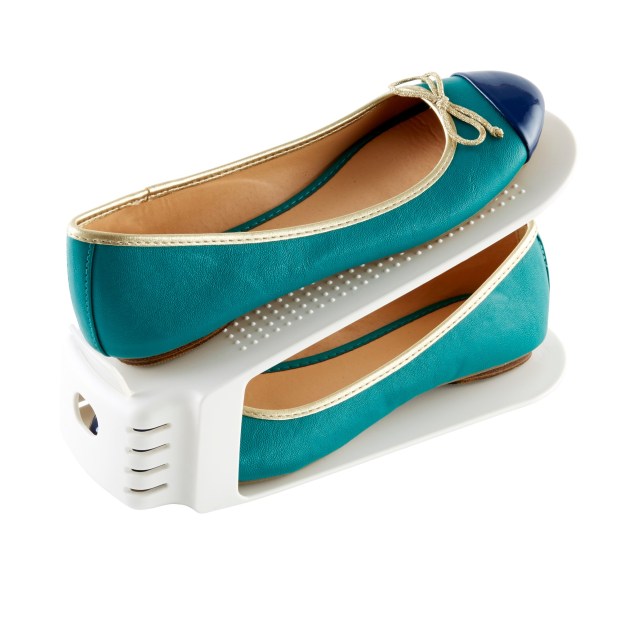 The Like-It Shoe Holder from The Container Store is an ideal solution for compact spaces, with a shoe stored neatly above its partner. (The Container Store)
Then there’s old-fashioned creativity. Swinburne described a photo of one very clever approach: attaching rows of molding to a wall with the side that would attach to the wall facing up. High heels were hung from the molding, creating almost a kind of art piece.
What about the little stuff?
“I think the best solution is a dedicated drawer for like accessories,” said Swinburne. “It could be scarves. It could be folded or rolled-up belts, rolled-up ties, something with a container that like a tray that just like kind of keeps it organized in a box that can be moved. I think when people only have hanging, if they don’t have the proper drawers and trays, then the other thing that we offer are pull-out racks, so tie racks and belt racks. Those are really nice because they just hang with what you’re hanging, and when you want to access them, they pull out towards you.”
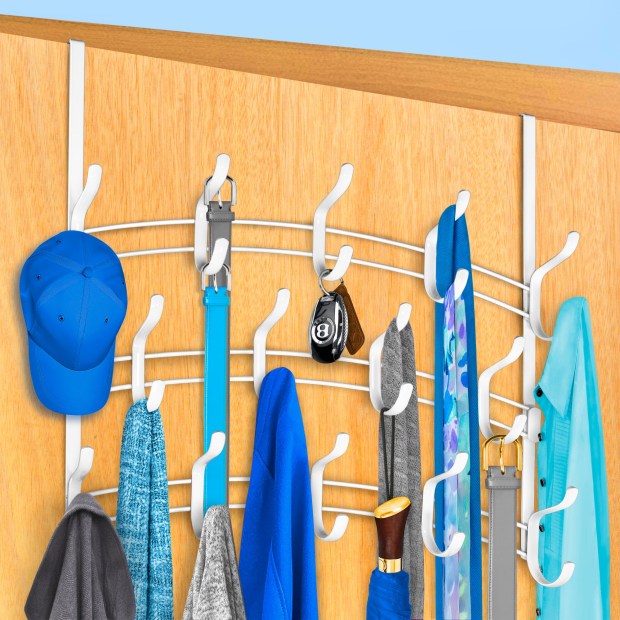 No room for extra drawer space or shelves of boxes? The space-saving Lynk 28-Hook Over Door Hanger holds a surprising amount of accessories. (The Container Store)
Sometimes, part of the solution has less to do with organizers and more how you place your accessories within a drawer or organizer. For example, I’ve spent years trying to corral scarves I’ve accumulated. I tried folding and stacking them neatly in a nightstand drawer, but I couldn’t see what I had.
Then I got one of those hangers that looks like a vertical honeycomb, the idea being that you tie the scarves into each hole. But the result was like someone with a wild hairdo, and every time I closed my closet door, I had to push the scarves’ ends into the closet.
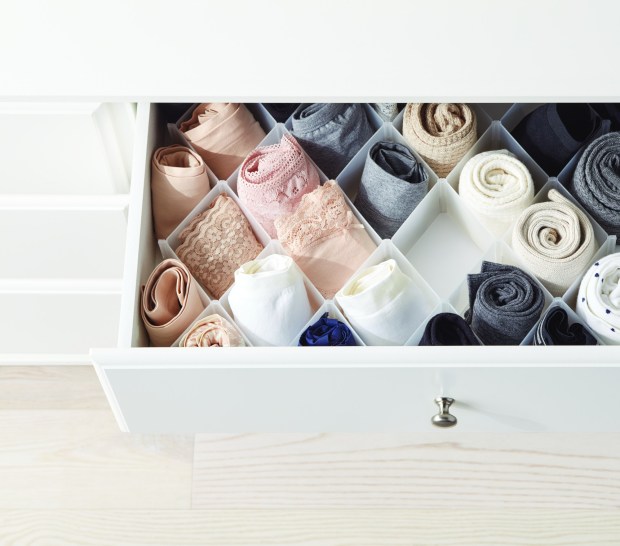 Everything will have a home in The Container Store’s 32-Compartment Drawer Organizer. (Jay Newdy / The Container Store)
I rethought it and decided to get an acrylic box with a lid and a couple of dividers, and roll up each of the scarves to form three lines in the box. Now I can see what I have, and they take up little space. The box is easy to access, just tucked under a nightstand.
I also stopped stacking and instead rolled and lined up in a drawer the socks I wear daily to walk or wear to the dog park.

This acrylic 3-Compartment Clutch and Small Purse Organizer from The Container Store shows off your chic small bags and protects them, too. (The Container Store)

The clear PEVA 8-Pocket Handbag File keeps the bags secure and easily accessible. (Jay Newby / The Container Store)
Show Caption
1 of 2
This acrylic 3-Compartment Clutch and Small Purse Organizer from The Container Store shows off your chic small bags and protects them, too. (The Container Store)
And don’t forget your junk, er, utility, drawer. Most of us have them in the kitchen, but I was reminded that we take a lot of our devices into our bedrooms to use and recharge. We store cables and batteries. There are also remotes, pens/pencils, and maybe we have a shoehorn. Anyway, we have stuff and need to find it easily.
Swinburne suggested that you can get adjustable grids for your nightstand drawers.
“And then you can even get a label maker and if you have batteries, put them in a box and label it, and it just kind of creates a little bit of order.”
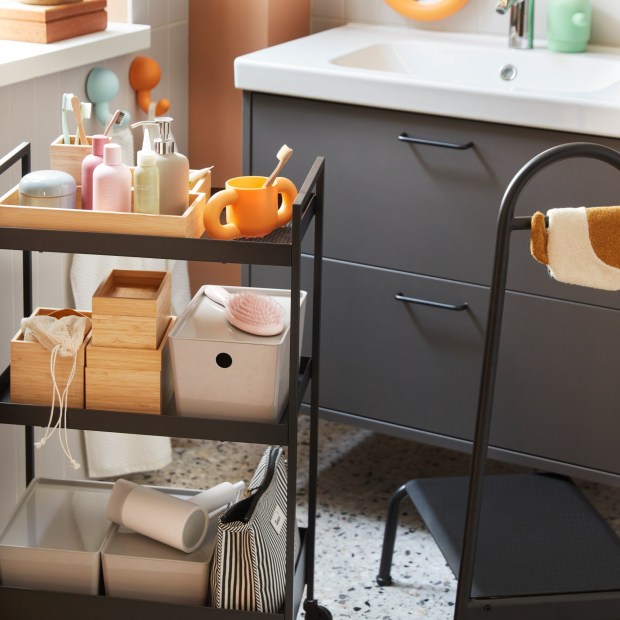 Rolling metal carts are workhorses, and the Nissafors Utility Cart from Ikea is versatile enough to be used in the bedroom, home office, bathroom and kitchen. (Ikea)
Speaking of labels, if you’re not aesthetically into acrylic boxes to store accessories you use only occasionally, like ski gear — gloves, goggles and the like — or a collection of clutch purses or hats, you can find beautiful or elegant baskets with lids that you can label, then stack on shelves in your closet so you can more easily find what you’re looking for when you’re ready to use them.
Of course, if you go through the process or reorganizing, it does require maintenance to work.
“My favorite organizing product is always the one a client will actually continue using six months from now,” said Toft. “You shouldn’t have to completely change your habits to maintain an organized home. The system should work with the way you naturally live. That’s really the difference between a space that looks organized for a week and one that stays organized.”