
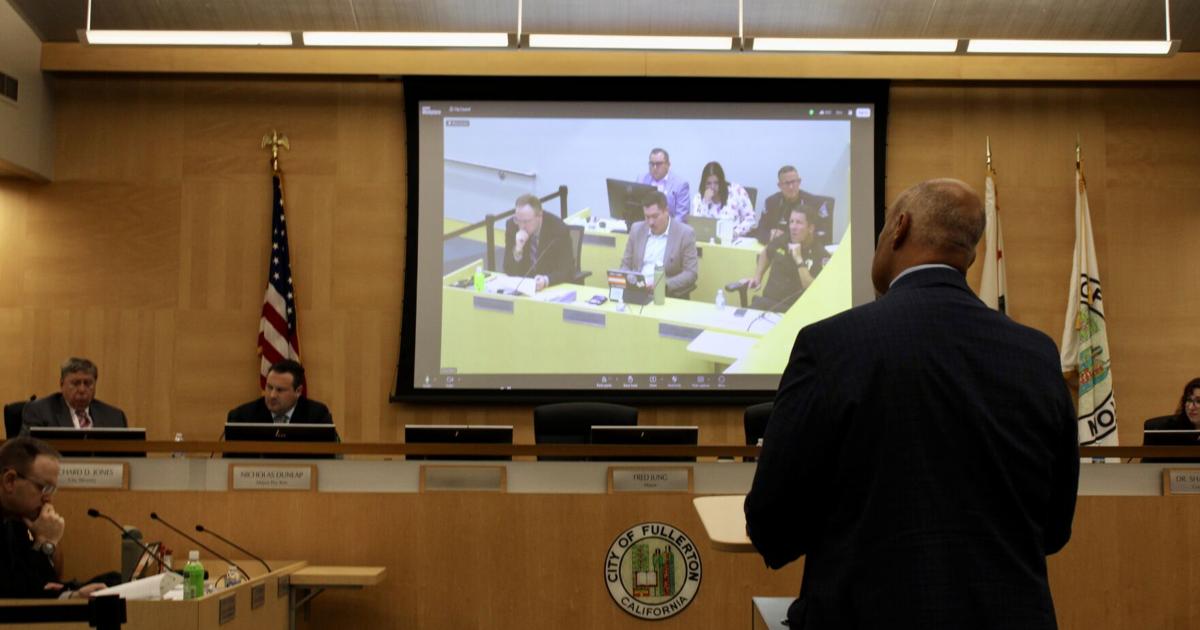
The Fullerton City Council voted 3-1 to impose a six-month suspension of the city’s Flock Safety Automatic License Plate Reader (ALPR) system, with District 4 Councilmember Jamie Valencia voting no and District 1 Fullerton Mayor Fred Jung absent from the vote.
Council action on ALPRs follows a presentation by the Fullerton Police Department at the Sept. 15 meeting regarding the department’s updated Flock policies, during which District 5 Councilmember Ahmad Zahra requested that the item be agendized for the Oct. 6 meeting, seconded by District 3 Councilmember Shana Charles.
The finalized motion, initiated by Zahra, included an amendment by District 2 Mayor Pro Tem Nicholas Dunlap allowing the city to immediately resume use of the cameras in instances of contract disputes or severe public safety emergencies. Otherwise, the pause will allow the city to collect comparative data on police investigation completion rates with and without the system.
The amendment followed a statement from Fullerton PD Chief Jon Radus that halting the cameras would risk losing data access from partner agencies, and noted that the city remains financially tied to its Flock contract through 2028, even with the system offline.
During the suspension, Fullerton will host a town hall meeting to gather public feedback, and the council will later review the data collected to discuss audit and communication protocols with Flock.
Valencia cited concerns during the council discussion on the item regarding the proposed length of the suspension and requested that it be reduced to two months.
“I don’t feel comfortable turning off the cameras because it’s been helping our police officers,” Valencia said. “So it’s really hard for me to say, for six months, we’re gonna not have this technology to help them do their job.”
Zahra replied that he believed a two-month suspension was insufficient time to collect valuable data on the effectiveness of ALPRs within the Fullerton PD.
Because Cal State Fullerton operates as an agency independent of the city of Fullerton’s jurisdiction, the university’s 46 ALPR cameras—while transitioning to Axon Technology—will not be affected by the city’s suspension of the technology.
Radus, alongside two Flock Safety representatives and Chief Technology Officer Randy Hornsby, presented information on Fullerton PD’s ALPR system, addressing areas of concern raised at the previous presentation, including auditing and data-sharing processes.
Fullerton PD uses Flock’s cloud network, hosted on Amazon Web Services, to host encrypted data from the city’s ALPRs. According to the presentation, all data, backups and disaster-recovery environments remain in the U.S. and independent auditing is being conducted by third-party company Bishop Fox this year.
The city’s Information Technology Department has determined that Flock’s security protocols align with industry-wide security standards.
Language regarding Fullerton PD’s data storage protocol has been adjusted from a one-year minimum storage requirement to 30 days to align with the city’s 30-day ALPR image retention window.
Hornsby stated that backup files for the data are kept for an additional week after the initial storage requirement has passed. Once all data and backups are erased from the system, those with access to the city’s ALPR data will no longer be able to view the images unless they download them as PDFs.
Radus additionally stated that Flock’s annual network audit provides the city with information regarding which partnering agencies have accessed the city’s ALPR data.
During the item’s public comment period, nearly every speaker opposed the use of Flock Safety in Fullerton.
“We should not have to accept a surveillance system simply because the technology exists,” said Carla Duran, a Fullerton resident and CSUF alumna. “If we’re gonna go spend hundreds of thousands of dollars on public safety, let’s invest it in approaches that make people feel safer, not technology that comes at the expense of our civil liberties.”
As of Oct. 7, Fullerton PD’s Flock Transparency Portal reports 1,027,509 unique vehicle detections, 366 user search sessions and 5,709 hotlist hits by the city’s Flock system over the last 30 days.