
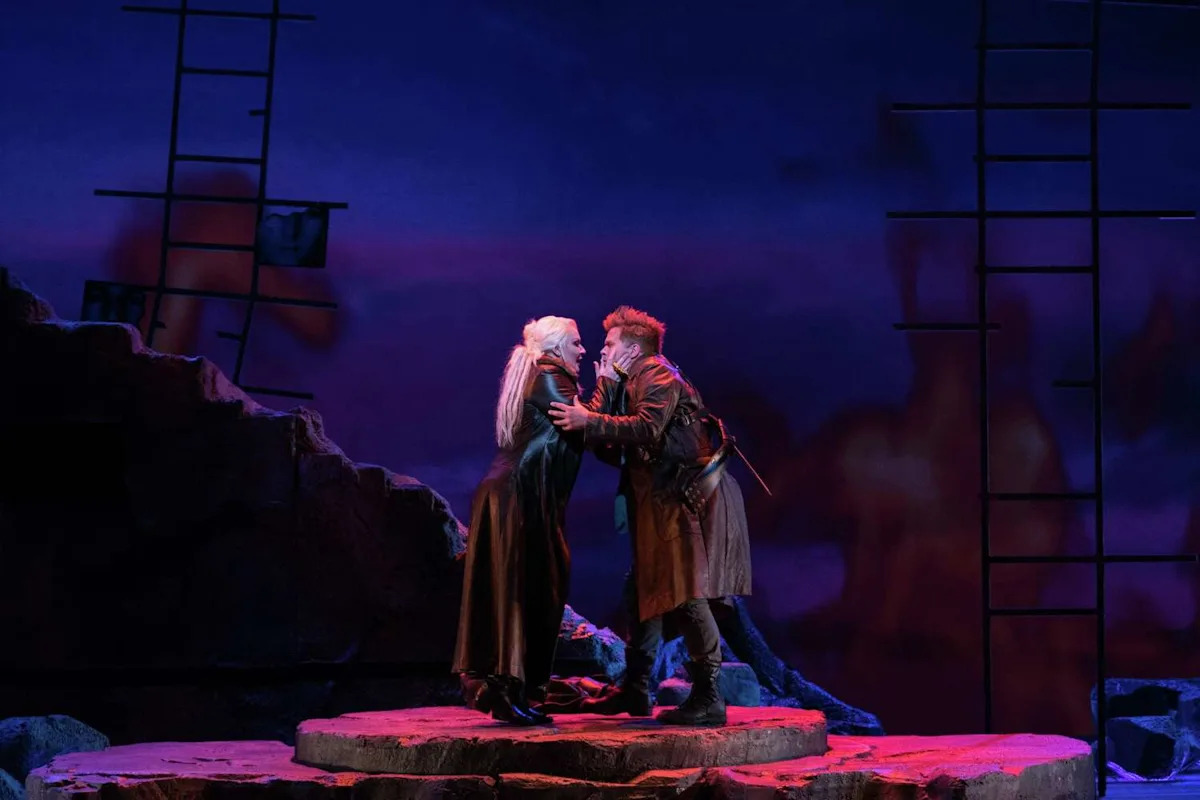
Ever since Music Director Eun Sun Kim and the San Francisco Opera first announced a multiyear plan for her to conduct one of Wagner’s works in each season, it’s been understood that the project would culminate in a revival of “The Ring of the Nibelung,” the composer’s massive operatic tetralogy based on Norse mythology.
Now it’s official.
On Tuesday, Nov. 11, General Director Matthew Shilvock announced the schedule and some of the casting for the “Ring,” which is planned for three full cycles in the summer of 2028. Each cycle will span six days, beginning June 13, 20 and 27.
Kim is set to conduct a revival of director Francesca Zambello’s American-themed production, which premiered at the War Memorial Opera House in 2011 and was revived in 2018.
“At various times I have unsubtly hinted that this would be the natural conclusion of the Wagner project,” Shilvock said at a gathering for donors, company members and the media in the Taube Atrium Theater. “Well, it’s actually happening.”
This will be Kim’s first complete “Ring” cycle, after leading up to it with productions of “Lohengrin,” “Tristan and Isolde,” and the current “Parsifal,” scheduled to end Thursday, Nov. 13. It may also be the first American “Ring” to be conducted by a woman.
“This company has a long tradition with the ‘Ring,'” Shilvock said. “Eun Sun is taking that tradition and shaping it for new generations of singers, choristers, orchestra members and audiences.”
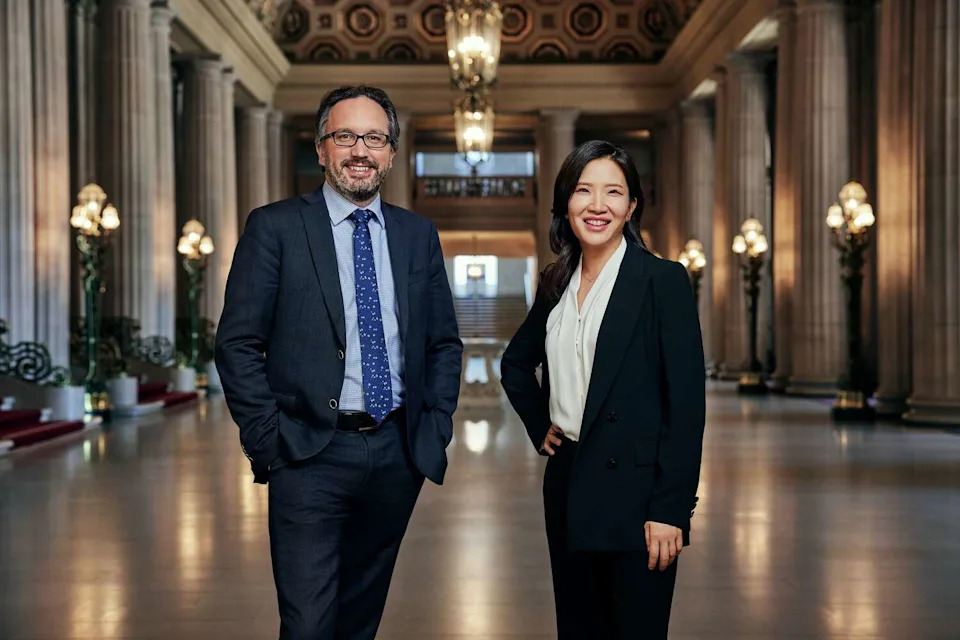
San Francisco Opera General Director Matthew Shilvock, left, and Music Director Eun Sun Kim. (Cody Pickens/San Francisco Opera)
The cycle’s three leading roles have been entrusted to eminent Wagnerian singers. The American soprano Tamara Wilson is set to make her company debut as Brünnhilde. Baritone Brian Mulligan, a San Francisco Opera regular who sang Amfortas in this fall’s production of “Parsifal,” will appear as Wotan, the king of the gods, and New Zealand tenor Simon O’Neill is slated to sing Siegfried.
Casting for the rest of the cycle’s 30-plus roles will be announced at a later date.
Mulligan was the only one of the three who was present for Tuesday’s announcement. Wilson is currently appearing in “Die Walküre” at the Paris Opera, and O’Neill is singing in a concert production of “Siegfried” in Sydney, Australia.
“Wotan’s monologues have an unimaginable wealth of detail in the score,” Mulligan said of the challenges of singing Wotan, who appears in three of the cycle’s four operas. “As a singer, I know that the more details I can bring out, the better the audience will understand what’s going on with him.”
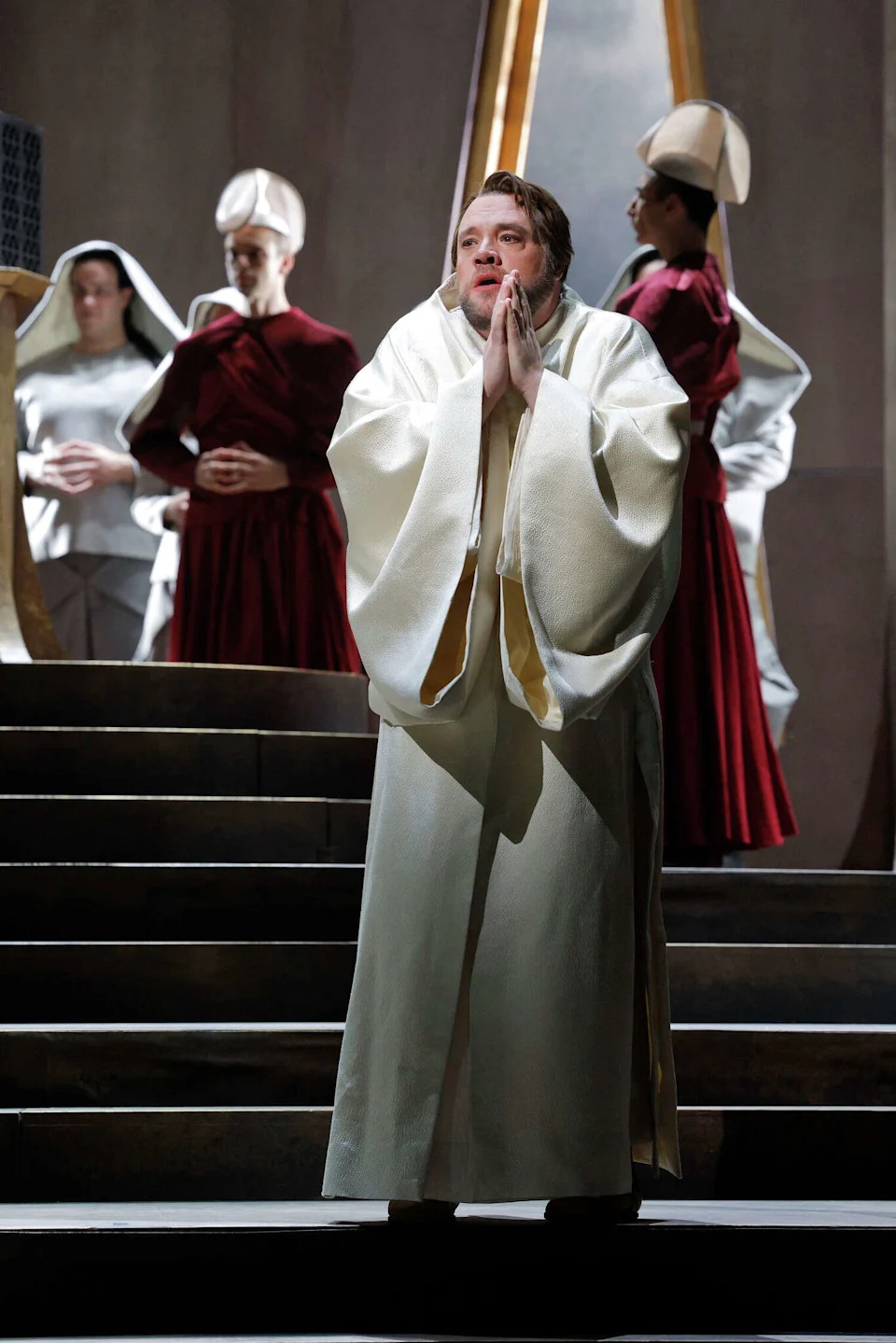
Brian Mulligan as Amfortas in San Francisco Opera’s new production of “Parsifal” by Richard Wagner. (Cory Weaver/San Francisco Opera)
Zambello’s production, a collaboration between San Francisco and the Washington National Opera, arrays Wagner’s complex tale of the struggle for power against the backdrop of American history. It begins during the Gold Rush and proceeds through chapters in the early and late 20th century before concluding in a dire futuristic dystopia.
By reimagining Wagner’s mythic world through familiar symbols of American life, Zambello sought to make complexities of the epic more immediate and accessible to modern audiences. That also helps the themes remain constantly relevant over time.
“When I began working on this production in Washington, D.C.,” she noted, “power and greed and corruption were dominating my thoughts. That’s even more true today.”
In addition to the scale, logistical complexity and expense of these operas, their length alone can be daunting. “Das Rheingold,” the first opera in the cycle, runs 2½ hours without intermission. Each of the latter three operas has a runtime between 4½ and 5½ hours.
Asked by Shilvock to suggest advice for first-time attendees, Kim chuckled and replied, “A good cushion.” Zambello advised patrons to give themselves over to the musical and dramatic flow of Wagner’s creation.
Tuesday’s event also marked the launch of the Ring Circle, a fund drive meant to raise the additional $15 million required to support the production. Those donors, with gifts starting at $7,500, along with subscribers, will have the first chance to purchase tickets for the whole package when they go on sale Oct. 13, 2026.
Cycle packages will become available to the general public in July 2027.
Leading up to the complete cycle, each component opera will be staged individually, beginning with multiple performances of “Das Rheingold” in June 2027 and “Die Walküre” that fall. Single performances of “Siegfried” and “Götterdämmerung” in spring 2028 are planned to precede the full cycles.
Amid all the extra programming that attends any production of the “Ring” – lectures, films, tie-ins and so forth – are there plans for a collaboration with the Valkyries, the Bay Area’s own “Ring”-appropriate WNBA franchise?
In answer to the question, Shilvock merely smiled enigmatically and said, “We are in close contact with them.”
Joshua Kosman is the Chronicle’s former classical music critic.
This article originally published at S.F. Opera reveals principal casting, dates for 2028 revival of Wagner’s ‘Ring’ cycle.