
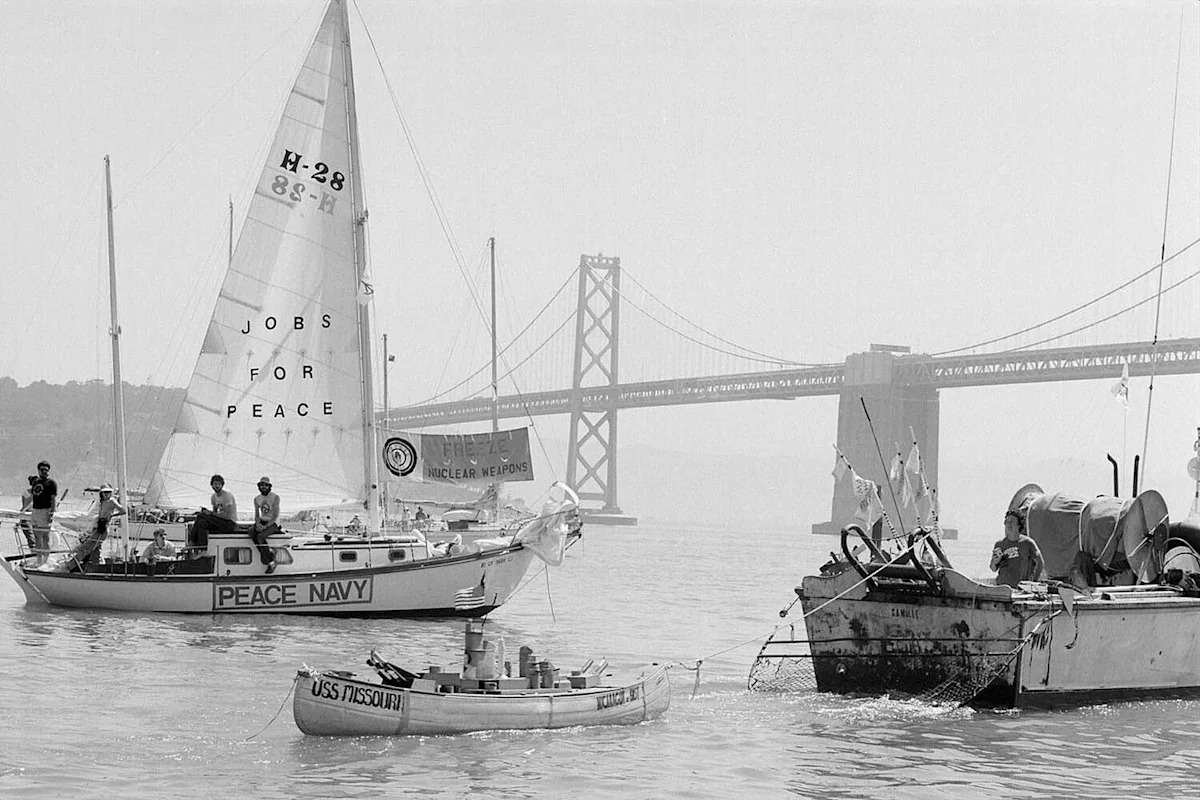
San Francisco’s Fleet Week has its critics – for every person climbing to the rooftops to watch the Blue Angels thunder over the city, there’s another bemoaning it as a waste of money, a celebration of militarism and a terror to pets. But there have been no naysayers who’ve put their words into action quite like the Bay Area Peace Navy.
Co-founder Bob Heifetz, an SF State urban studies professor, equated the group to a mix between Greenpeace and the guerrilla theater of the SF Mime Troupe.
“Our events use humor and satire to express our views depicted by the beauty of small and larger boats festooned with banners and sails carrying our message,” he wrote in an essay archived by FoundSF.
Two years after the launch of Fleet Week, the Bay Area Peace Navy was formed in 1983 by members of the American Friends Service Committee, a group whose original mission was to offer patriotic alternatives to military service during World War I. The first operation of the battalion of privately owned vessels was to attempt to disrupt arms shipments to Central America from Port Chicago north of Concord. A year later, in 1984, the group first set its sights on Fleet Week, with 27 protest boats hoisting banners in opposition to the event as the aircraft carrier USS Constellation sailed into San Francisco Bay. Despite the attempted disruption, the Peace Navy received a surprisingly warm reception from some enlisted men.
“Some of them showed the peace sign and waved at us,” group spokesperson Elizabeth Branca told the San Francisco Examiner.

Members of the Bay Area Peace Navy and Greenpeace protested the homeporting of the USS Missouri at Hunters Point in San Francisco, June 15, 1985. (UC Berkeley Library/Calisphere)
The early years of the Peace Navy saw the group protesting several different U.S. military interventions. In 1984, the group circulated mock warning letters declaring that mines had been laid in the Port of San Francisco, a response to CIA mining off the coast of Nicaragua. The same year, it also staged a fake invasion of Angels Island to protest American actions in Grenada.
In 1985, members of the group traveled to Nicaragua in defiance of the U.S. support of Contra guerillas. A year later, the group demonstrated at Pier 39 and Fort Mason against off-shore drilling and amassed a group of 100 boat owners to protest the docking of the USS Missouri, the battleship on which Japan formally surrendered, ending World War II. The Peace Navy described its objections in a letter to the Chronicle.
“Our mayor’s flag-waving, public relations extravaganza promoting this military presence paints the present in the colors of World War II’s battle against fascism, thereby desecrating the memory of those who fought and gave their lives for that cause,” wrote Heifetz.
Although much of the group’s defense of its mission happened in newspaper editorial pages, its activities also brought it into a courtroom. After the military tried to create a 75-yard security zone around a pier during Fleet Week for fear of a terrorist attack, the Peace Navy objected, stating that its banners, peace songs and guerrilla theater performances would not be discernable from the shore, thus violating the group’s First Amendment rights. A federal judge ruled in favor of the Peace Navy, allowing it to sail within 25 yards of the Aquatic Park during Fleet Week festivities.
“[If] the government can keep any kind of protesters away from government officials, it would make the First Amendment a real shell,” said American Civil Liberties Union lawyer Matt Coles.

Greenpeace protesters used bungee cords to carry banners and lower themselves down to the water from the Golden Gate Bridge, photographed Oct. 21, 1988. (S.F. Chronicle/Getty Images)
The organization continued its activism throughout the late 1980s and early 1990s, including a 1988 Memorial Day collaboration with the SF Mime Troupe to stage a fake nuclear accident on a specially constructed 100-foot submarine off the Sausalito coast in support of the Disarm the Seas Campaign. By 1989, its Fleet Week flotilla grew even more, to a 100-boat protest against dumping near the shore of Alcatraz.
From 1993 to 1996, the Peace Navy launched a “Convert Fleet Week” campaign, which included redistributing large prop bags of money from its ships as a protest against the growing Defense Department budget. In 1995, it attempted perhaps its most ambitious protest piece, a 75-foot long inflatable loaf of French bread bearing the slogan “make bread not bombs” related to French nuclear testing in the South Pacific.
Historical records of the Bay Area Peace Navy mostly trail off in the late ’90s, with co-founder Bob Heifetz dying in 2001. A few scattered posts made calls to action on behalf of the Peace Navy in 2008, 2015 and 2019, but the days of dozens of vessels hoisting protest sails have passed. Nevertheless, the group’s legacy remains, even if Fleet Week persists.
“Remember, you are only up the creek if you don’t have a paddle. And you can fight fire with water,” wrote member Lincoln Cushing.
Most Read
News
| The global escape hatch attracting wealthy Californians
Food |
Beloved buffet chain to finally reopen in California in 2027
Health
| Virus that can cause polio-like illness rising in Northern Calif.
News |
Calif. woman reported missing from work found alive after 100-foot fall
Read our stories ad-free on the new SFGATE app.
This article originally published at The ‘Peace Navy’ that trolled San Francisco’s Fleet Week for years.