
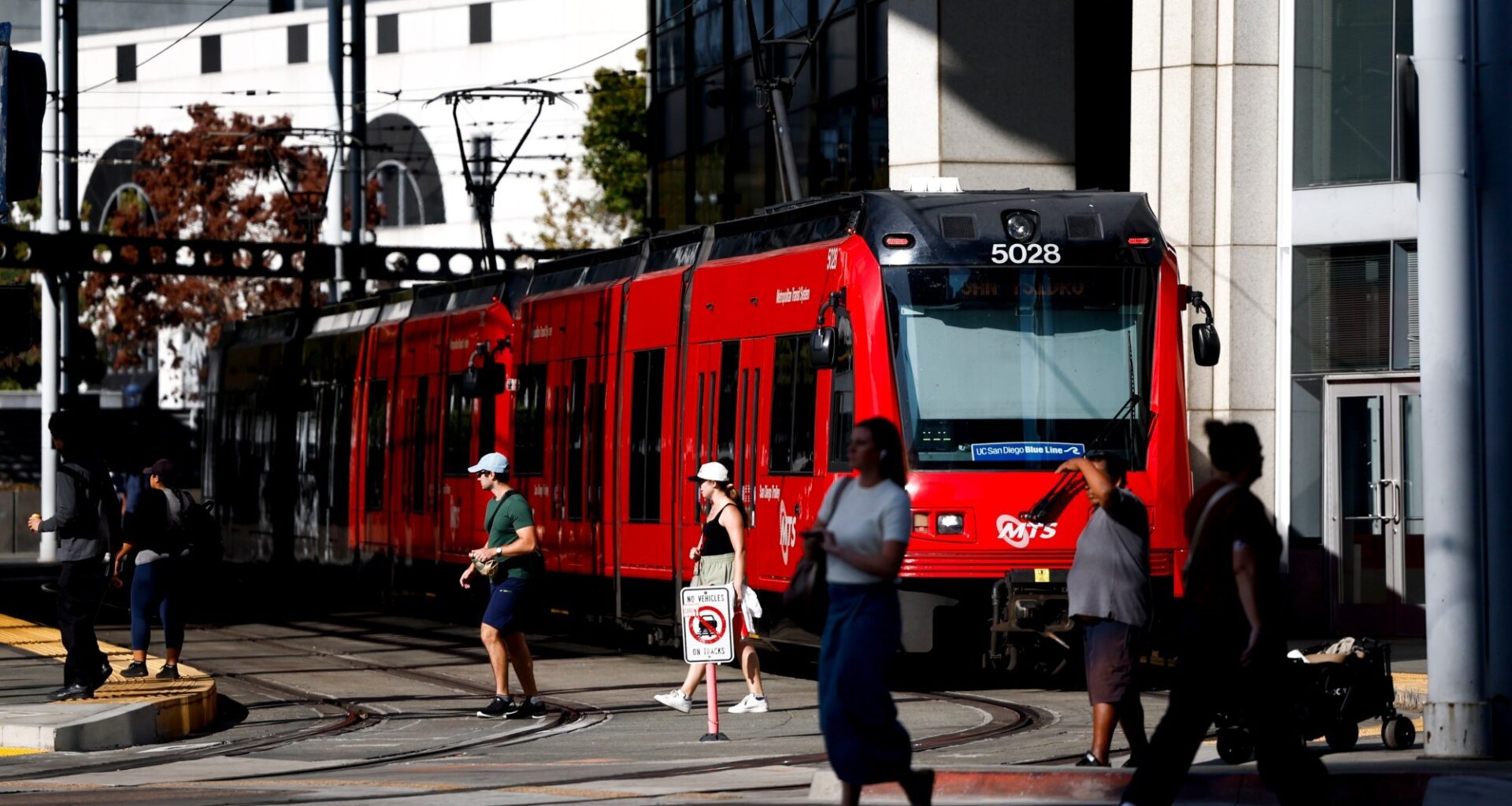
A low-profile state Assembly bill just signed into law is raising concerns that sales tax rates in San Diego County could soon rise from the 8% range toward the 10% and 11% rates seen in Los Angeles County and much of the Bay Area.
The new law — AB 2484 — marks the first time the state Legislature has given a government agency in San Diego County the kind of exemption that other parts of California have used to exceed the statewide 9.25% sales tax cap.
Local and statewide taxpayer advocacy groups say the law, which would exempt a proposed Metropolitan Transit System sales tax hike from the cap, could open the floodgates to more exemptions in San Diego County.
Since the cap was first exceeded in 2009 in the Los Angeles suburb of Southgate, it has become routine for the Legislature — lobbied by local officials — to approve steadily more exemptions in greater L.A. and the Bay Area.
“If the cap is breached in San Diego, the future could look like Los Angeles where no city is below 10%,” said Scott Kaufman, legislative director for the anti-tax Howard Jarvis Taxpayers Association.
A series of exemptions has allowed the rate in the Los Angeles County desert cities of Palmdale and Lancaster to rise to 11.75%, the highest in the nation and 3 percentage points above San Diego County’s highest rate of 8.75%.
Every city in Alameda County, which includes Oakland and much of the East Bay, has a sales tax rate of at least 10.25%. Other counties where the 9.25% cap has been exceeded include San Mateo, Sonoma, Santa Clara and Contra Costa.
Two co-authors of AB 2484, San Diego Assemblymembers David Alvarez and Chris Ward, stressed in interviews last week that the law doesn’t put San Diego over the cap; it only allows voters the chance to make that choice.
“If you can’t make your case, you won’t get the votes,” Alvarez said.
The two men, both Democrats, said the Legislature hasn’t granted any other local exemptions, so sales tax rates in San Diego County won’t be rising anywhere near 11% anytime soon.
But Ward also said he believes low sales tax rates come with a compromise. “We can be glad our rates are lower, but we’re also getting weaker services,” he said.
He said the survival of quality local transit service will probably depend on the $300 million per year that a proposed half-cent sales tax hike would generate for MTS, which is facing annual budget deficits of about $125 million starting in 2030.
Mark Kersey, chief executive of the San Diego County Taxpayers Association, said he’s worried some local politicians look at raising taxes as the solution to every problem.
“There’s definitely a concern when you look at the Bay Area that we could see those kinds of high rates down here,” Kersey said. “I don’t think voters in San Diego are going to be as willing as voters in the Bay Area to do that.”
Ward said seeking the exemption to the cap in AB 2484 wasn’t a case of laying the groundwork for a flood of other exemptions. He said it was essential to allow the proposed MTS half-cent sales tax measure, which is now tentatively slated for the November 2028 ballot, to even be possible.
Because four of the 10 cities served by MTS — Chula Vista, National City, Imperial Beach and Lemon Grove — already have rates of 8.75%, those cities are now only a half-cent below the cap.
With voters now considering a countywide half-cent sales tax hike to pay primarily for health care and public safety programs, those four cities could already hit the 9.25% cap before voters can even consider an MTS hike in two years.
In addition to next month’s county measure and the MTS measure, the San Diego Association of Governments has discussed asking voters for sales tax increases to pay for transportation projects. A proposed half-cent countywide sales tax hike to fund transportation narrowly failed in 2024.
And individual cities across the county, including cash-strapped San Diego, frequently discuss possible sales tax measures. Voters in San Diego narrowly rejected a one-cent hike two years ago.
Ward said local sales tax hikes can be true game changers because all the money stays local. Of the state’s base sales tax rate of 7.25%, most of the money goes to Sacramento, and only one cent on the dollar stays local.
When a city approves a local one-cent hike, all the additional money stays local — essentially doubling sales tax revenue in that city.
Ward said having lower sales tax rates also forces government agencies in San Diego to miss out on some statewide programs that require matching funds.
But Ward and Alvarez agreed that the timing for proposed sales tax increases is not great amid ongoing cost-of-living concerns caused by inflation and rising fees for nearly everything.
To Kersey, such concerns make a slew of sales tax increase proposals over the next few years a very bad idea.
The sales tax rate everywhere in San Diego County is at least 7.75% — the state rate of 7.25% plus the half-cent countywide Transnet surcharge to pay for transportation projects.
Voters in six of the county’s 18 cities have never approved an increase beyond 7.75% — San Diego, Carlsbad, Encinitas, Poway, Santee and Coronado. Santee voters are considering a one-cent sales tax hike this fall.
Three cities have approved half-cent hikes to 8.25% — Oceanside, Vista and El Cajon — and eight cities have approved full-cent hikes to 8.75% — Chula Vista, Escondido, San Marcos, National City, Lemon Grove, Solana Beach, Imperial Beach and Del Mar. Oceanside is also voting this fall on another half-cent hike.
And La Mesa has approved a three-quarter-cent hike to 8.5%.
The statewide cap hasn’t always been 9.25%, which is the statewide minimum of 7.25% plus a maximum of 2% in local taxes.
The Legislature first established a cap of 1% in local taxes in 1987, raised it to 1.5% in 1991 and then to 2% in 2003.
Another element of AB 2484 is establishing that the approval threshold for the MTS sales tax measure will be a simple majority — instead of two-thirds — if the measure is placed on the ballot by citizens who gather signatures instead of by the MTS board.
Alvarez said AB 2484, which was signed into law by Gov. Gavin Newsom on Sept. 27, aims to clear up some vagueness on the approval threshold for transit agencies like MTS.