
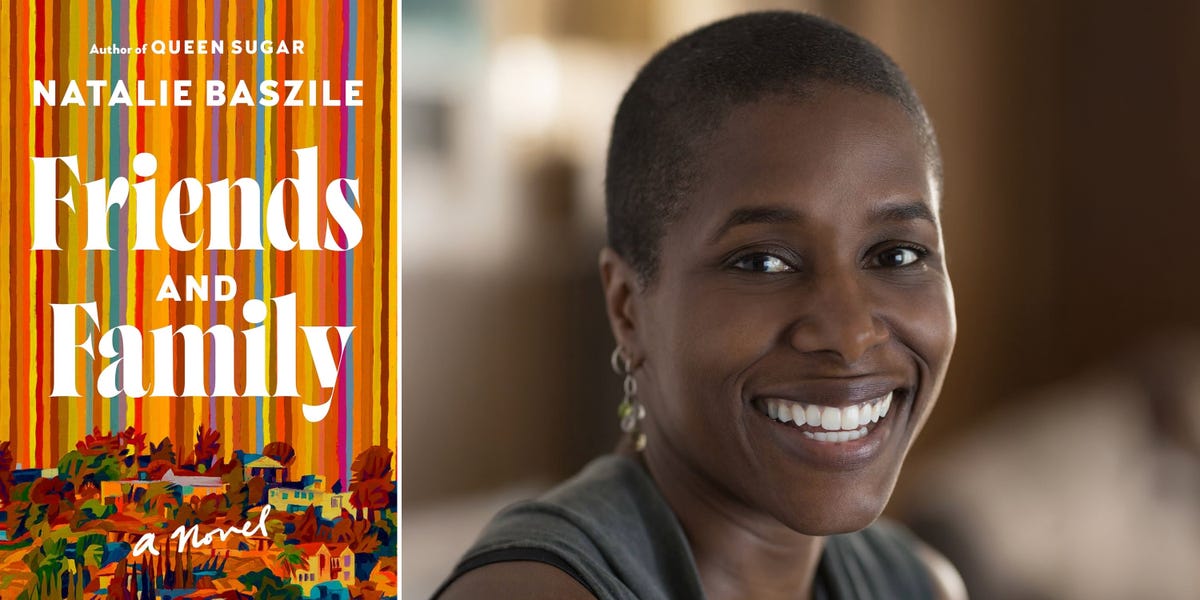
Writers find inspiration for their fiction almost anywhere. Toni Morrison was sparked to write Beloved when, while working as an editor on the groundbreaking The Black Book, she read an 1856 newspaper clipping about Margaret Garner killing her own child to prevent her from being returned to slavery. Percival Everett thought up the question that led to James while playing tennis. And shortly after an adaptation of Queen Sugar, her first novel, premiered on OWN, San Francisco Bay Area resident Natalie Baszile was taking a break from the novel she had been drafting to fly to Seattle for an anniversary trip with her husband when she received the impetus to write a different novel, Friends and Family.
“We were literally on the plane,” she recalls over our Zoom call, “strapped into our seats, when I got a call from my daughter, whom we’d given permission to have some friends over while we were away. The police had come to the house and were harassing the only other Black kid at the party, a Black boy.”
Alarmed, Baszile and her husband caught the first available flight back to San Francisco, where she observed some fascinating differences between the way her family dealt with the incident and the parenting style of the boy’s white adoptive parents.
“I knew the boy’s mother, who is British,” she says, “but didn’t know her well. I knew she was very much aware of racial issues involving raising a Black son—they’d done the work, had ‘the talk’ with him about how to interact with police—but she expressed concern about pressing forward with a grievance against the police. I couldn’t forget what she said: ‘If I make trouble, I’ll get kicked out of the white club.’ That blew my mind because I’d never really explored the psychology of whiteness, what motivates their responses in certain situations.”
Baszile’s surprise prompted her to have conversations with a wide range of adoptive parents about the challenges of raising a Black child. “I have some good friends, a gay couple, who adopted two Black kids,” she explains. “They love these kids, but they sought out Black people to bring into their circle to give their kids what they knew they could not provide.” Others she spoke with included white adoptive parents who sought out their child’s birth mother, as well as Black single mothers, all of whom sought ways to give their children a perspective broader than their own.
Soon Baszile’s other novel was shelved so that she could focus on Friends and Family, a fascinating examination of the intersection of racial identity, class privilege, and child-rearing. The novel centers on the friendship between Babbette “Babs” Holloway—a Black interior designer who lives with her husband, Galen, and daughter, Reese, in San Francisco’s diverse Inner Richmond neighborhood—and Nora Lachman, a third-generation, white San Franciscan who lives in posh Pacific Heights with her husband, Stuart, and adopted son, Nathan, who attends school with the Holloway girl. Their friendship is tested when Nathan is harassed by the police while both sets of parents are out of town.
Unlike in some contemporary fiction, the class distinctions among the white and Black characters in Friends and Family are subtle, or, as Babs calls it, “a case of the Haves and the Have Mores.” Yet those distinctions fuel the conflicts that arise between the girlfriends, as well as between Babs and Galen, over everything from marital infidelity to where to hold Galen’s 50th-birthday party to how to handle an explosive incident similar to the one that sparked the novel—one that makes Babs question the limits of her loyalties to friends versus family.
Although the Holloways seem to have succeeded, Baszile sees a clear connection between the couple and their parents’ struggles, something that is a major theme in the novel: “Babs and Galen are part of what I call ‘the integration generation.’ They’re aware of the civil rights struggles of their parents but are forging their own paths. But while they live in an integrated neighborhood [and] have achieved a certain level of success, the couple still carries that weight.”
At one point in the novel, Babs observes, “I wished we gave ourselves permission to celebrate the life we’d managed to build for ourselves.… We should have found more ways to celebrate our progress, but there was always another job to do, another hill to climb. We were always pushing, pushing, pushing.”
Babs’s journey, then, becomes one of how to reconcile the rage and burden she and her husband feel carrying what she calls “the invisible suitcase” of “hopes and dreams, our fears and memories; the one peculiar to being Black in America.”
Those feelings were front and center for Baszile as she was writing the novel through the COVID-19 pandemic and the protests that followed the murder of George Floyd and its aftermath. “I had a lot of backyard conversations in those days,” she recalls, “which gave me a chance to express the rage I was feeling, as a Black woman, at having to carry that suitcase. As I was writing, I thought, if I was thinking about these ideas, there had to be other Black women who were dealing with them too.”
Friends and Family will strike that chord for many readers, while being a revelation to others. One can imagine book clubs—especially interracial ones—talking about the invisible suitcase, the barriers that race and class present when one is responding to charged situations, and even the dynamics that race presents in intimate relationships. Nothing is off-limits for Baszile’s thoughtful inquiry, although the novel is firmly grounded in Babs’s perspective.
“Originally, I thought that I would tell the story in ‘Babs chapters’ and ‘Nora chapters.’ But I realized that Babs needs to tell this story, to be our guide. We need to hear the voice of this Black woman,” Baszile says. “And while I did have some fascinating conversations with my white friends about their experience of whiteness, which I could see from the outside, I didn’t know it from the inside because it’s not my experience.”
What results from that focus is a powerful novel that is different from Queen Sugar and We Are Each Other’s Harvest, Baszile’s 2021 nonfiction anthology about African American farmers, which spawned a documentary film she and her daughter produced that she’s currently shopping for a distributor. But what unites all of her projects is a love of place, which Baszile, who was born in Los Angeles, was keen to explore in Friends and Family.
“I love and appreciate L.A.’s grit and hustle,” she admits, “but my soul is at peace in the Bay Area. I wanted to capture how stunningly beautiful it is here. Whether you’re in the city—which is beautiful if it’s foggy, if it’s rainy, if it’s sunny—or Napa, or Marin, or Oakland. They’re all so different. And so the challenge for this book was, How do I convey all of the beauty and the magic of this place that is akin to the beauty and the magic of south Louisiana? To be able to really celebrate the beauty and the magic of the Bay Area, I just felt it would make the novel distinct.”
For its evocative sense of place and unforgettable characters, Friends and Family is a marvel. And what of that project Baszile put down to take up this challenge? “I’m seriously considering going back to the book I shelved.”
Readers will be waiting.•
FRIENDS AND FAMILY, BY NATALIE BASZILE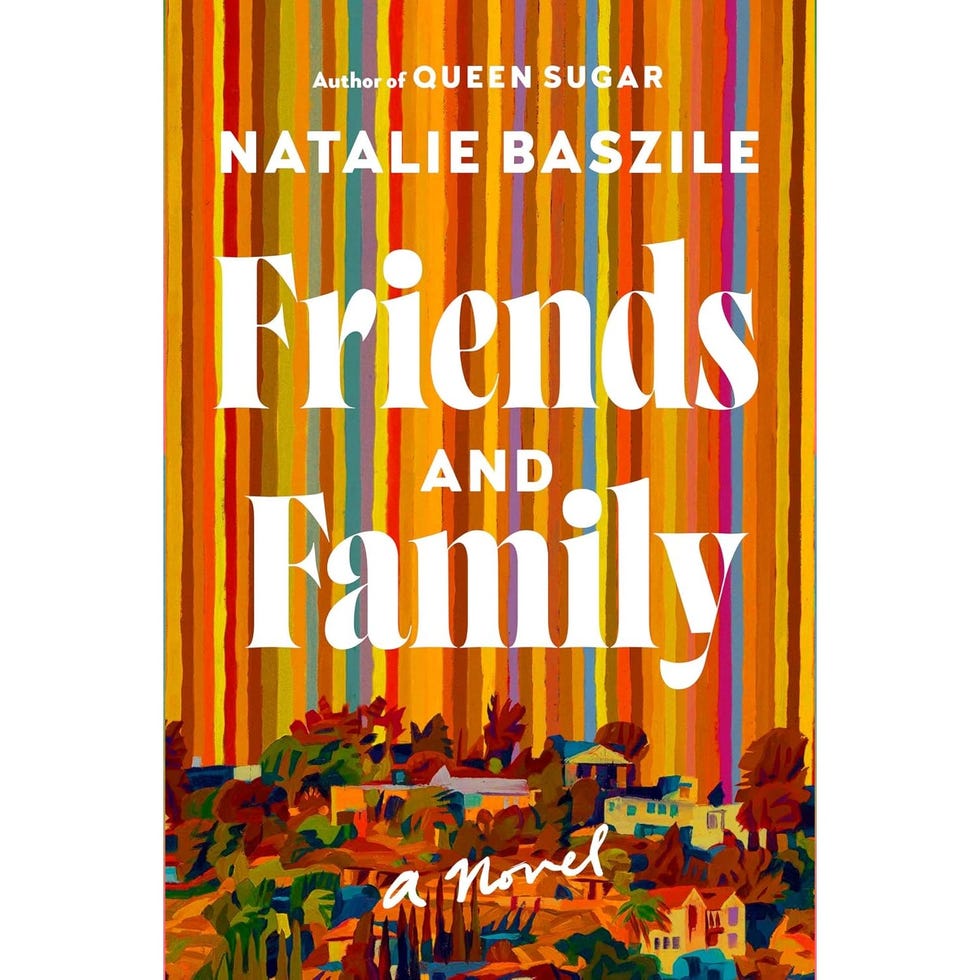 FRIENDS AND FAMILY, BY NATALIE BASZILECredit: Pamela Dorman Books

Paula L Woods is an author, editor, and contributor to Alta Journal, as well as a regular contributor and crime fiction columnist for the Los Angeles Times.