
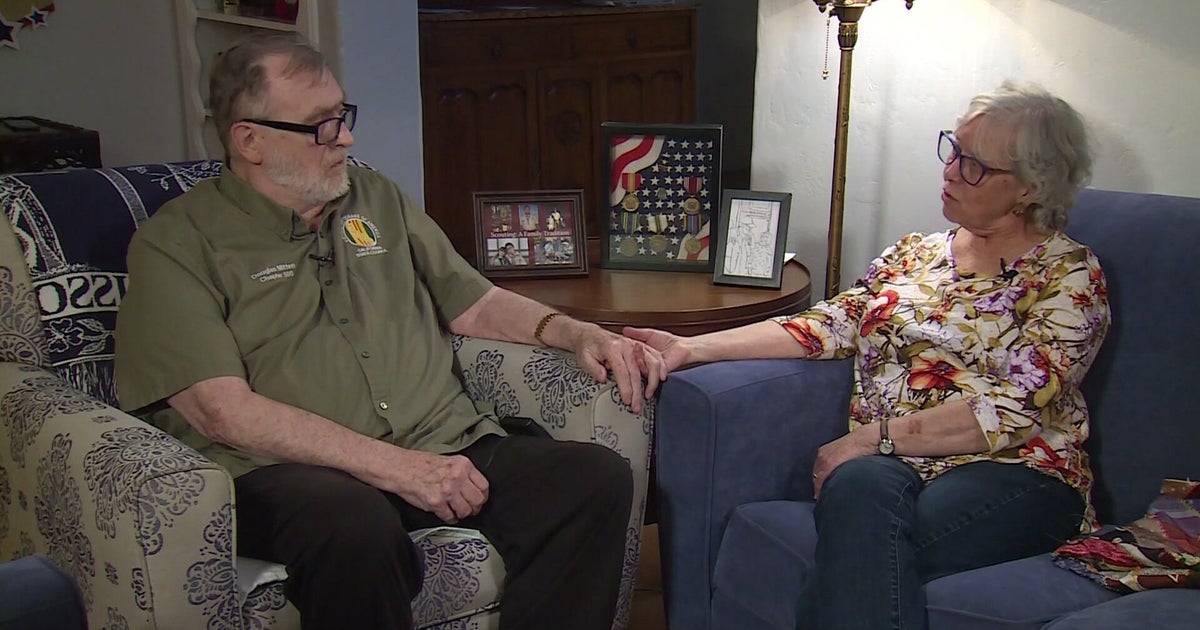
On this Veterans Day comes a sobering reminder: veterans struggling with post-traumatic stress disorder (PTSD) have almost double the risk of developing some type of dementia, according to the Alzheimer’s Association.
Hoping to bring awareness that treating PTSD early on can help reduce the risk of dementia is one Sacramento family, who wishes they had known that sooner.
“It would not have eliminated all the risk, but it would have helped, I think,” Deborah Franklin said.
Franklin is the full-time caregiver for her husband of 38 years, Doug Mitten.
“Your relationship changes as you feel less like a spouse and more like the caregiver. For somebody that’s had a pretty long marriage, passionate, romantic, we love spending time together. To lose that companionship is very difficult and sad. You know, there are days I just cry,” Franklin said.
Mitten is entering the late stages of his Alzheimer’s diagnosis, after seeking treatment for the disease back in 2020 and first noticing signs of cognitive decline in 2017.
Franklin advocates that early action, for both dementia and PTSD, can make all the difference.
“The one thing you know about Alzheimer’s dementia is today, it’s probably the best day. From now on, it’s just going to get worse,” said Franklin, as she and her husband take things day by day. “It is very painful, because you see their abilities diminishing.”
Franklin laid out all the keepsakes of her husband’s military service on the dining table for him to see on Veterans Day, November 11.
From medals to pins to pictures and hats, the mementos help him remember his time serving in the United States Army during the Vietnam War.

Doug Mitten, 1969
Mitten served for two years. He enlisted to become a chaplain’s assistant, but was instead trained to become a sniper.
“Most of Doug’s PTSD comes from being a sniper and getting involved because he was such a good marksman, being involved in Army intelligence. There’s a lot of things that happened there, some probably are still classified, and it was very difficult,” said Franklin. “He certainly believed in the idea that you don’t kill people. He enlisted to be a chaplain’s assistant, where he wanted to help people. He ended up with assignments that he felt were very counter to that.”
Franklin’s father served in World War II. He got a college deferment but decided to enlist in 1968 to serve his country.
“My mother just had a fit,” Mitten remembered.
As is true for so many Vietnam War veterans, he returned a different man.
“They’d come back, and they were they were booed, they were spit on,” said Franklin. “There was a lot of talk about survival guilt. They felt bad because they made it back. A whole lot of them didn’t. Doug wanted nothing to do with the military ever again when he got home.”
That included seeking out any treatment for his PTSD. The issues from the undiagnosed disorder were obvious as soon as he returned home.
Still, he wanted to bury those feelings.
PTSD was first officially recognized as a mental health condition in 1980, just five years after the end of the Vietnam War.
“I wasn’t really convinced that this is what I should do,” Mitten said of seeking out PTSD treatment.
“And it took a long time, because it is excruciatingly painful work,” Franklin added.
It took him 40 years and a lot of counselling to finally take that step and get help.
“I think when you first got out, you felt bad about what you had done and you wished you hadn’t done some of the things that you’d been ordered to do,” Franklin reminded Mitten.
Mitten wanted so badly to tell CBS Sacramento his story on his own and in his own words.
“This damn disease,” he said, struggling to keep his train of thought.
He leans on his loving wife when he struggles to finish his own sentence.
“Do you wish you had gotten involved in PTSD treatment earlier?”
“Yeah,” he responded. “Go to get help.”
Franklin encouraged her husband to seek out PTSD treatment around the year 2010, which she says did make a huge difference in their lives.
Mitten had also become very active in the Vietnam Veterans of America organization, even serving as the chair of the organization’s PTSD committee.
Talking with other veterans about the pain also helped him find healing.
“I think you were finally able to understand how important your service was and what a commitment you’d made and what a personal sacrifice it was that you should respect. Yes, does that sound right?”
“Yeah,” Mitten agreed.
Franklin says knowing what she knows now about the increased Alzheimer’s risk associated with PTSD, she would have pushed her husband to seek out treatment much sooner if she could just rewind the clock.
Despite it all, in the face of a daunting diagnosis, sacrifice shines through.
“We are going to continue to do things until it’s proven that we can’t. For me, that gave me a lot of good memories. Even though Doug doesn’t remember them, I’ve got those memories, and I can share them back with him,” Franklin said.
In the end, dementia may win the battle, but love wins the war.
Franklin credits getting connected with a lot of local resources through the Veterans Affairs department, the Vietnam Veterans of America organization, and also Alzheimer’s support groups like the Alzheimer’s Association, the Alzheimer’s Aid Society and the Del Oro Caregiver Resource Center for helping them navigate difficult times.
Resources for veterans with PTSD can be found on the Alzheimer’s Association website.