
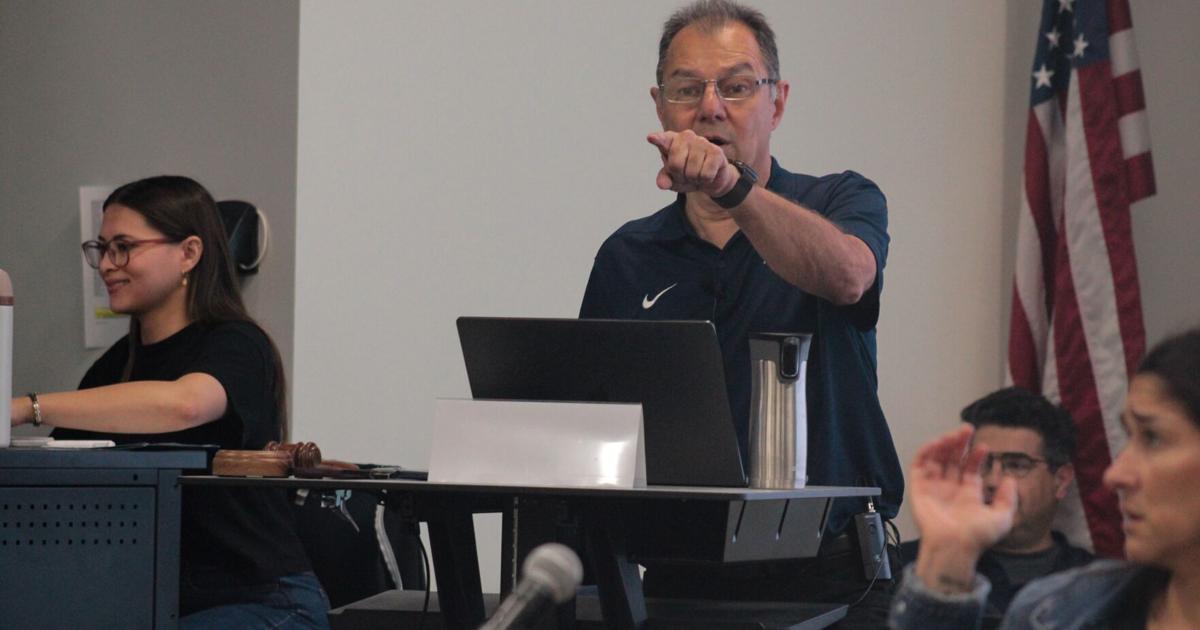
During Thursday’s Academic Senate meeting, Cal State Fullerton academic senators raised concerns regarding the logistics of the upcoming pedestrian bridge project.
The pedestrian bridge, slated to begin construction on Oct. 19, aims to reduce danger and improve traffic flow at the Nutwood Avenue and Commonwealth Avenue intersection and to connect the campus more effectively.
Construction is expected to take over a year and is expected to open in 2028, with the main bridge built off-site, leaving the ramps and stairway access areas to be built on-site.
“We will be building the ramps on-site. It’s the bridge that spans Nutwood Avenue that will be built off-site and then put in place,” said Director of Planning, Design and Construction Laura Riegler.
The majority of the project, about 80% to 85% of it, according to Academic Senate Chair Amir Dabirian, is funded using federal, state and county dollars, with $10 million in federal support from Congressional Community Projects, one million from the state and $500,000 from the county.
This intersection is among the most dangerous near CSUF for both cars and pedestrians.
According to the project website, more than 10,000 students cross Nutwood Avenue daily. The website reports that Nutwood Avenue was the site of 23-injury related traffic accidents, 43 non-injury accidents and nine arrests for driving under the influence in 2015 and 2016, not including unreported near misses.
According to Fullerton Police Department Public Information Specialist Kristy Wells, the intersection’s location near the university may impact the level of traffic incidents that occur.
“The intersection of Commonwealth Avenue and Nutwood Avenue experiences a high volume of pedestrian and vehicular traffic due to its proximity to the university,” Wells wrote in an email to the Daily Titan. “This activity may create more opportunities for traffic conflicts.”
Wells also noted that volume alone does not establish the cause of collisions.
Some academic senators raised concerns regarding short-term pedestrian safety in the project.
Academic Senator Matthew Jarvis noted the overlap in construction between the bridge addition and the existing construction for Landmark Hall, which began last August.
He also cited concerns about concentrated foot traffic, referencing an e-scooter incident where a student was seriously injured in a collision in September.
“The foot traffic is going to be restricted, and it’s going to be in really one place, and we have not yet solved the issues of those e-scooters,” Jarvis said. “But I think it’s going to be particularly problematic while both of those construction projects are going on at the same time.”
Along with safety concerns, senators cited worry about parking displacement.
At College Park, 61 spaces on the north side are to be temporarily relocated and reassigned to the south side, according to Monica Chavez, associate director at Parking and Transportation Services.
“We’re ready to start within the next couple weeks to start our site logistics that will be going out to the whole campus,” Riegler said. “There’s a plan for what will be fenced off and what we’ll be impacting.”
According to Riegler, these fenced-off spaces on the north side are primarily to make way for construction parking.
Chavez also mentioned that Parking and Transportation Services is working on mitigation efforts for students, including using off-site leasing locations for students during construction.
“Anything pedestrian, walking-friendly is a plus,” said fifth-year marketing major Jesus Marquez. “We live in a car-centric country, so anything that we can do that benefits pedestrian traffic is a plus.”
Construction for the project is slated to begin on October 19.