
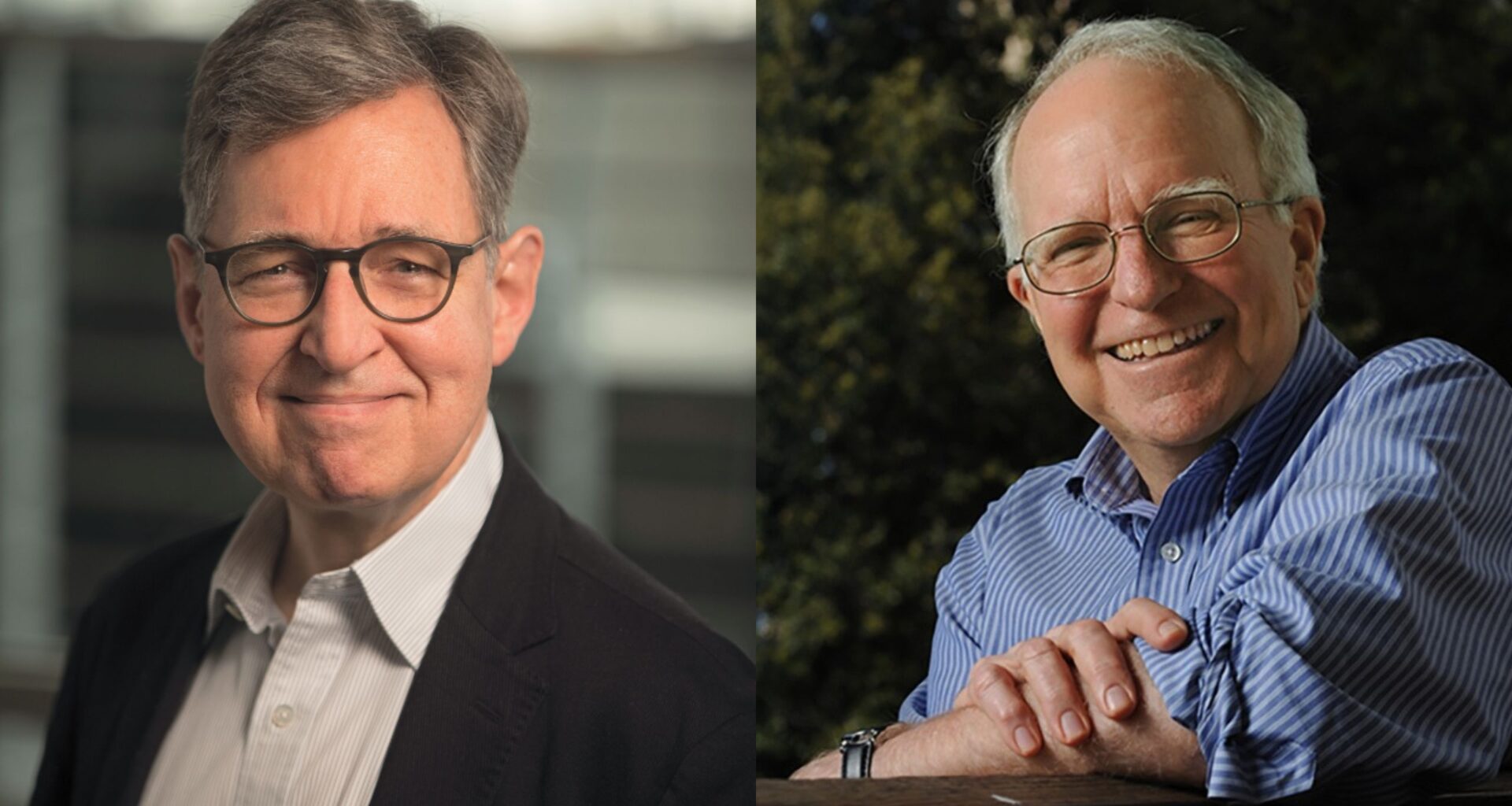
When the Royal Swedish Academy of Sciences today announced the two winners of Sveriges Riksbank Prize in Economic Sciences in Memory of Alfred Nobel, the UC Berkeley economics community celebrated them as scholars who have achieved the heights of economic influence — and as colleagues with deep connections to the campus.
Robert E. Hall was an accomplished young scholar who earned his bachelor’s degree at UC Berkeley in 1964, and served on the economics faculty from 1967-1970 before moving to MIT and then to Stanford University. Michael Woodford, a scholar at Columbia University, was a deeply important teacher and mentor for some of Berkeley top young faculty economists even before coming to Berkeley as a visiting scholar last year.
Their remarkable careers, capped with the Nobel announcement yesterday, underscore the historic, extended influence of the Berkeley economics department in the 1960s — and affirm that Berkeley today is a robust center of contemporary economics, attracting some of the world’s most important scholars.
“The prizes announced today really speak to the continuing influence of the Berkeley Economics Department, both at the undergraduate, graduate, and faculty level,” said department chair Stefano DellaVigna. “Bob Hall started as an undergraduate student here and was also faculty. Mike Woodford has close ties with our macro and behavioral faculty of today. We are delighted with the strength of our department both historically, and at present.”
Six Berkeley economists have previously won the Nobel: David Card (2021), Oliver Williamson, (2009), George Akerlof (2001), Daniel McFadden (2000), John C. Harsanyi (1994) and Gérard Debreu (1983). Notably, James A. Robinson of the University of Chicago won the prize in 2024, honored in part for work on development economics that he had done from 1999-2004 while on the Berkeley faculty.
The Swedish Academy this year honored Hall and Woodford for what their scholarship tells policymakers about stabilizing the economy in turbulent times.
“The laureates’ work has provided us with a stable theoretical foundation for the models that are now used by central banks and governments around the world,” said John Hassler, chair of the academy’s Committee for the Prize in Economic Sciences. “With them, we are better equipped to deal with shocks in the economy, such as energy crises or sudden changes in how much households consume.”
A gathering of titans
Hall, now 83, was born in Palo Alto. His selection crystallizes how profoundly important the 1960s were for Berkeley economics — and how the influence of that era resonates even today.
The prizes … speak to the continuing influence of the Berkeley Economics Department, at the undergraduate, graduate and faculty levels.
Stefano DellaVigna
It was an extraordinary time, a gathering of titans. Debreau and Harsanyi were senior professors. Dale Jorgenson was on the faculty in that era; he’d won the John Bates Clark Medal, seen as the second highest honor for an economist, and was seen as a Nobel contender.
Williamson, McFadden and Peter Diamond were all young assistant professors, and Diamond would later win a Nobel while at MIT. Hall’s fellow student and Class of ’64 graduate, Thomas J. Sargent, would win the Nobel in 2011 for research on cause and effect in macroeconomics.
Even as an undergrad, Hall was making innovative contributions. He began research with Jorgenson that would lead to the seminal 1967 paper, “Tax Policy and Investment Behavior.”
The paper was “an instant classic,” said Michael Reich, who joined the Berkeley economics faculty in the fall of 1974 and now serves as Chair of the Center on Wage and Employment Dynamics. “It was required reading when I took a public finance class at Harvard in 1968, and it is still cited as a major contribution.”
Even after landing at Stanford, Hall maintained connections at Berkeley. For example, he delivered a talk at the centennial celebration of the economics department in 2002 and gave the department’s commencement address in 2006, when it was chaired by Ben Hermalin, now Berkeley’s executive vice chancellor and provost.
Woodford’s connection to Berkeley is more recent. Now 71, he arrived at Columbia by way of the University of Chicago, Yale Law School and MIT, where he earned his Ph.D. For the 2025-26 academic year, Woodford was a visiting scholar at UC Berkeley.
‘An amazing colleague’
“He is intellectually close to all of our macro group and also to the behavioral group,” said DellaVigna. “One way to think of his recent work in this area is that he builds on evidence from cognitive science and neuroscience on how people actually process information, and is able to show that getting that right really matters for understanding how people would process macroeconomic information, such as on inflation or economic growth.”
Woodford also spent time on the faculty at Princeton — that’s where he served as undergraduate thesis advisor to Emi Nakamura and Jón Steinsson in 2000 and 2001. Both are now on the Berkeley faculty.
Nakamura credits Woodford with encouraging her to focus on macroeconomics; she won the Clark Medal in 2019.
“The questions he asked about monetary policy were so interesting that it changed how I thought about economics as a whole,” Nakamura recounted. “As a thesis advisor, he was incredibly generous. I remember when I was working on my undergraduate thesis, struggling to understand the logic of one of the standard equations in the model, I sent him an email on December 24th, not expecting to hear back, of course. But he did write back — and really helped me understand what these equations were meant to represent.
“Later on in my career, I became increasingly aware of the impact that his work on monetary policy had on practical monetary policymaking around the world. My guess is that his research has had more practical impact on policymaking than almost any other economist. Anyone who visits a central bank almost anywhere in the world today is aware of this.”
After her studies, Nakamura joined the Columbia faculty, where Woodford became an important colleague.
“I remember a number of conversations I had with him at critical points in my own research, where he gave me some insight or encouragement that made a big difference,” she said. “Sometimes it was just a short conversation, but sometimes it was an insight that made all the difference. He was an amazing colleague to have.”