
In honor of Banned Books Week, the Cal State Fullerton Pollak Library held events from Monday through Thursday to highlight banned books and curriculum censorship.
The first event to kick off the week was Movie Monday with the showing of the film “Banned Together: The Fight Against Censorship.”
The film, which follows three student activists, highlights two controversial topics across America — book bans and curriculum censorship in public schools.
When taking steps to putting an end to curriculum censorship, Rachel Riter, education librarian for the Pollak Library, stresses the importance of activism in your community.
“Voting is coming up,” Riter said. “Making sure that you are involved in your community, meaning that you are registered to vote and you are voting timely.”
She also recommends going to public libraries, as they thrive and survive on checkouts.
“The more people are using their libraries and doing active requests for things, you’re exposed to a lot of different information,” Riter said.
Out of the 11,000+ instances of book bans from July 1, 2025 to June 30, 2026 across America, 87% of the books were fiction. Through reading fiction, Riter expresses how parents can gain empathy and understanding so that they aren’t afraid or have fear based on “What if my child read this?”
“Literacy is not just reading; it’s the comprehension and the critical thinking that goes along with it,” Riter said. “When you read a book, how did it change? Did it impact you? Do you now understand someone different?”
The film, “Banned Together,” touched on these literacy issues and how books with darker storylines are misinterpreted and misconstrued. At one point, students in the film discuss how a book is attempted to be banned because it contains sexual assault content and is considered pornagraphic.
“How do you feel as a college student when stuff that you want to study, that you’re paying to be there to study, you no longer have access to that information?” Riter said. “We want people to know that just because we’re in an area where it’s not as big of a deal, it still is.”
She emphasizes how academic institutions ultimately impact each other, and can have an effect on academic freedom as well as what we may read one day.
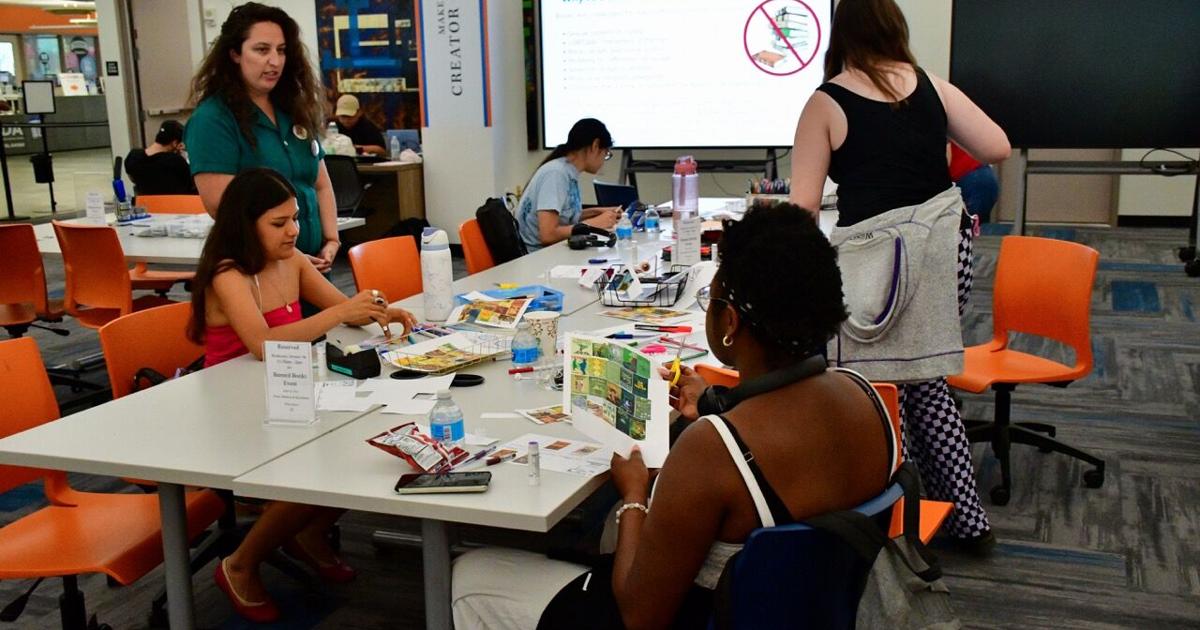
For Wednesday’s event, the library held a zine workshop, where students were welcome to create zines inspired by banned books, censorship, freedom of expression and the freedom to read. Tables were displayed with materials such as paper, scissors, colored pens and a QR code that detailed a tutorial on how to fold and construct the zine itself.
This experience offered students an interactive opportunity to both participate in a fun craft, but also get a better understanding of what banned books week is all about.
“We live in America, and there’s a lot of different viewpoints, a lot of different cultures and backgrounds,” said Kellie Lanham, art and Makerspace librarian at CSUF. “I think we see that coming into libraries and educational spaces.”
Pre-made book cutouts as well as paper layouts with cutting instructions were ready to go for students, including prompts such as “I can’t believe this book was banned” and “I learned something new from…” The purpose of the prompts were to guide students throughout the craft, giving them ideas of what to write as well as where to paste the given book cutouts.
In addition to the zine craft, there was a button station where students could make their own unique banned book related buttons, adding to the spirit of the event. Free stickers, snacks and water were also available.
To conclude banned books week Thursday, the library held what they called a “readers advisory,” where librarians hosted a table to allow students to get different kinds of book recommendations from them. A lot of the books recommended were either banned or challenged, but generally there was a variety of options for students to choose from.
The event took place in the library’s lobby which displayed banned books, offered photo opportunities and had a game for different reasons why certain books have been censored. The purpose of the game was to navigate why someone felt a certain book was banned.
This took place on a blackboard where various images of books, such as “Animal Farm” by George Orwell, were propped for the person playing to see. Then, prompts were written on white velcro cards that, depending on the person’s decision,were to be stuck underneath any of the displayed books.
“I hope people come to all the events and learn about what’s happening. Because even though you may feel it’s not happening to us particularly, it’s still happening,” said Brenda Patino, marketing communications professional at CSUF. “We support the freedom to read all types of books and we have a display of banned books/challenged books that the more we read them, the more we take a stand for it.”