
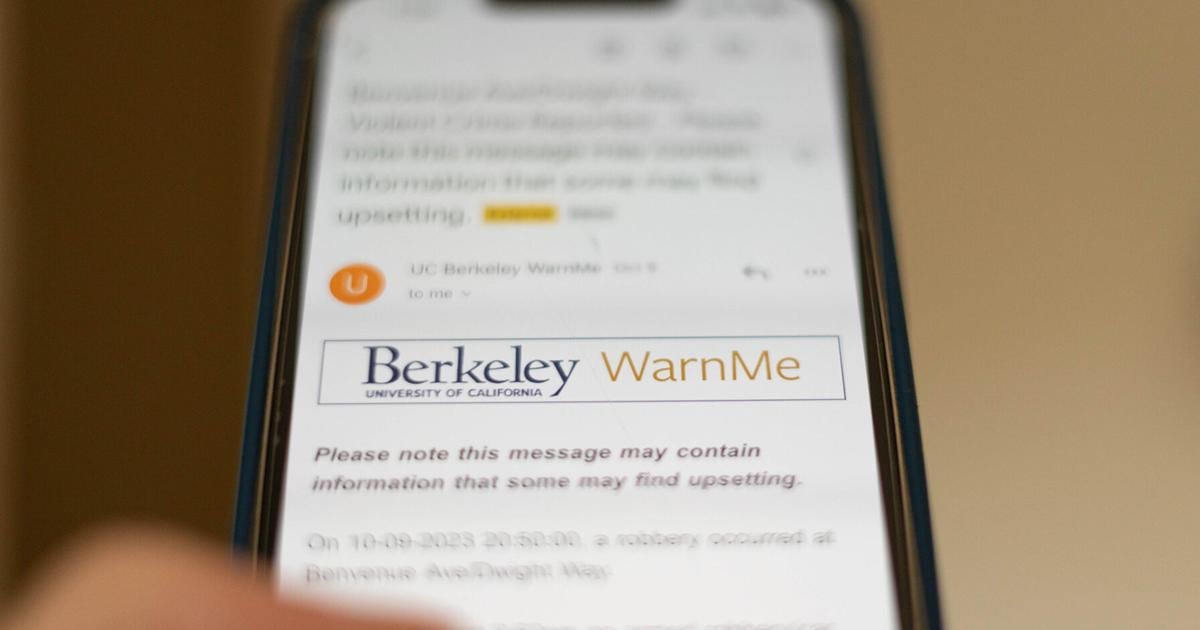
WarnMe cannot operate on Berkeley Time.
On the morning of Friday, Oct. 2, two individuals were fatally shot on Panoramic Way, just across from the Oakland-Berkeley border. Authorities received initial reports of gunfire at 10:48 a.m. and promptly rushed to the scene.
For nearly two hours, no one knew who and where the shooter was, hearing only whispers from friends, Slack channels and club leadership amid the whirring drone of helicopters circling Berkeley’s Southside.
It wasn’t until 12:35 p.m. that UC Berkeley released a WarnMe announcement, stating that there was an “ongoing police investigation.” By then, the danger had dissipated.
This is not the first time that UC Berkeley’s WarnMe proved ineffective. In 2024, WarnMe left students in the dark by failing to promptly send a notification of a shooting on campus for more than 40 minutes. The Daily Californian Editorial Board demanded then that UC Berkeley improve the WarnMe system and accelerate its notifications. We ask the same now.
Today, WarnMe’s shortcomings remain unresolved. And as its Oct. 2 response proved, its aberrant shortcomings have only worsened.
We, the UC Berkeley community, have the right to know what is going on in our neighborhoods — and we have a right to get that information from our community leaders and the alert system that is meant to distribute it.
Police investigation concluded that the shooting took place in an Oakland residence, and UC Berkeley subsequently determined that the shooting posed no danger to the campus community.
However, students undoubtedly felt they were in danger. UC Berkeley students did not know whether to believe the shooting rumors or not. Collective panic arose from hallway gossip and anonymous Yik Yak posts, and anxiety bred from uncertainty and ignorance. An email simply stating that there was a shooting reported on the Berkeley-Oakland border, that a police investigation was ongoing and that there was no active threat to campus at the moment, would have sufficed.
On Friday, Oct. 2, UC Berkeley completely misunderstood the purpose of the WarnMe; an emergency notification is not a verdict, but a precaution. We have a right to know what is going on, especially when withholding vital information creates an environment of panic.
A timely warning is better than none at all. As it stands, WarnMe has become InformMe, offering students a brief summary of violent crimes and threatening activity well after the dust has settled.
Campus spokesperson Janet Gilmore told the Editorial Board that a WarnMe community advisory was only issued because “members of our community were under the impression that the campus was in danger and that such misinformation was spreading across campus.” The shooting in Oakland “did not meet the threshold for an emergency notification or for a timely warning.”
But a late announcement prevents nothing. It offers no solace to frightened students and, crucially, it does not offer them a chance to find safety. If the WarnMe truly wanted to ease anxiety on campus, it should not have waited until the anxiety had already been assuaged, campus community members relying on third-party sources such as Instagram and Yik Yak to ease one another’s worries.
The Editorial Board has addressed this once, and is disappointed that it must address it again.
The first step toward public safety is access to information. When dissemination of exigent information is delayed, students are not able to take the necessary safety precautions necessary to prevent themselves from harm and panic.
Trust is built upon communication, and students should be able to place their trust in campus rather than in third-party platforms, such as Yik Yak or Instagram. It is not the police’s prerogative to judge what information is worth relaying — a student should simply be given sufficient information to make a judgment call themselves.
One day, a delay like that Friday’s may be the difference between a student reaching safety or not.
If campus and UCPD truly strive to protect and gain the trust of the community they serve, the first step they must take is to communicate potential dangers to students as soon as a report is received.
Post hoc community advisories are simply not enough. We demand proper communication from the very system that is tasked with disseminating such information.