
If one asks Sato Academy Principal Chris Thompson what is working so well at the Long Beach school, he doesn’t hesitate.
“What’s working well is collaboration,” Thompson said. “The teachers, the staff, the students, and the families, everybody comes together with one goal, and that’s to lift up our learners and help support them in becoming successful not only here at Sato, but beyond.”
Eunice Sato Academy of Math & Science ranks No. 46 among California public high schools and No. 322 nationwide in U.S. News & World Report’s 2026–27 Best High Schools rankings. U.S. News evaluated about 27,000 eligible public high schools across the country, using measures that include state assessment performance, graduation rates and college readiness.
Collaboration has built Sato’s academic program around rigorous engineering and biomedical pathways, hands-on learning and systems designed to identify students who need help before they fall behind.
Sato serves students in grades nine through 12. Now in its 11th year, the school combines demanding academics with more access to teachers, greater responsibility for students and opportunities to apply what they learn to real-world problems.
Thompson calls the culture Sato’s “secret sauce.”
“The secret sauce to Sato is the professionalism and collaboration of our staff,” he said. “We have a built-in structure here where our teachers, at least two days a week, have the opportunity to collaborate with one another to work in support of students.”
Period 8: Time to ask for help — and time for teachers to talk
One of the most important pieces of that structure is something called Period 8.
On Tuesdays, Thursdays and Fridays, students have a 45-minute block they can use for teacher office hours, tutoring, making up work, collaborating with classmates or using school technology and equipment for projects.
Teachers also have dedicated collaboration time to plan curriculum and, importantly, talk about individual students.
“It’s not just the students that are here to learn, the teachers are also lifelong learners,” teacher Hajra Saeed said.
Saeed said teachers don’t operate in silos. If she notices a student becoming disengaged, she can bring it to other teachers to determine whether they are seeing the same thing.
“If I’m having trouble with a student in the class, maybe they don’t look like they’re engaged in class,” Saeed said, “then I’m wondering, is this a me issue in my classroom or is this across a grade level?”
During collaboration time, teachers compare what they are seeing.
“The other teachers say, ‘Oh, yeah, I see this situation, too, in my class,’” Saeed said. “So we discuss what’s going on in our classrooms.”
Then they look for a solution.
“Perhaps the student needs to find, you know, a peer that they can work better with,” Saeed said. “Or maybe there’s something going on at home that we need to support them with.”
Sometimes the intervention is immediate.
“Sometimes we will even pause the meeting and call up the parent during the meeting time,” Saeed said. “Because all the teachers are there, and we’ll have a conversation with the parent. What can we do to help support your child better?”
Thompson describes the idea more simply.
“Everybody’s plugged in,” he said. “Everybody knows every student. No one slips through the cracks.”
Students say the system works
Senior Zachi Ozude said she takes advantage of Period 8 when she needs it most.
“My most difficult weeks are definitely finals week,” Ozude said. “So in the weeks leading up to it, I’m always in Period 8, asking questions, reviewing stuff from the beginning of the year that I might not remember.”
Often, she said, students work together.
“A lot of time I’m with my friends or in groups, so we’re just quizzing the teacher, basically, on all the stuff that we think we might forget,” she said.
That combination of independence and support is visible throughout the campus.
Sato doesn’t even use traditional bells to tell students when it’s time to move from one class to another. Students watch the time and are expected to get themselves where they need to be.
Saeed said it’s intentional.
“We try to foster independence and treat the kids like the young adults that they are,” she said.
At lunch, she said, students may be outside playing basketball or spending time with friends. Then, as class approaches, they simply start moving.
“There’s no like, ‘Get to class,’” Saeed said. “And then when they get into class, I’m not transitioning them. They’re already pulling out their notebooks and we just hit the ground running.”
“If you treat the students with respect and like young adults, then they own it,” she added.
Building, coding — and sometimes blowing things up
Inside Sato’s classrooms, much of the learning is hands on.
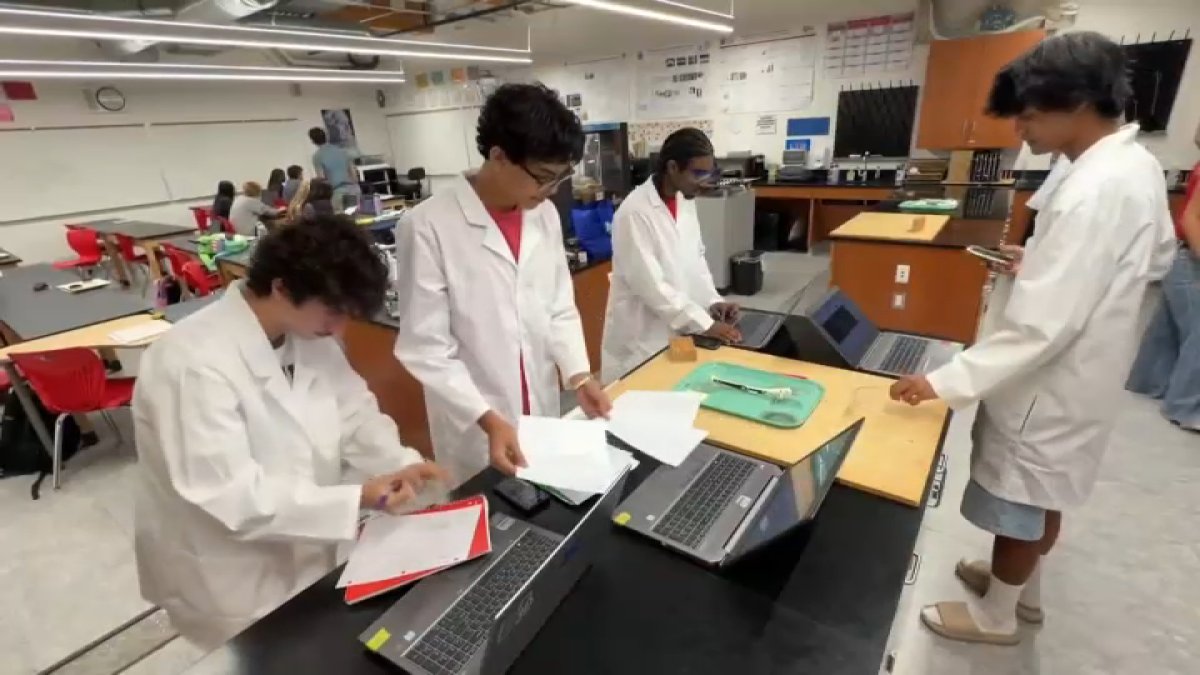
Students in lab coats work through biomedical problems. They use models of human bones and 3D engineering to explore how damaged bones can be repaired. An interactive digital anatomy table allows students to explore the human body and examine anatomy in ways that go far beyond a traditional textbook.
In other classrooms, students code, design, build and test their ideas.
Saeed said the difference from her own high school experience is striking.
“I remember a lot of pencil, paper, notes throughout high school,” she said. “But we were never creating something.”
At Sato, she said, creating is part of the culture.
“We never felt empowered to build something new and innovative,” Saeed said of her own high school experience. “But that’s part of the culture here at Sato. It’s one of our student outcomes to be a creative innovator.”
And sometimes that creativity can be heard across campus.
“You hear a boom outside and you don’t get scared,” Saeed said. “You’re like, ‘Oh, it’s a rocket exploding outside.’”
Or she might walk past another classroom and find students “breaking bones and rebuilding them with 3D printed parts.”
“It’s so neat to see students translate learning into what it looks like in the real world,” she said.
‘Oh my gosh, I did that’
For Ozude, one of those moments came when she designed a model rollercoaster.
“I had no idea how to start this,” she said.
Students first created the design, then had it printed and worked on the finished model. But the assignment wasn’t just about building something that looked like a rollercoaster.
They had to do the math.
“We had to sand it and smooth everything out and do the math for the calculations to see if it was even safe for someone to ride if it was built in real life,” Ozude said.
The final result gave her a moment she still remembers.
“Oh my gosh, I did that,” she recalled thinking. “I built a rollercoaster. It was pretty awesome.”
Ozude said what makes the experience unusual is how subjects connect across the school day.
“Even though we’re taking the same PLTW classes or math and English classes, there’s something about how they’re all interwoven together that makes it feel like I’m going to school through one class the whole day because everything’s all connected,” she said.
She remembers sitting in math class and recognizing equations she was also using elsewhere.
“I was like, ‘Oh, my goodness. So they know what we’re learning,’” Ozude said.
A pathway from Long Beach to NASA
Sato is also expanding its hands-on approach through NASA/HUNCH — High school students United with NASA to Create Hardware.
Thompson said Sato is the only school in the area currently participating in the program.
Students from Sato’s engineering and biomedical pathways will work together on teams, with their work potentially supporting NASA projects.
“The skills that they’re going to develop within NASA HUNCH and the products that they’re going to build help to foster collaboration between our two pathways,” Thompson said.
For students like Ozude, the school’s career pathways can also help answer a bigger question: What comes next?
She arrived at Sato already interested in medicine but unsure where that interest might take her.
“I knew I wanted to enter the medical field, but I wasn’t sure where,” Ozude said. “So I think my 10th grade pathway class was super helpful because we got to explore a lot of medical careers.”
‘Everyone’s moving up together’
The school is demanding, and Ozude acknowledges there can be competition among students. But she describes it as a competition that pushes students forward rather than pulling them apart.
“We’re always pushing each other, which is competitive in a way that I believe is healthy,” she said.
“You’re pushing your friends to do better and everyone’s moving up together.”
Saeed said that culture is one reason she remains enthusiastic about teaching at Sato after joining the school in its second year.
“I am most proud that we don’t stagnate here,” she said. “I feel just as excited about coming to Sato every day today as I did when I first joined Sato.”
For Thompson, however, the clearest measure of the school’s success isn’t a ranking.
It’s what he sees when students arrive each day.
“The way that I measure Sato is the joy that our students bring to school,” Thompson said.
“Our students are not only serious, they not only care about their academics and where they want to go beyond high school, but they also really care about the community, and the community that they built here.”
“And I believe that that community that our students, that our staff, and our families have built is what makes Sato so successful.”