
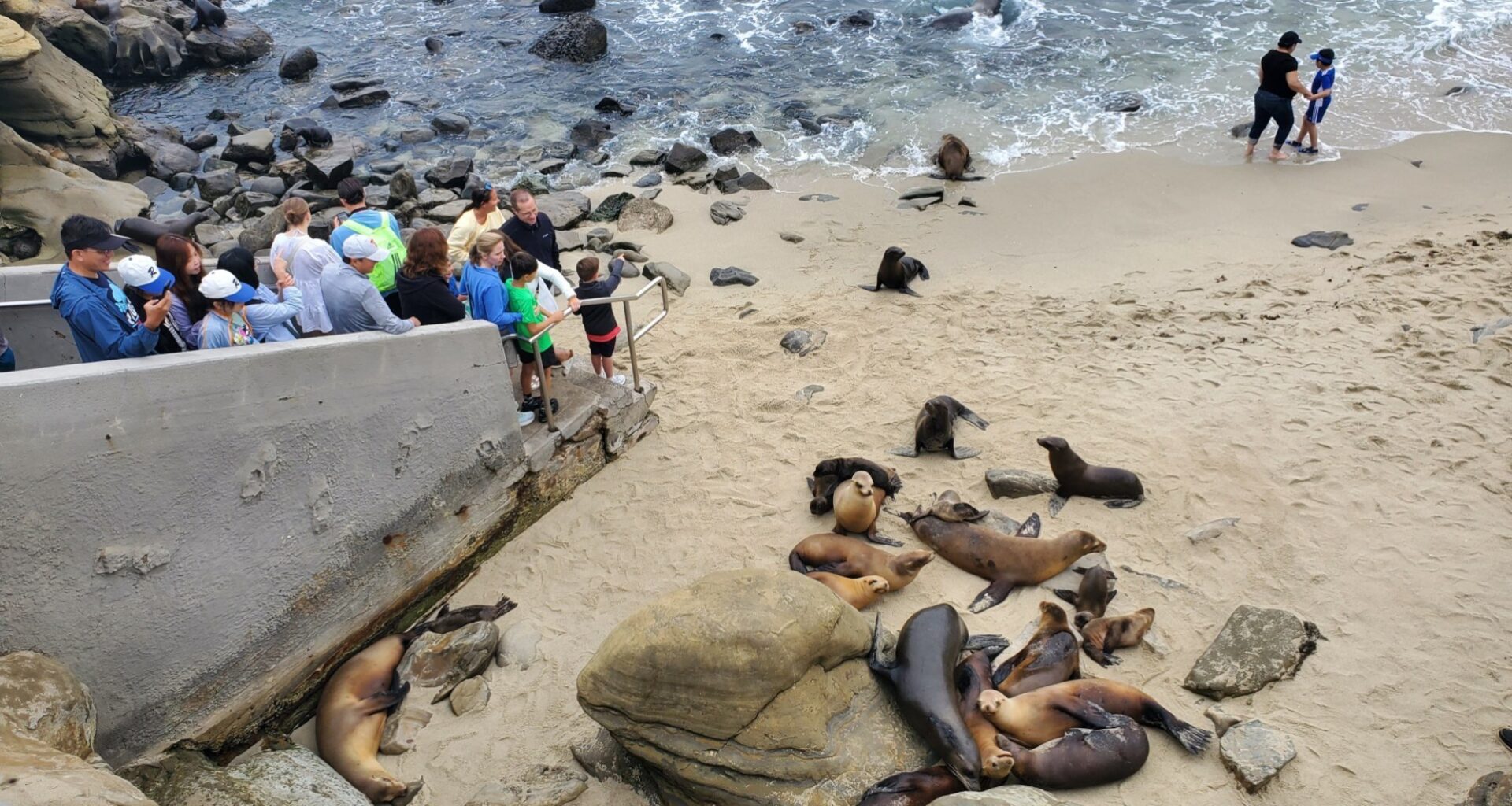
As the city of San Diego and California Coastal Commission wrestle with the future of access to La Jolla Cove, the two entities are now looking to a third party for stricter enforcement.
At the Oct. 8 California Coastal Commission meeting, executive director Kate Huckelbridge said that she and Coastal Commission staff have met with representatives from San Diego Mayor Todd Gloria and San Diego City Council President Joe LaCava’s offices to discuss “creative options” for enforcement at The Cove. Specifically, they are penning a letter to the National Oceanic and Atmospheric Administration asking its agents to enforce the Marine Mammal Protection Act or deputize city park rangers so they can issue citations.
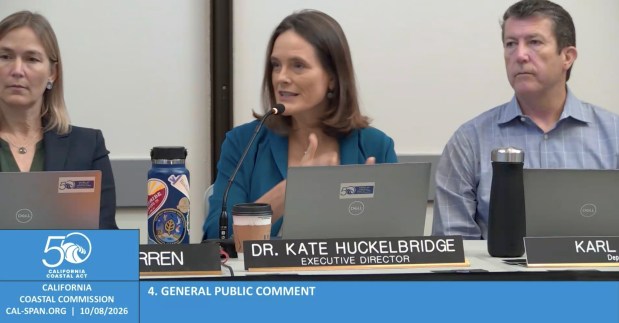 Dr. Kate Huckelbridge, executive director of the California Coastal Commission, speaks at the group’s Oct. 8 meeting at the City of Oceanside Civic Center about what the CCC and the city of San Diego are doing behind the scenes to address concerns at La Jolla Cove. (Screenshot by Noah Lyons)
Sea lions are protected under the federal MMPA, making it illegal to harass, harm, pursue, feed, capture, injure, restrain or kill the animals. Such actions may be punishable through fines or jail time.
But only NOAA can enforce the terms of the MMPA.
“There’s a threading of the needle that needs to occur,” Huckelbridge explained. “(The city) can’t enforce the MMPA, only NOAA can do that. So we’re working on creative options on that front.”
Thus, Huckelbridge, Gloria and LaCava are working on a letter to NOAA “to ask them to engage and to enforce their law.”
In the letter, Gloria and LaCava jointly request NOAA provide staffing to enforce the MMPA, with the caveat that “Frankly, we are expecting that request to be respectfully declined given NOAA’s minimal staffing management of the MMPA across the entire western coastline.”
As an alternative, the letter continues, “We are pinning our next step on NOAA to ‘deputize’ city park rangers so they can issue citations. (We) believe that visitors will be more responsive and compliant and either stay a safe distance from sea lions or to move quickly from the stairs and into the ocean water.”
Echoing his previous sentiments that he hopes to keep The Cove open, despite “increasingly challenging” circumstances, LaCava said in a statement to La Jolla Light, “Unlike Point La Jolla that moved from outreach to education to closure, we are in partnership with the Coastal Commission to explore every step with a goal to avoid closure, preserve coastal access, and maintain appropriate distance from sea lions.”
Conversations about the increasingly fraught relationship between humans and sea lions at The Cove intensified following the posting of a video appearing to show a person chasing and kicking a sea lion near the area.
In the video, the sea lion appears to have been sitting atop a low wall that separates the colony at La Jolla Cove and Point La Jolla from a public walkway. The video shows a young man taunt and then kick at the sea lion before chasing the animal as it tries to escape along the wall.
Tyler Muehl, an 18-year-old La Jolla resident, admitted to attacking the animal as it sat on the sea wall the night of July 22, according to a plea agreement. He ultimately pleaded guilty to a misdemeanor violation of the MMPA.
Opinions on how to proceed with access to La Jolla Cove have varied in community meetings in and outside of La Jolla.
During the Aug. 14 California Coastal Commission meeting, board members wondered if a temporary closure of La Jolla Cove would be beneficial.
“I’m at the point where I believe a partial closure is the only way to deal with this issue until the city gets their program implementation figured out and investigates what is going on here,” said Commissioner Matt O’Malley at the time. “I’m sorry to have to be an advocate for that at this point.”
Commissioner Jose Preciado added that he, too, questioned whether the city “needs some sort of reboot in the sense that maybe preserving the environment completely … while everyone gets policies and practices squared away.”
Ten days later, during an unusually crowded La Jolla Parks & Beaches meeting at the La Jolla/Riford Library, a contentious conversation took place that culminated in the board issuing a recommendation of reduced access to The Cove.
During the meeting, 37 people signed up to speak during public comment, with 15 selected to address the board. With competing groups arguing over whether The Cove should be closed or remain accessible, there were several incidents of cross-talk and even shouting among attendees.
The LJP&B board’s proposal would keep La Jolla Cove open while limiting access to only allow swimmers, snorkelers and divers — and prohibit other forms of access and beach recreation there — during the sea lion pupping season of June 1 to Sept. 15 annually.
Several members of the public advocated for LJP&B’s proposal at the Oct. 8 Coastal Commission meeting. One audience member described it as “the most balanced and effective tool that we have right now,” while Commissioner Caryl Hart called it “the most obvious approach during pupping season.”
Hart continued, “People aren’t sun bathing on the beach. They’re just going to the beach, doing selfies with the sea lions, getting as close as they can — endangering themselves and the sea lion. I understand the need to get in the water there — that’s really important. But it just seems like a pretty simple and obvious solution during that particular time.”
Others speaking at the Oct. 8 meeting offered other perspectives on how to proceed with The Cove.
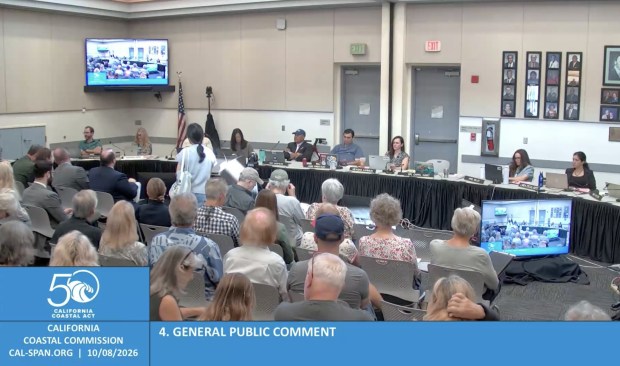 Several public commenters at the Oct. 10 California Coastal Commission meeting in Oceanside spoke on conditions at La Jolla Cove and what they see as the best path forward. (Screenshot by Noah Lyons)
One public commenter said a scientific study should be done before deciding on any closure, rather than relying on anecdotal and emotional evidence.
Sierra Club Seal Society chair Robyn Davidoff, meanwhile, asked at the meeting for five steps to be taken at La Jolla Cove: requiring lifeguards and city park rangers to collaborate; stationing rangers regularly on the beach; use cones and tape to make for a more clearly-defined buffer zone between people and sea lions; establish clearer protocols for overcrowding; and close the western stairs when sea lions are on or below them.
LaCava encourages community organizations to continue offering their input as they work on the letter and anticipate a response from NOAA.
— La Jolla Light editor Ashley Mackin-Solomon contributed to this report.