
The Fresno County board of supervisors first revisited discussions to privatize public libraries after a 3-2 vote on May 12 to prevent the libraries’ participation in local pride month celebrations. This was followed by a request to study private company management across all library branches on June 2.
The board of supervisors said in a media release that the library privatization item will not be present at neither the Oct. 20 board meeting nor future 2026 meetings. Friends of the Fresno County public library (FOL) President Shannon Wise said she doesn’t buy it.
At the Sunnyside regional branch gathering on Oct. 10, Wise claimed that it wasn’t on the meeting agenda for Supervisor Garry Bredefeld to ask County Administrative Officer Paul Nerland to conduct the study in the first place.
For that reason, “We’re not done,” Wise said.
“We are still planning to show up at that meeting. We are still planning to comment, even if they don’t talk about it. We are still going to comment,” Wise said. “And we are going to turn out in numbers. And the reason being is none of us trust what they’re saying.”
During the Sept. 22 meeting, Supervisor Buddy Mendes, who plans to retire from the board, said the board should accept the completed study as a public board briefing report.
Bredefeld said his interest lies in simply getting the information to the board.
“If the board in the future decides they want to do it, that’s their choice,” Mendes said. “Starting in January there’s only going to be two of you here, and we’re all going to be gone so that’s something for a new board to really look at, not this board.”
Rosa Huerta, president of the Friends of the Sanger Library, said it’s not a matter of if the privatization will go through, she said it’s a matter of making sure that the subject stops being brought up by the board.
“Don’t bring it up anymore. Just stop picking on the library because we all know that this is not about funding because Measure B and the property tax fund 97% of the library. It’s not about money, so stop lying and saying it’s about money when we all know that’s not true,” Huerta said.
Wise suggested that alongside writing to the board of supervisors in opposition of the effort to privatize, students are also encouraged to get involved voluntarily with the FOL.
“Let’s get them involved in Friends of the Library because let’s face it, we’re all getting older. We can’t do this forever,” Wise said. “We need to put into the future a new generation that can come in and say libraries are important, and younger generations are using libraries even more than we thought they would.”
For students interested in volunteering at any branch location, Gillis Branch Library being the closest to FCC, they can contact the executive assistant Sam Retton to be connected with President of the FOL group at the Gillis branch, Janice Romero-Nelson, or fill out the volunteer application on the FOL website.
Stacy Williams, owner of BB’s Gelateria in downtown, said that as soon as her shop team heard that there was an attempt by the board to privatize the libraries, they got to work on using their small platform to raise awareness.
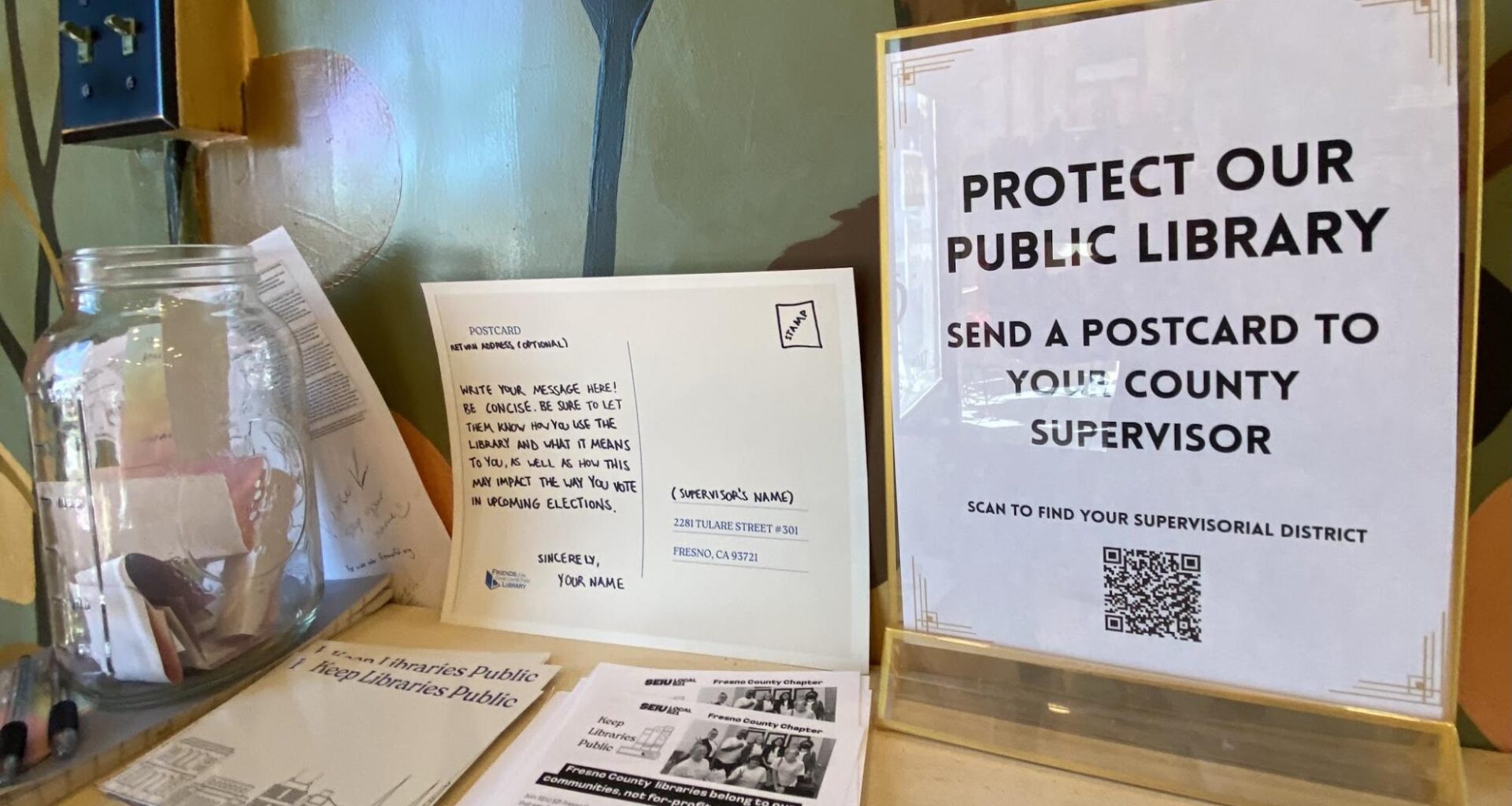
The store posted a video on Instagram saying that it would provide free postcards provided by the FOL for the public to write to the board of supervisors against privatization.
“We thought if we could do our little part to let people come in and fill out postcards and mail them and raise awareness for this, so that hopefully we could deter the board of students from privatizing our library, which we think would be awful,” Williams said.
The postcard activity at the shop also helped to inform community members.
“It actually became kind of educational as well, we’ve got a QR code here, where people could scan and figure out who their board of supervisors was, and I think there was a lot of confusion between what a city council member does and what a board of supervisors does,” Williams said. “We’ve actually really had the honor and privilege of being able to educate people and let them know what parts of your life these electeds govern.”
In the event of privatization, Jim Poptanich, president of the Fig Garden branch FOL group, said without the public aspect of the library, branches would no longer be able to spend funds, and disbandment of all FOL groups would be likely.
“Prior to Measure B, which would be an example where you would go back to [after privatization], all the branch libraries would close at 5 p.m.” Poptanich said. “And the staff’s benefits are going to get cut because they’ll be on a worse program than what the county is offering them. So, you won’t be able to go to the library, is what’s going to happen.”
Williams said nobody at BB’s thought the postcard service would take off like it did. The post itself went viral, with almost 200,000 views, according to Williams. She expected 10 or 15 people to write, instead the store accumulated hundreds of postcards ready to mail in.
Kristin Baer, a librarian at FCC who previously worked in the Fresno County Public Library system for seven years, said libraries are a prime example of spaces where the community can congregate without being expected to exchange anything for that experience.
“When I worked at the the county library, we would have regulars who would show up throughout the week, and you know, you’d have like there were a few people that would just show up and read the magazines and newspapers and just want the camaraderie, especially older folks or people that were kind of between jobs,” Baer said.
Baer recalled that during her time there, the public library offered a type of library account for foster youth. The account prevented overdue fines from being held against kids who had aged out of the foster system, since transportation and group home situations can complicate the process of returning borrowed books or items.
“I still remember helping these two young men. It was at our Downtown Fresno branch, they were these kids. And I call them kids because they were young. They were just barely adults, 18 or 19. They came up to the desk just wanting to know what their fines were,” Baer said.
According to Baer, the two had been in the same housing situations and were trying to help each other out. They had visited the library to put together resumes and were dressed like they were on their way to a job fair.
“I looked up their accounts, and I was like, ‘oh, you guys are former foster youth, right?’ And they were like, ‘Yeah, we know that we have a lot of fines.’ I was like, ‘No, no, no, no, great news for you. Those fines, you’re not responsible for. And the one kid looked like he was gonna cry. Because again, so many systems had failed or barely served those two young men, that I think they just didn’t take for granted that the library was going to kind of give them a free pass, so to speak,” Baer said.