
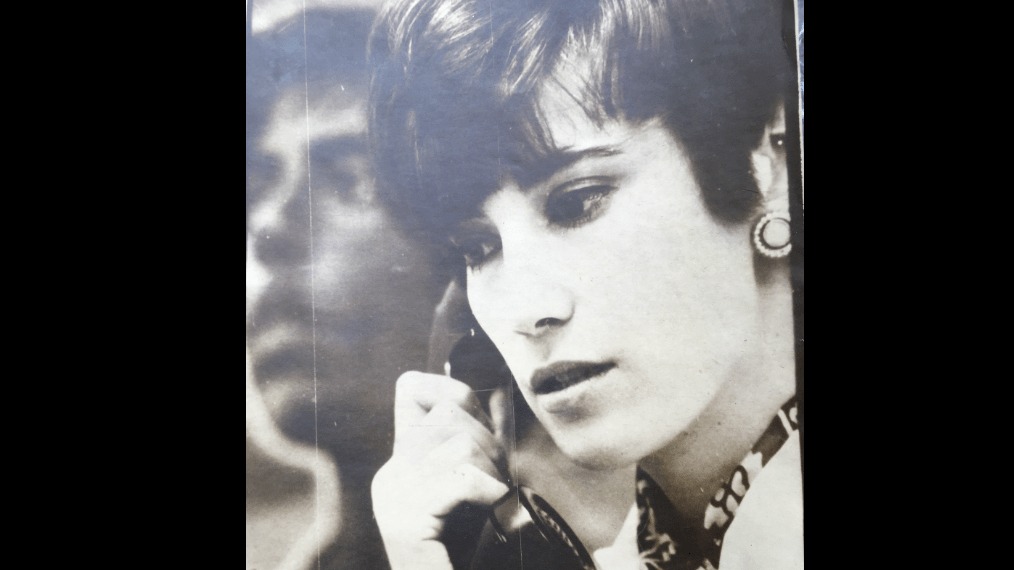
 Joan Bieder. Courtesy of her friends
Editors’ note: This story first appeared in J. The Jewish News of California.
Athens-based journalist Phoebe Fronista has trouble putting into words just how much she learned from Joan Bieder as a student a dozen years ago at UC Berkeley’s Graduate School of Journalism. Bieder was an industry pioneer who had come up in the male-dominated news field, but she was intent on covering the basics with her student proteges.
“Joan could be a feminist icon, but she started out at ABC News making photocopies,” Fronista said. “She said to me, ‘We’re going to the copy machine, because young people have to know how to do this.’”
She also recalled how the no-nonsense Bieder would “plop down next to you in the editing room and say, ‘So, what do you got for me?’”
Bieder, who helped grow the broadcast track of the journalism school, influencing numerous journalists in the field, died at her home in Kensington on Oct. 26. She was 83 and a member of Berkeley’s Congregation Netivot Shalom.
Born on Feb. 13, 1943, in Stamford, Connecticut, Bieder was raised in an Orthodox Jewish home and attended her high school prom with Joe Lieberman, the future senator and vice presidential candidate. Her nephew Erik Bieder confirmed the prom date anecdote, noting “she would say that with an eyeroll and a shrug.”
Bieder worked at ABC News in the 1960s as a producer when newsrooms were very much a man’s world. She spent a decade there, and another as an associate professor at Columbia University Graduate School of Journalism. She left New York when the winters started bothering her arthritis and came to Berkeley in 1990, working first as a temporary Cal lecturer, and later becoming one of the first women hired by the journalism school. For much of her tenure, her title was senior lecturer; she stayed for 26 years, serving as associate dean from 2008 until her retirement in 2016.
Bob Calo, who taught with Bieder in Cal’s broadcast division, worked closely with her for 16 years. “She was ego-free. She was incredibly generous, gracious, and very blunt. You’d think that bluntness could get her in trouble, but it always came with such warmth.”
Bieder spent several summers as a consultant to news stations in Singapore, where she became fascinated by the country’s tiny Jewish community. In 2007 she wrote a book, “The Jews of Singapore,” tracing the roots of Singaporean Jews from their Biblical and Baghdadi Sephardic origins to the present. Her expertise in this niche history led to invitations to academic conferences and Jewish book fairs, particularly on the topic of Singapore Jewry under the Japanese occupation from 1941 to 1945.
“She had such a joy and curiosity for life,” said Fronista, a Greek American journalist who first encountered Bieder when she took her introduction-to-television course.
After a 2009 trip to the Middle East, Bieder created a one-semester course titled “People, Places and Passions of Israel and Palestine,” and then a two-semester course on reporting in Israel and the West Bank. Students in the latter traveled to the region as part of the curriculum.
Fronista thought she would major in print when she arrived at journalism school, but after classes with Bieder and Calo, she went the documentary route instead. In her second year at Cal, she worked closely with Bieder as a graduate teaching assistant. Skype, the video chat software, was relatively new then, and Fronista remembers teaching her mentor to use it. She recalled how Bieder would use her many connections to get Middle East correspondents to speak to her classes via Skype.
Fronista, who ultimately produced a documentary segment for the class about the contested Jerusalem neighborhood of Silwan, recalled how during her three-week stay in Jerusalem Bieder guided her from Berkeley.
Fronista hasn’t seen Bieder in person since graduating in 2011, but the two stayed in close contact on WhatsApp until the week she died.
“She continued to be a regular in my chats,” Fronista said. “We would just talk constantly, as both a friend and a mentor. Now that I’m older, I realize how special she was as an educator.”
Fronista said Bieder cared deeply about each of her students and followed them long after graduation. “She’d be asking, ‘Do you have an internship yet?’ or ‘Did you get a job? I’ll speak to someone for you.’”
Bieder also served on the faculty advisory committee of Cal’s Helen Diller Institute for Jewish Law and Israel Studies. Rebecca Golbert, the institute’s executive director, said that when she arrived, she was somewhat intimidated by Bieder’s career accomplishments. But that quickly changed.
“She was so unassuming and one of the most warm, friendly, down-to-earth, funny people,” Golbert said.
The two worked closely together to bring Israeli journalists to campus, with Bieder moderating the conversations. Even in retirement, Bieder helped Golbert brainstorm, or reached out to her network on the institute’s behalf.
Bieder had a wide range of interests — she was an active member of a film group, regularly attended local theater productions, loved opera, and was an aficionado of classic movies. In addition, her neighborhood remembers her as a caring neighbor who took pride in maintaining a beautiful house and yard.
Despite significant health challenges, Bieder helped shape an entire generation of journalists, Calo said.
“She was very comfortable,” he said. “She found a spot where she could have such influence.”
In addition to her nephew, Bieder is survived by her niece, Julie Robson of Surf City, North Carolina, and a wide circle of friends.
Catherine Trimbur contributed reporting to this story.
“*” indicates required fields