
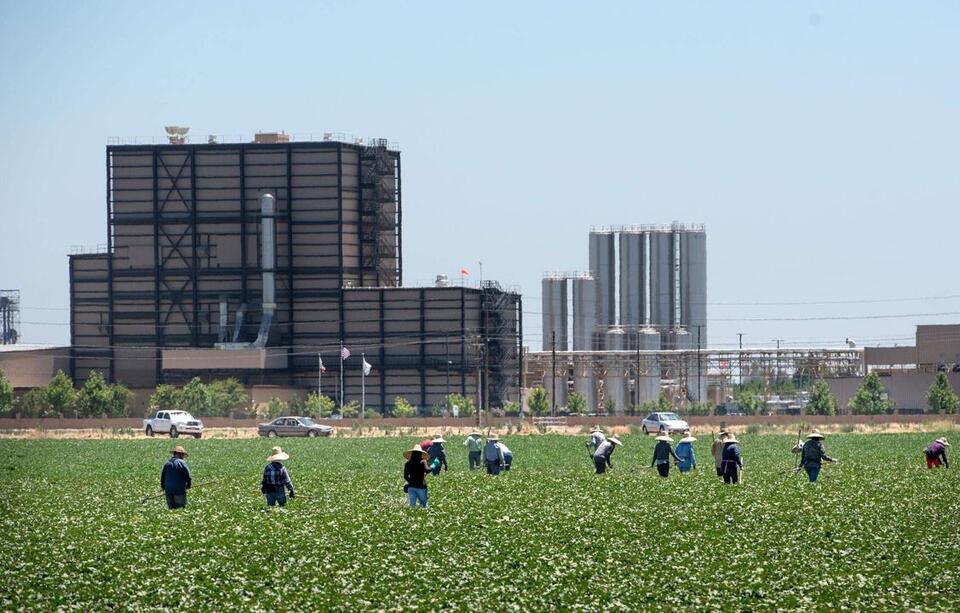
I’ve spent my career working alongside the men and women who harvest the food that feeds our state, particularly in Kern County and the Delano area, where table grapes, citrus, almonds and other crops dominate the land. They take immense pride in their work and remain deeply committed to sustainability. But the way California is pursuing its clean energy goals is putting that commitment — and livelihoods — at risk.
Every day, I’m reminded of how resourceful and adaptable our Central Valley farmers are, navigating unpredictable weather, market pressures and constant technological change. Yet, even with their resilience, the strain on family farms is impossible to ignore.
I oversee post-harvest operations at a grape-packing facility in Delano, where we process thousands of boxes of grapes every day. Running the heavy machinery to do this work takes an enormous amount of energy. We’ve invested in five acres of solar panels generating around one megawatt of power, but even that isn’t enough to keep our operations running smoothly. We still rely on the grid, but rising energy costs, unrealistic energy mandates and expensive equipment requirements are stretching family farms to the breaking point.
Farmers across the Central Valley need the freedom to run their businesses on their terms, choosing the methods, tools and equipment that make sense for their land and operations. When energy prices rise and regulations make operations harder, it’s not just the farmers who suffer, it’s every worker, every family and every table that depends on them.
Rising costs, shrinking options
Central Valley farmers are under tremendous pressure. Costs for water, labor and fuel continue to rise, while many crop prices struggle to keep pace. In response, some growers are leaving land unplanted or considering selling property their families have held for generations. Escalating housing and land costs are also making it harder for young and beginning farmers to get started, threatening the future of small, family-run operations.
Now, new energy mandates are adding to the strain. The push to electrify vehicles and equipment hits small and mid-sized farms hardest, where margins are already razor-thin. When compliance costs exceed profits, it’s not just unsustainable, it’s unfair.
Mandates without means
The California Air Resources Board’s Advanced Clean Fleets rule requires local government and utility fleets, including those used by irrigation districts, to transition to zero-emission vehicles. While everyone supports cleaner air, the technology and infrastructure aren’t ready for much of the Central Valley’s agricultural regions.
Electric trucks and heavy machinery still fall short of the durability and endurance needed for farm and water operations. Charging stations are scarce in the Central Valley compared to urban coastal areas, and many rural power grids lack the capacity to support large-scale equipment.
Farmers aren’t rejecting progress; they’re asking for time, tools and choice. They want to adopt cleaner technologies when they are proven, practical and affordable.
Affordability is sustainability
True sustainability is both environmental and economic. California already has some of the highest energy costs in the country, and every rate increase affects irrigation, cooling and food processing. Each added expense ripples through the food supply chain, raising prices for families and threatening food security statewide.
Small family farms across Delano and surrounding areas— the backbone of rural California — are especially vulnerable. Unlike large corporations, they don’t have access to massive reserves or financing to overhaul fleets or facilities. Without affordability and the freedom to choose how we power our operations, many will be forced to scale back or close. When a family farm shuts down, it’s not just an economic loss, it’s a loss of heritage, jobs and community stability.
Keeping farms and choices alive
California feeds America, yet the very people who make that possible are being regulated out of existence. If the state truly values sustainability, it must also value the people who sustain it.
A cleaner future shouldn’t come at the cost of family farms. California can still lead the nation toward a greener future by working with farmers — not against them — empowering them with the flexibility to choose the equipment, methods and technologies that work best for their operations.
Because when farmers lose the freedom to decide how to run their farms, we all lose the freedom to choose what ends up on our tables.
Luis Katsurayama is director of post-harvest operations at and a board member of the California Farmworker Foundation.