
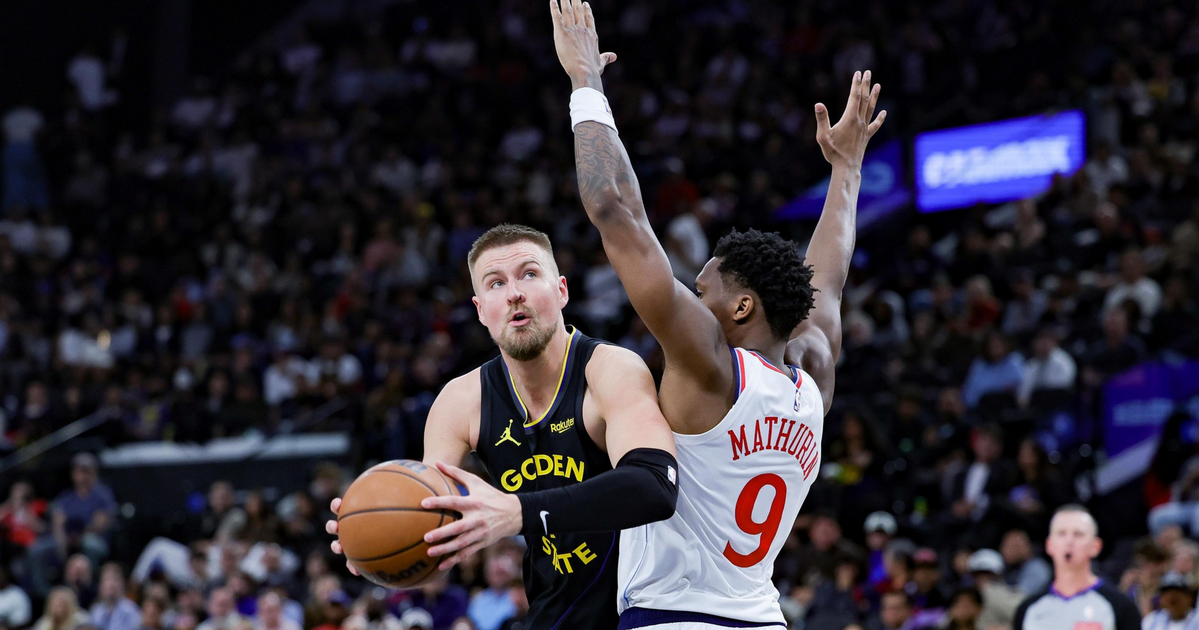
The Warriors say they don’t know where Kristaps Porzingis is, exactly what he’s dealing with health-wise, or when he might be able to return to the court. He didn’t make last week’s trip to Hawaii after GM Mike Dunleavy announced that he’d be out indefinitely and has been absent since.
It’s a familiar spot. The team experienced this after acquiring Porzingis at the trade deadline last season, which is what the Boston Celtics and Atlanta Hawks also went through when he was on their rosters.
The most clarity any team has received on Porzingis’ health in recent years was his POTS diagnosis after the 2024-25 season. But that chronic disorder has led to more questions than answers. The incurable and unpredictable condition can manifest in sudden, serious bouts of symptoms. The veteran has said he and his doctors know how to manage it with a higher salt intake and more mindful recovery schedule.
Every team knew about the center’s diagnosis this summer, when the Warriors signed him to a flexible, two-year, $40 million deal that’s guaranteed for $3 million in 2027-28 and immediately trade-eligible.
The Warriors have expressed support for Porzingis, and rightfully so. Whatever he’s going through can’t be fun. Empathy is appropriate.
But his health is also relevant to the Warriors’ on-court outlook, now and in the future.
There is no reason to believe the Warriors are hiding anything. There’s no nefarious conspiracy that holds any weight. By multiple accounts, the team was encouraged by the condition in which Porzingis arrived at the facility before training camp. Then, the mysterious health issue arrived.
Dunleavy said he was informed of Porzingis’ current health issue Sept. 27, so the center has been sidelined for two weeks. He has missed half a dozen training-camp practices and four preseason games.
The last time Porzingis spoke to reporters was April 15, after the Warriors’ thrilling play-in win over the Clippers, in which he scored 20 points in 28 minutes. He didn’t participate in exit interviews and hasn’t been available over the summer, adding to the uncertainty.
“Obviously, we’d rather have KP here and part of it, but he’s got to take care of his health, and again, we’ll support that and keep moving forward with the team,” Steve Kerr said Oct. 8.
The contract, explained
Injuries and illness have limited Porzingis to 87 of a possible 177 games over the past two seasons, including the postseason. He has played 65 or more games once since the start of the 2020-21 season.
Availability concerns inspired sticker shock when Golden State brought him back on a two-year, $40 million deal this summer.
But his contract is more complicated than it appears.
The deal includes just $24 million guaranteed. He also agreed to start in a nonguaranteed phase, giving the Warriors about a week of added flexibility to pursue free agents, though that didn’t yield results. There is also value in having a midsize contract on the payroll, because it’s more easily movable for salary-matching purposes in a trade.
The center market is also tricky. There’s a lot of demand and not much supply. Jusuf Nurkic signed for $22 million guaranteed over two years. Jock Landale received $14 million from the Hawks. Robert Williams III, who has struggled to stay healthy, starts at $14 million.
Today

5 days ago
Tuesday, Oct. 6
Porzingis is flat-out better than those players — when healthy, of course.
Yet for an older Warriors team, it’s fair to argue that Golden State should have prioritized healthy players to endure the regular season, especially after finishing outside the top six in each of the past three seasons.
If Porzingis isn’t ready for opening night, the Warriors will start the year with about $90 million in unavailable players, because Jimmy Butler and Moses Moody are also out.
Not ideal! No team would choose to have more than half its cap space in street clothes. But the Warriors knew about Moody and Butler’s long-term injuries before this offseason and could build depth around their positions. Porzingis’ recent track record suggests the organization could have done the same at center, or considered a steadier alternative.
The Warriors would’ve had to get creative for the latter because simply letting Porzingis walk wouldn’t have unlocked cap space to sign a free-agent center. They could have explored a trade for a star like Anthony Davis, but that would have been both risky and costly. Perhaps they could’ve used their taxpayer midlevel exception on a center instead of on De’Anthony Melton, but then you’re wading into Precious Achiuwa waters (while cutting into your guard depth). They could’ve matched Memphis’ offer sheet for Quinten Post, but he was essentially unplayable for long stretches.
Golden State’s frontcourt includes Al Horford, 40; Draymond Green, 36; rookie Yaxel Lendeborg; and unproven options Charles Bassey and Graham Ike.
Why bring back Porzingis at all?
On Aug. 11, Dunleavy was asked about his concern level regarding injuries for the team he’d assembled.
He first said that because Butler and Moody are out indefinitely, there’s concern “right off the bat.” Then, the GM explained his thought process.
“As far as the rest of the roster goes, I think in constructing it, we had to make a decision between talent and availability,” Dunleavy said. “And there was no perfect solution in terms of a combination of the two. And I think we leaned a little more toward talent, knowing the team that we have, what we need, and hoping we can get some good luck.”
No player represents that dichotomy — talent versus availability — more than Porzingis.
Even past his prime, Porzingis is one of the most gifted players in the league. At 7-foot-3, he’s a legitimate 3-point threat who protects the rim. Imagine jumbo, five-out lineups with him, Steph Curry, and three of Butler, Moody, Lendeborg, Green, Horford, Brandin Podziemski, and Gui Santos.
That seems to be the Warriors’ vision. At full strength, the roster makes a lot of sense. There’s size, shooting, playmaking, and two-way wings. But getting anywhere near full strength for an extended period of time is a moonshot.
At this stage of Curry’s career, is that idealistic approach the right one?
For years, the Indianapolis Colts never rostered a real backup behind Peyton Manning. The general theory was that if the extremely durable play-caller ever went down, the Colts were screwed. So they might as well devote resources elsewhere and hope for the best.
There might be some of that going on with the Warriors. Nothing matters if Curry plays 43 games, like he did last year while dealing with runner’s knee.
So if you’re already banking on health luck with Curry, perhaps it’s worth tolerating an additional red flag if the talent is tantalizing enough.
A grand unified theory
When deciding whether to bring Porzingis back, the Warriors knew there was baked-in health risk. But they were hopeful that interventions to manage his health would put the worst behind him. Because there weren’t a lot of appealing, similarly priced options available to Golden State, Porzingis’ upside outweighed the possibility of adding a different player. That he agreed to a tradable, market-rate deal didn’t hurt.
The Warriors haven’t fully wrapped their arms around what Porzingis has dealt with over the past two years because it appears nobody has clarity on the severity of his health issues. His inability to get through an offseason intact was unexpected and bad optics, but there’s still time before the season starts to get him right. And with a team already dependent on health luck, taking a swing on a clear talent and hoping for the best is par for the course. With so many injury variables up in the air, what’s one more?