
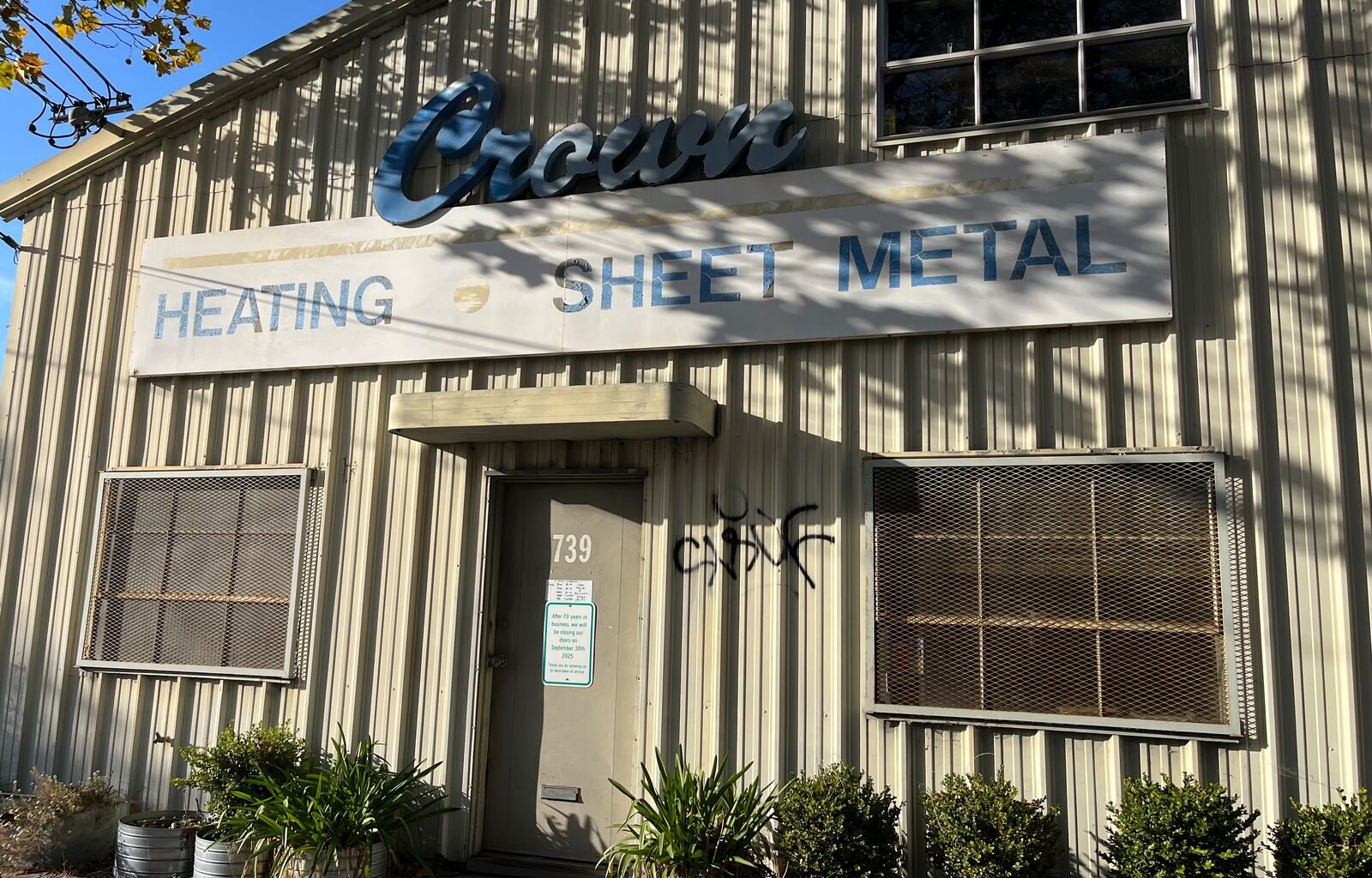
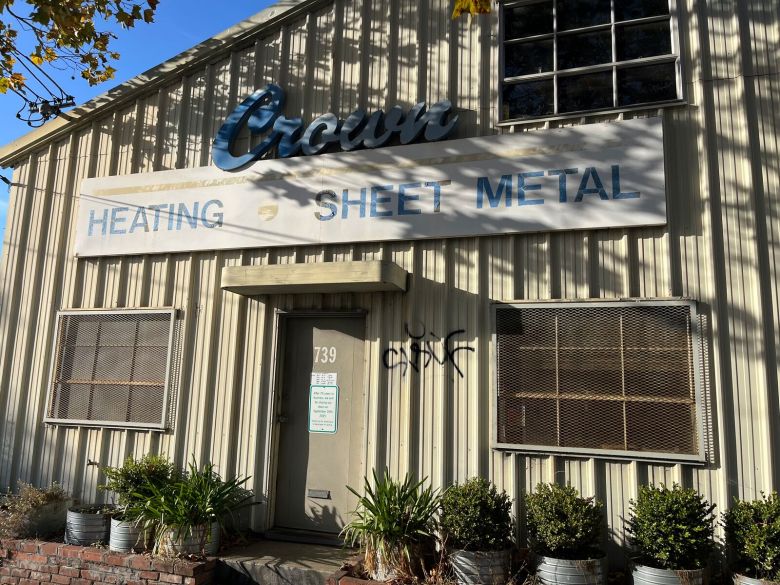
 Crown Heating and Sheet Metal on Gilman Street has closed after 70 years. Credit: Nathan Dalton for Berkeleyside
Crown Heating and Sheet Metal, a 70-year-old metal fabrication company, has closed its Berkeley shop.
But unlike the Walter Mork Company, another decades old Berkeley-based sheet metal shop that recently announced its closure after 116 years, the closing of Crown does not reflect the company’s struggles to compete in an age of computer-aided fabrication, or even a lack of work. Its owners are just ready to retire.
“We had enough work to keep the shop going because we’re pretty small,” said Kathy Latak, who owns the business with her brother Jim Sturgeon. “We’ve been talking about retirement and we’ve been talking for several years about an ending date. And we decided since the business was just completing its 70th year, that seemed to make sense. That was a good time.”
The shop closed on Sept. 30.
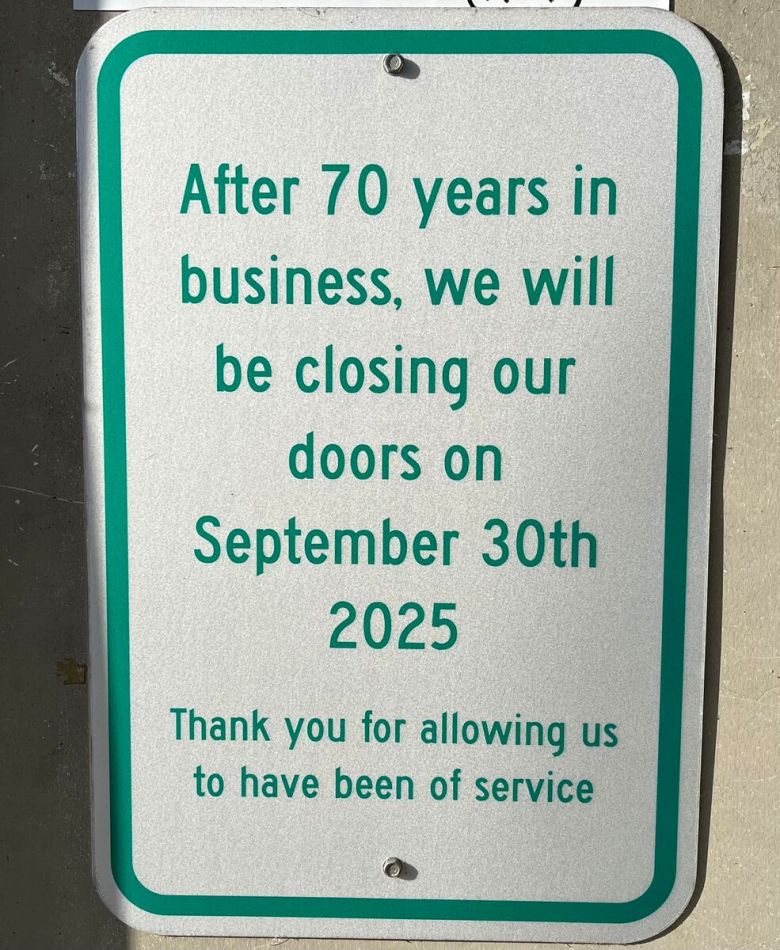 A metal sign fittingly announced the store’s closure. Credit: Nathan Dalton for Berkeleyside
Latak and Sturgeon have decided not to sell the business, which was founded by their father, fearing that the new owners would change it too much.
“We’ve been a family business and just wanted to close it and leave it at that,” said Latak.
Crown Heating and Sheet Metal was founded by Jim Sturgeon, Sr. in El Cerrito in 1954, and moved to its current location on Gilman Street in 1960. Sturgeon fought in Europe during World War II, flying on a B-17 bomber, which was shot down over Germany in 1944. He managed to parachute out of the plane and was found by German farmers. After receiving care at a POW hospital, he was transferred to a POW camp in Poland, where he spent the last year of the war.
A native of Oakland, he resumed his career in the sheet metal business after returning home from the war, working for a few different companies, before opening his own shop. He died in 2022 at the age of 101.
His son, Jim Jr., started working part-time at the shop as a teenager in the 1960s and took on a full-time fabricator role when he was in his 20s. Latak began working at Crown in 1976.
The shop once had as many as seven employees, but its niche in the past few decades has been “small scale” work for contractors, according to Latak, including architectural sheet metal, galvanized flashing, countertops and copper work. Work that was done by hand.
“We never really got into having a computer,” she said. “We never got into that. It was pretty much hands-on.”
For most of its existence, Crown also had a steady stream of HVAC clients, hence the “Heating” in the company name. But since most of the materials for that type of work can now be purchased prefab, it doesn’t make sense to hire a custom fabricator, according to Latak.
“You don’t really need a shop to do that,” she said.
Crown’s only current full-time employee, Bruce Sturgeon, the owners’ cousin, is “not quite ready to retire,” according to Latak, and is opening his own shop called Red Barn Sheet Metal, which will be based in Mariposa. He’s currently using Crown’s shop until he gets Red Barn up and running, which could take several months.
“He will continue with a lot of our regular customers to fabricate for them,” said Latak. ”They were kind of relieved that there would still be somebody they could go to for fabrication.”
The shop’s closure is yet another instance of what Berkeley historian Charles Wollenberg called “the larger decline of the historic industrial base of West Berkeley and the Bay Area in general.”
Berkeley was once home to large factories like Colgate, which closed in the ‘80s, and Pacific Steel, which closed in 2018, as well as smaller operations like Walter Mork Company, which will be closing in the coming months.
Wollenberg noted that, unlike the “rust belt” of the Midwest and East, the Bay Area has been able to offset the loss of many blue collar jobs with newer industries like tech and biotech and an increase in service economy jobs.
“But these don’t really replace the pretty well-paid and often unionized blue collar jobs that the old industrial base offered to working class people without college degrees,” he said in an email. “And since much of the new working class can’t afford to live in Berkeley, this has contributed to the gentrification of many flatland neighborhoods, a process that has all sorts of social and ethnic implications.”
There are still a handful of metal fabrication shops in West Berkeley, including Captive Spark, which opened in 2001. It is a decidedly different operation than old-school shops like Crown and Walter Mork — using state-of-the-art technology like waterjet cutting and CNC machining, which allows it to do large projects with a small staff of four.
“Several years ago I realized the need to modernize equipment and get familiar with up to date fabrication methods that would allow us to stay competitive in this field especially with the dwindling skilled labor pool,” said Alexander Frith, owner of Captive Spark.
Frith said that a “fair amount” of his firm’s work is for other shops who do not have modern equipment.
“We are able to blend the artisan craft skills with modern fabrication to provide something unique without the very labor intensive work of past times,” he said.
While Latak and Sturegeon don’t plan to sell Crown, they are planning to sell the 6,000-square-foot building that the company has called home since 1960. But first they need to clear it out.
“It’s going to take us time to figure out what to do with all the equipment and clean out the shop,” said Latak. “We’ve been there a long time, so you can imagine we’ve acquired a lot of stuff.”
Crown Heating and Sheet Metal, 739 Gilman St., Berkeley
“*” indicates required fields