

Published Oct. 14, 2026at6:00am
“This city has money.”
So said Mayor Daniel Lurie in response to one of many wonky questions I asked during a nearly hourlong interview Oct. 2 in bucolic Lafayette Park in Pacific Heights. Among other things, I wanted to know how he intends to pay for new contracting authority for the city administrator under Proposition E, one of three charter-reform measures the mayor placed on the November ballot.
Lurie’s answer was succinct and accurate — but it was also a convenient rationalization. The city, with a budget of $17 billion, certainly has an abundance of cash. But its leaders don’t hesitate to cry poor when it suits them.
When it comes to plugging the $307 million hole in the San Francisco Municipal Transportation Agency’s annual budget, Lurie and transit advocates aren’t helping out with more money from the city’s general fund. Instead, they are asking taxpayers to dig deeper into their pockets.
“There’s one public transit system in the world that makes money, and it’s in Tokyo,” Lurie told me, warming up to the excuse-making case for why San Franciscans need to make up the balance between what Muni spends and what it collects in fares and other revenue. “Most governments take this as a public good and as a way to keep a city affordable and moving.”
The issue at hand is Proposition H, which would raise $185 million annually by imposing a new parcel tax on San Francisco property owners for 15 years, allowing Muni to avoid threatened service cuts and layoffs. Most homeowners would face an additional tax bill of $129, while a richer few would pay considerably more, and businesses would bear 75% of the burden.
Voters have a choice, at least as Lurie and his allies have framed it: Bail out Muni or suffer crippling service cuts that would kill downtown’s recovery and clog city streets.
Let’s get an important argument against this referendum out of the way quickly. Transit absolutely is a public good. Full stop. You benefit from Muni even if you never ride it. You drive on Muni-maintained city streets, for example, and your nurses, merchants, teachers, and housekeepers (and the children of all these and more) rely on it to get to work and school. That’s called life in a city.
The question isn’t whether Muni itself is a public good but rather at what level we are willing to subsidize it. Fare revenue makes up a paltry 8% of SFMTA’s revenues — about half of 2019 levels. The city’s taxpayer-funded general fund is already the agency’s largest source of revenue, at 38%. I asked Lurie what percentage he thought was appropriate. “I’m not going to sit here and tell you I know the number,” he said. He argued instead that Sacramento and Washington should pay more, and that failure to pass Prop. H would “kneecap” the economic recovery and cause gridlock on the city’s streets. Lurie and other supporters point to timely studies that back up these assertions, including a September report (opens in new tab) by City Economist Ted Egan that forecasts a 1% dip in residential and commercial property values if the tax measure fails.
It’s a stretch to call this a calamity. The traffic-congestion apocalypse Egan forecasts is actually a 0.08% decline in work trips. That’s a rounding error. And property values otherwise are soaring, so any hit to property owners will be more than superseded by the gains of the AI economy.
The larger issue with such studies is that they analyze only Muni’s promised cuts and not any other possible reactions. In the real world, employers might offer shuttles, and riders would adjust their schedules. This is no knock on his analysis, but Egan does not envision the city finding the money elsewhere, which it always does.
Hotel occupancy is up (opens in new tab), for example, which generates tax revenue that has a direct impact on the city’s coffers. Why couldn’t future tourism gains fund Muni? Additionally, the general fund recently came into $200 million in unclaimed funds (opens in new tab) from businesses that pay into a mandatory health-insurance program. Though many in the restaurant industry hate that mandate, maybe they’d hate it less if it were funding transportation for their workforce and customers. There is more where that came from. As Lurie says, the city has money.
To my eyes, some of Muni’s threatened cuts actually look reasonable. The agency says if voters reject Prop. H, it will reduce service on its busiest routes; eliminate duplicative lines; slash expensive cable car service; and extend less-frequent late-night service by four hours, meaning more “owl” buses, rather than full-service, in the wee hours. With the exception of trimming the busiest routes, these seem like actions Muni should be considering now.
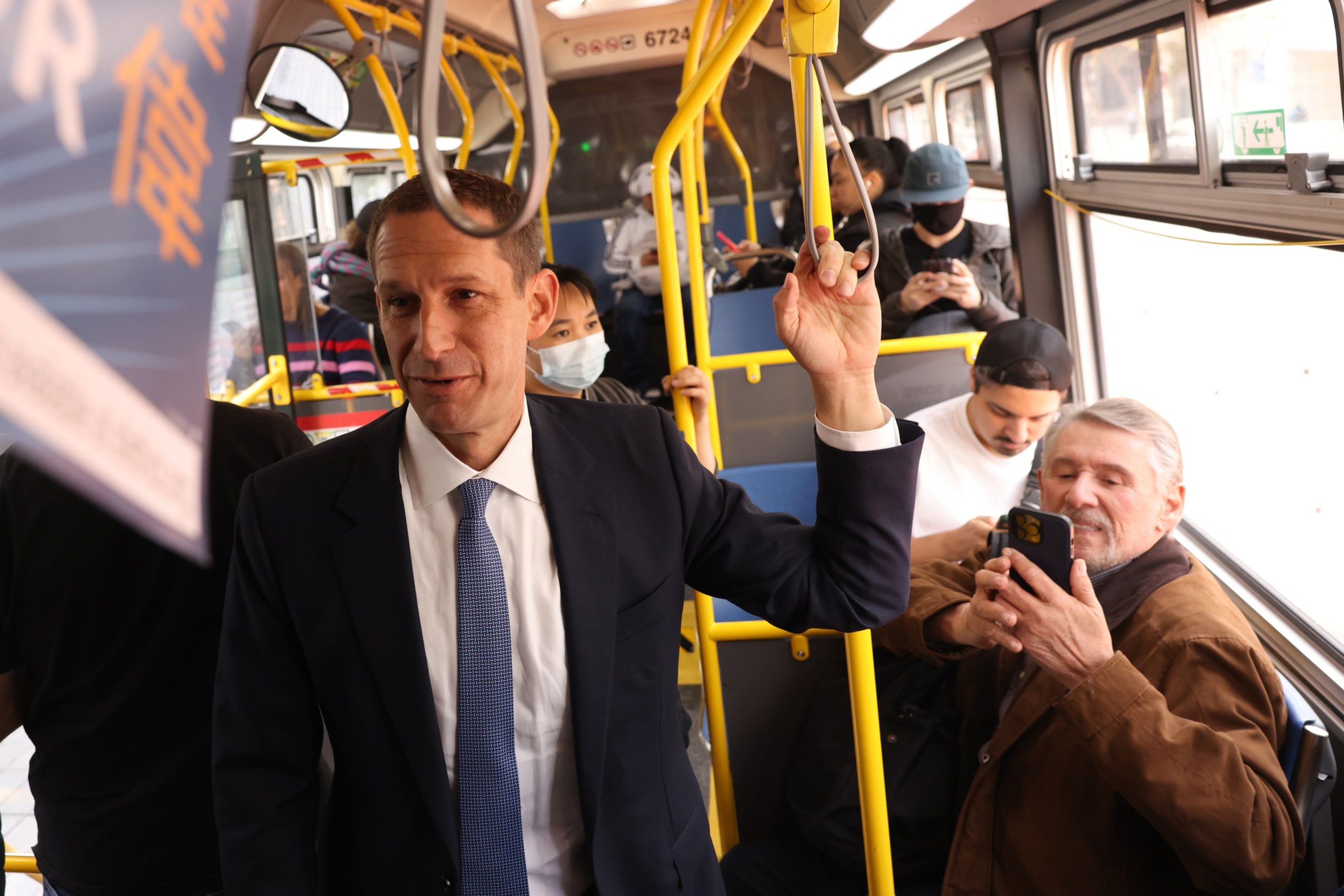 Voters have a choice, according to Lurie and his allies: Bail out Muni or suffer crippling service cuts that would kill downtown’s recovery. | Source: Emily Steinberger/The Standard
Even modest cuts, however, would put Muni in conflict with its labor unions, which has yet to ratify Lurie’s across-the-board salary increase and no-layoff promise, despite his having said the deal is not contingent on the passage of the parcel tax. Avoiding layoffs is a stated Muni goal of the taxpayer buyout, which agency chief Julie Kirschbaum told me is important for worker morale.
The numbers tell the story. SFMTA’s 6,000-person workforce has remained constant since 2019, before the pandemic, even as ridership yo-yoed. Labor costs then were around $700 million, versus $900 million now. Ever-rising labor costs are a fact of public-sector life in San Francisco, and Lurie has shown he would rather buy labor peace with taxpayer dollars than poke this formidable bear.
In that same time frame, fare revenue has plummeted after Muni halted fare enforcement during Covid. Transit fares accounted for $200 million in 2019 and $100 million in 2025. In (opens in new tab) recent months, Muni has begun emphasizing fare collection again, if half-heartedly. In September, two months before asking voters to back its tax, Muni started posting “Fare required” on the digital marquees of its buses. The Chronicle captured (opens in new tab) the cultural aversion to asking customers to pay by noting that one bus operator, responding to pleas from riders, turned off the message. Muni believes fare-enforcement efforts added about $5 million in revenue last year. (It doesn’t know for sure, but it extrapolates from firmer revenue-collection and ridership data.) Progress is progress, but so far Muni’s gains are a drop in the fare-collection bucket.
I asked Kirschbaum the same question I posed to Lurie: What is the appropriate level of subsidization for Muni? “I am trying to grow this percentage,” she said, pointing to a Muni-provided pie chart (opens in new tab)from February showing that fares, revenue from MTA-owned parking garages, and advertising on buses and shelters account for 30% of revenue.
Kirschbaum, a Muni veteran whom Lurie named as director of transportation in February 2025, is making progress in many ways. She eliminated hundreds of management positions and has boosted rider satisfaction. She realized that some ad agencies will not bid for Muni contracts that require them to maintain bus shelters. Rejiggering that and using Muni’s maintenance crews could raise the value of the contracts.
These moves are genuinely encouraging and are part of the reason I literally have lost sleep trying to decide how to vote on Prop. H. I believe in public transit. (I also ride my e-bike in MTA’s bike lanes every day.) I can afford the extra $129 in annual taxes and defer to businesses that have been persuaded they can stomach their share too. It is my choice to live in a high-tax city whose elected officials, Lurie included, won’t take up the difficult fight with public-sector unions, undoubtedly because a systemwide strike would be more devastating than limited service cuts.
Sure, I believe that the city can find additional funds and that business-as-usual with Muni’s labor unions should end. But I also think the benefits of keeping Muni humming — while encouraging Lurie and his deputies to keep pushing for efficiencies — outweigh the risks of service cuts and labor strife. That’s why I will hold my nose and vote yes on Prop. H, despite my arguments against it.
I realize that Muni’s boosters will read my weak defense of Prop. H as giving permission to Muni’s detractors to vote no. That’s fine. San Francisco, and Muni, will survive one way or the other.