
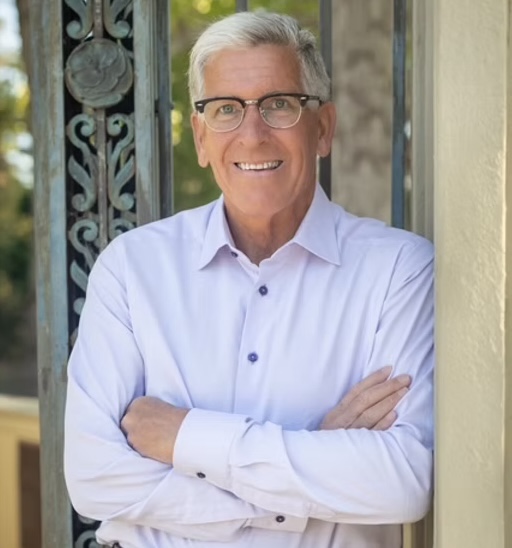
How long have you lived in Piedmont?
My wife, Julie Tanner Reichle, and I moved to Piedmont 26 years ago from North Berkeley. We had two daughters under the age of four and Julie, a Piedmont native, suggested this would be a good place to raise our family. As always, she was absolutely right!
What do you do for work, either in or out of your home?
I worked at UC Berkeley for 20 years and retired two years ago as Assistant Vice Chancellor and Chief of Staff of the Administration. In that role, I helped manage several university departments that are similar to those found in city government here in Piedmont, including: police, facilities services, capital strategies, emergency preparedness, disability access, sustainability, human resources, and IT. Although the scale is larger than the City of Piedmont, the challenge of delivering outstanding service within tight budget constraints is similar.
Prior to my career at Berkeley, I owned a marketing communications agency in San Francisco for twelve years. My partner and I, along with eight employees, provided creative marketing services to large corporations, law firms, and financial services firms downtown. Managing a small agency taught me rigorous financial discipline because our revenues were project-based and variable while our expenses were for the most part fixed.
Have you worked or volunteered in the Piedmont community (or elsewhere) previously? If so, in what capacity(ies)?
I have served on the Boards of Directors of several community organizations that Piedmonters support including the Piedmont Education Foundation, where I served as chair of its audit committee; Camp Augusta; Piedmont High School Boosters; and Piedmont Youth Soccer League.
When my daughters were younger, I was a youth softball coach (Go Fuzzy Puppies!), a soccer coach, and a youth soccer referee.
For several years and to this day, I enjoy helping Dress Best for Less set up for their monthly “Bag Sale” on the last Saturday each month. This is physical labor with a group of volunteers who come together for just one hour to talk and laugh and set up the sale to help raise money in support of Piedmont schools.
Outside of Piedmont, I chaired the capital campaign for UC Berkeley’s Lair of the Golden Bear family summer camp, raising $2.5 million to help rebuild and refurbish Camps Gold, Blue, and Oski. Julie and I met through working at the Lair and the camp holds a very special place in my heart.
What motivated you to run for office?
Piedmont delivers a high level of service to citizens on a relatively lean budget. It is well-known that Piedmont has the highest average household income of cities in Alameda County. What is less well-known is that our city government operates on less per capita than neighboring cities including Berkeley, Oakland, and Emeryville. One difference is that Piedmont has a small commercial tax base that those cities enjoy.
Receiving a high level of service on a lean budget is something which all Piedmonters can be proud of. Sustaining that level of service during inflationary times is a constant challenge.
My motivation to serve is to ensure that Piedmont can sustain its level of city services, parks, and facilities, and that we make smart financial decisions today that enable us to continue to do so into the future.
What are your qualifications to be on the City Council? Any special skills or experience the voters should know about?
My qualification includes serving as Assistant Vice Chancellor and Chief of Staff of the Administration at UC Berkeley. In that role, I helped manage several university departments that are similar to those found in the city government here in Piedmont, including: police, facilities services, capital strategies, emergency preparedness, disability access, human resources, and IT. This included developing and managing budgets, strategic planning, succession planning, scenario planning, and communications.
Prior to my experience at UC Berkeley, I owned and operated a marketing communications agency in San Francisco for twelve years. Owning a small business is a fantastic education in financial management, employee hiring and retention, customer service, and vendor relations.
My basket of skills is varied but all fall under the umbrella of business management. The consistent thread that runs through my business experience — and my success — is treating all people with dignity and respect.
What do you see as the most challenging issues currently facing the city?
There are several problems facing the city, from climate change exacerbating fire risk, to navigating the Housing Element in a way that keeps Piedmont in compliance with state mandates without sacrificing our character or compromising our safety. Addressing century-old infrastructure needs in a thoughtful and creative way that balances our needs in a way that we can afford also comes to mind.
All that being said, the most challenging issue facing Piedmont is inflation. Piedmont has a very lean operating budget; lower per capita than Berkeley, Oakland, and Emeryville. While that is something we can be grateful for, it doesn’t leave much room for financial shocks from a downturn in the economy or slowing down of the housing market.
On the expense side, complex mandates from Sacramento, aging infrastructure, and living in an expensive area with a competitive labor market all put upward expense pressure on the City’s ability to maintain current services.
City leaders including the City Council, the city administrator, department heads, and the volunteer Budget Advisory and Financial Planning Commission have done an outstanding job of navigating our financial situation. Doing a good job doesn’t mean we can stop worrying about money; we have to remain vigilant.
What do you see as strengths of the Piedmont community?
Piedmont is a wonderful community for several reasons. Most people move here for the schools which creates a community of people who value education and support our schools with their time, their volunteer efforts, and their financial contributions. This spirit of volunteerism and philanthropy goes beyond our schools and Piedmonters show up for several community organizations.
Piedmont is in the middle of a huge metropolitan area but feels like a small town. I enjoy walking our dog around town and greeting friends. Neighbors on our block look out for each other and bring in the mail and garbage cans when someone is traveling. The city Rec department puts on programs and manages facilities that bring people together. Especially in this day of individual electronic entertainment, Piedmont continues to be a community where people know and support each other.
What will be your top priority if elected?
I have three priorities for Piedmont: public safety, fiscal discipline, and community engagement. Without reliable public safety, nothing else really matters. Without fiscal discipline and budget management, nothing else is possible. When those two are well-managed, all of the parks, programs, venues, events, and programs that bring Piedmoners together can thrive.
Do you see yourself being especially involved in any particular city issue or program, whether or not it’s your top priority?
I hope to move forward the conversation about how we will sequence and finance the replacement of our aging city facilities. I recently came across an article online in the Oakland Tribune reporting that the City Council was considering replacing the fire house. The article was written in the late 70s. The current building is beautiful and functional but at some point it will need to be replaced and optimized for the fire department’s current needs. The same can be said for Veterans’ Hall, the Community Center, and the Recreation Department building.
Each one of those buildings is functional for now. I’d rather not wait for a critical failure to put a plan together to improve or replace them. I hope to move the conversation forward.
Talk about any leadership roles you’ve held and what you learned from them
My role as Assistant Vice Chancellor and Chief of Staff at Berkeley taught me the importance of listening to all sides and making sure people know they are being heard. The Administration had 2,000 employees in twelve departments and countless underlying issues and processes. There is no way one person could know all the details. What was required was the ability to listen, to understand concerns, to exercise consistent judgement, and to communicate effectively.
In that role, I was particularly proud of my ability to get along with various stakeholders including senior campus leadership, faculty, staff, students, donors, vendors, parents, and City of Berkeley officials.
Share an example of your decision-making style.
In general, my decision-making style is to gather information, check assumptions, discuss scenarios, and to try to balance caution and courage. Depending on the decision, I tend to seek out experts’ opinions, especially legal and financial.
Further, my decision-making style depends on the context of the decision.For instance, I definitely believe in taking a long-time to find and vet the best employees you can find. And, I have learned over time to be decisive when an employee turns out not to be a good fit for a particular role.
I am a “cautious optimist,” so I prefer to test my assumptions by creating best-case, likely-case, and worst-case scenarios and contingencies. I’ve worked for leaders who exercise what I call “reckless optimism” with no regard to the underlying data to support their decisions. That is not a practical way to manage.
What project have you worked on that you are especially proud of?
I am proud of my role in helping to secure the site of the former People’s Park in January 2024 so it could be developed into student housing. Over the last twenty years, the park had descended into violence, despair, drug dealing, prostitution, rape, and drug overdose deaths. Any allegiance to the utopian vision by activists only revealed their lack of familiarity with present day conditions. Securing the park is something that successive UC administrations had been attempting for fifty years and I myself participated in a failed-attempt in 2022. But from that failure we learned and adjusted and were able to successfully navigate the politics and secure the site with no one getting hurt and all of the residents of the park being offered transitional housing and social services.
City Council members must navigate a wide range of community opinions and demands. How will you handle those pressures?
One key to leadership is to listen to as many sides of an issue as practical and to let people know that I want to understand their point of view even if I can’t commit to it. At the end of the day, there may be things that I support that the city simply can’t afford or isn’t allowed to do.
As I walk around the city talking to voters about my campaign, a concern I have heard is people were disappointed when a particular decision made by city staff was not communicated well to them or their neighbors. In most cases they understood the decision but felt disengaged because it had been poorly communicated. For this reason, I am pleased that the city now has a Director of Communications who is available to assist departments in thinking through how they are communicating with Piedmont residents.
What should the city’s priorities be when it comes to upgrading city infrastructure?
I tend to put infrastructure into three buckers: short-, medium-, and long-term.
Short-term projects are those that have been identified to be addressed in the current year and budget and have identified dollars to pay for them. This includes on-going needs such as street paving, sewer repair, sidewalk repair, and hazard mitigation. This could also include upgrades for which money has been secured in the coming year.
Medium-term projects are known upgrades, replacements, ADA accessibility issues, technology enhancements, etc. These projects are known but dollars may not be identified or may be beyond the ability of the current budget. Sequencing of these projects is vital and can change often as money from specific grants, or an operating surplus, or philanthropy may create possibilities to move forward.
Long-term projects include the repair and replacement of aging city infrastructure, especially our public safety buildings. These projects would require long-term planning and creative financing involving state or federal sources, a bond issue, and most likely philanthropy.
The adoption of public surveillance technology such as Flock cameras has expanded in use across the country and has sparked community backlash in many localities, including here in the Bay Area. Some neighboring cities and counties have limited or removed Flock access, while others have continued to use or added Flock technology to their policing infrastructure. What are your views on Piedmont’s use of policing technology, including Flock?
I was an early advocate for ALPR technology as it wasn’t used to capture individual identifying characteristics, and the data obtained was only matched against a list of vehicles for which a known crime was under investigation. Further it allowed our small police department to expand its patrol presence without the need for additional officers. Piedmont has had success deterring crime using this technology.
I have read some of the disturbing anecdotes of the unauthorized misuse of ALPR data, such as the police officer who used location data to stalk an ex-girlfriend, or a deputy who scoured out-of-state data to determine if a Texas citizen had gone out of state seeking abortion services. These are chilling invasions of privacy.
With proper guardrails, this is effective crime-prevention technology. Piedmont has created a transparency portal and has published an ALPR policy which address concerns over the unauthorized use of data. However, ownership, use, and misuse of data is worthy of continued reporting and oversight to ensure that privacy rights are not compromised when using this and other technologies.
Piedmont is required by the state to meet new affordable housing goals, and the Moraga Canyon project is moving forward. What will you do to ensure that any development of that site includes a focus on pedestrian and traffic safety?
My concerns regarding possible housing in Moraga Canyon include: traffic circulation (both daily and during an emergency evacuation), pedestrian safety, bicycle safety, disability access, and wildfire mitigation.
The Moraga Canyon Specific Plan outlines requirements for those topics and several others in order to guide developers in the preparation of detailed proposals. If and when any proposals are submitted, I will be eager to review them for adherence to the vision and guidelines as specified in the Specific Plan.
During the course of this campaign, I have spoken with neighbors from the Maxwelton neighborhood north of Moraga Avenue. They expressed concern about pedestrian safety for kids returning from school and hope that eventual plans can include a pedestrian bridge over Moraga Avenue. While I cannot commit to one particular solution, I will be reviewing any proposed plans for specific traffic, pedestrian, and bicycle safety solutions.
Piedmont has recently received an award for its sustainability accomplishments and goals. The new all-electric pool is a testament to that progress. What would you do to further Piedmont’s Climate Action Plan?
Piedmont’s Climate Action Plan is ambitious and comprehensive. And slightly overwhelming for citizens to comprehend. It includes 27 objectives spread across 7 categories. I believe there is an opportunity to make further progress by developing communications campaigns around specific actions homeowners can take to achieve its objectives.
The addition of solar panels and storage batteries to many homes in Piedmont has demonstrated the power of financial incentives in getting homeowners to make investments that benefit the environment. In addition to the ideas expressed in the Climate Action Plan, I am also interested in exploring ways to further reduce residential food waste and to reduce the carbon output of last-mile delivery services. Like most communities, the number of Amazon, FedEx, and UPS deliveries has increased in recent years. Finding ways to reduce, consolidate, and electrify those deliveries would have a significant impact on reducing carbon emissions in Piedmont.
Piedmont leaders have grappled in recent years with the city’s racist past, most notably by commissioning a memorial to the Dearing family, who were the city’s first Black residents and who were forced from their home in 1924. Is a memorial enough?
When I first heard the saga of the Dearing family in Piedmont I was shocked, saddened, but not surprised. Sadly, there is no shortage of racist incidents in our nation’s history, and Piedmont is no exception.
I have talked to Piedmonters who are uncomfortable with the idea of the memorial. When I ask if they are able to share their concern, the most common response is that no one alive today in Piedmont was alive back when that tragic event occurred and it does not describe the Piedmont they know today.
From my perspective, that is the whole point of the memorial. Not to dwell on the past, but to share its story to convey how far we’ve come since then and how we refuse to go back.
In addition to the memorial, which has been developed with consultation of Dearing family descendents, the City has issued an apology to the Dearing family, and has made strides in addressing explicit and implicit bias through audits of its city communications, changing language to be more inclusive; and by requiring bias training for all police department personnel and other city employees.
Just for fun: What’s your favorite spot or feature of the city? (ie, a walking path, park bench, view spot, building, etc.?)
I walk all over Piedmont with our dog, Olive, and have many favorite spots. I am reluctant to name just one but the first one that came to mind when I read this question is the corner of Bell and Blair. I’m a sucker for a good view and that corner has a top-of-the-world feel to it where people often linger to take in the sweeping bay view. This time of year, you can watch fog enveloping the Golden Gate and sliding between Alcatraz and Angel Island on its way toward Berkeley. It’s magical.
Do you have a website to share with voters? If so, please add URL below.
I do. The address is ReichleforPiedmont.com
Piedmonters can read more about me and my interests, contact me with questions or comments, review their friends and neighbors on my Advisory Committee and endorsements. You can also sign up for a vintage California license plate lawn sign and a volunteer will drop one off on your porch.
Editor’s Note: Reichle’s wife Julie is the photographer for the Piedmont Exedra.