
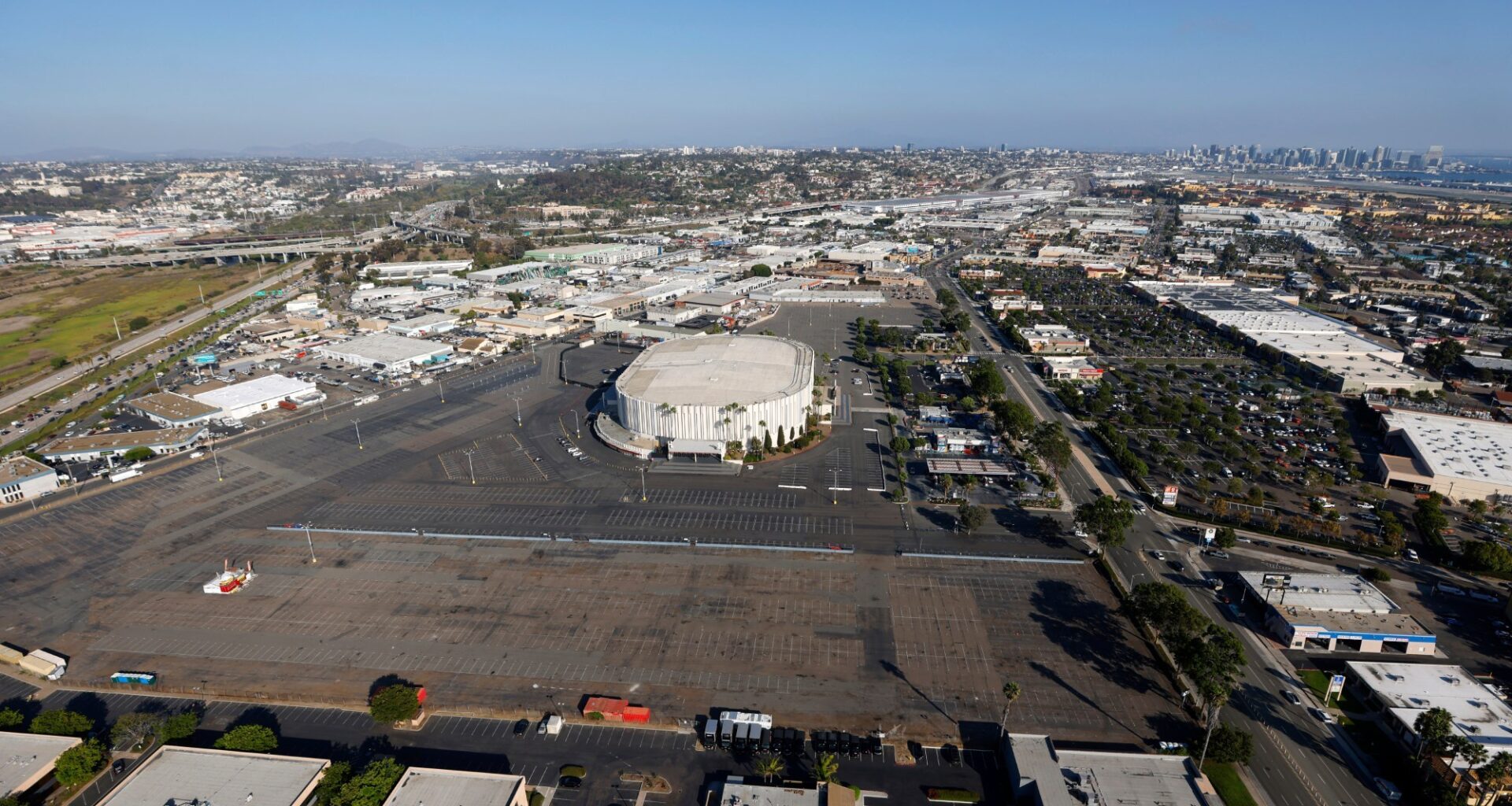
The proposed deal to trade San Diego’s expansive sports arena real estate for a new entertainment venue, thousands of low-income apartments and park space is a sensible one despite the risks, according to a new report.
San Diego’s Office of the Independent Budget Analyst released its analysis of the city’s proposed development agreement with master developer Midway Rising, LLC, on Monday.
The office, which exists to provide objective financial advice to the City Council, has participated alongside staff in negotiations with the development team for the past four years and believes the deal is “fair and reasonable” for the city.
The deal also represents one of the largest redevelopment efforts in the city’s history, according to the report, authored by Independent Budget analyst Charles Modica and senior fiscal and policy analyst Noah Fleishman.
“The city would retain ownership of the land, receive revenue over the life of the agreements, and potentially benefit from additional economic activity and investment in surrounding areas resulting from the redevelopment,” the analysts state. “While the proposed agreement involves a significant commitment of public resources and carries financial, construction and market risks … we believe the proposed agreement provides a reasonable balance of risk, financial returns and public benefits.”
The report also flags potential snags that could significantly reduce the rent the city collects or impact the construction of the project’s low-income housing.
Midway Rising is planning to lease and redevelop 48.5 acres of city real estate at 3220, 3240, 3250 and 3500 Sports Arena Blvd. in the Midway District. The development plan calls for 4,254 residential units, a 16,000-seat replacement arena, 130,000 square feet of commercial space, 8.1 acres of parks and an additional 6.4 acres of plazas and public space.
The team consists of market-rate housing builder Zephyr, affordable housing developer Chelsea Investment Corp., and sports-and-entertainment venue operator Legends. The group was selected to redevelop the land in September 2022, largely because of a commitment to set aside 2,000 residential units for households earning 80% or less of the area median income or what’s considered affordable housing.
As proposed, San Diego will collect rent as a small percentage of revenue generated by the project’s market-rate housing units and retail space, and on a per-ticket-fee basis for the future arena.
According to the IBA report, the city could collect $884 million to $1.23 billion in total rent over the lifetime of the proposed long-term arrangement, which is divided into a series of leases that extend for around 105 years.
The report notes, however, that the success of the atypically large transaction is highly dependent on economic conditions that will play out across multiple decades, meaning there is inherent risk for both the city and the developer.
For instance, the proposed 85-year lease agreement for the future entertainment venue allows the developer to skip out on hundreds of millions of dollars in rent payments if the venue isn’t profitable enough.
The city will collect rent on a per-ticket basis after the new arena has been in operation for 10 years. The fee will start at $1.50 per ticket in year 11 and grow by 3% each year. Initially, the developer will only pay 25% of the ticket charge to the city. The remaining 75% will accrue and be deferred until the developer hits a profitability threshold, which is set at a 16.5% levered internal rate of return on its capital investment.
But the developer may never reach the profitability threshold.
“There are reasonable scenarios in which the threshold could be achieved, as well as scenarios in which it may never be achieved during the lease term,” the report states.
If the developer meets the threshold or sells the venue in year 20, the city stands to collect $458 million from ticket fees during the 85-year term, based on attendance assumptions. However, if the hurdle is never reached, the city will only get $114.5 million from the fees, meaning it will lose out on $343.5 million in revenue, as reflected at the lower end of the IBA report’s estimate of total rent for the proposed deal.
Still, the analysts believe the lease structure is acceptable because the new arena will be constructed entirely at the developer’s expense and the city will share in its success.
San Diego may also need to wait a while before collecting rent on the market-rate units.
The city plans to lease individual development pads for market-rate housing and retail for 85 years, and will charge rent as a percentage of gross revenue, or 0.5% of revenue through year 55 and 2.5% thereafter. But rent is not due until the developer is made whole on its equity investment for each lease.
The market-rate housing will be financed through a combination of debt and equity, with the developer’s investors, mainly The Kroenke Group, expected to contribute around 38% of project costs, according to the IBA report. The equity investment is described as a “substantial” one that limits the financial risk associated with funding the residential units, but it does come with a trade-off.
“Because participation rent does not begin until the developer recovers its equity investment, a larger equity contribution could also delay the commencement of rent payments to the city,” the report states.
The IBA’s office is projecting that the city will receive $769.2 million in rent over the life of the market-rate ground leases, although 90% of the revenue is expected in the final 30 years of the leases.
Other deal variables identified in the report include the to-be-determined details of the financing mechanism expected to reimburse the developer for infrastructure expenses, and the financing assumptions associated with the affordable housing units.
The city and the county are contemplating the formation of an enhanced infrastructure financing district to reimburse the developer for a portion of the upfront cost to construct new parks, new streets, roadway improvements, parking, and on- and off-site utilities. With an EIFD, the public agencies would give their share of future property tax growth in the project area to a special district to fund the improvements.
However, the financing mechanism may not raise sufficient funds to cover the expenses, at least as currently envisioned. A 3% carrying cost, or the compensation rate the developer would get to cover the period between its out-of-pocket costs and the reimbursements, might be unrealistic given higher market financing rates, the report states. And the available tax increment may not be as great as anticipated if the assessed value of project assets grows slower than 4% each year, as assumed.
When it comes to the affordable units, the report states that the developer may be overestimating how much it can get from investors for low-income housing tax credits awarded by the state, potentially leaving a gap in the financing required to fund construction. The model assumes the tax credits can be sold at 90 cents on the dollar, which is above current market rates.
“The developer’s ability to secure financing and proceed with each phase, particularly the affordable housing, will be critical to the project’s ultimate success. Similarly, the proposed EIFD will require additional analysis and future approvals to ensure that infrastructure reimbursements and associated financing costs remain supportable under reasonable economic assumptions,” the report states. “These uncertainties underscore the importance of continued city oversight and periodic review as the project progresses.”
San Diego’s Land Use & Housing Committee will consider the transaction terms in open session for the first time on Friday.