
By Dan Walters, CalMatters

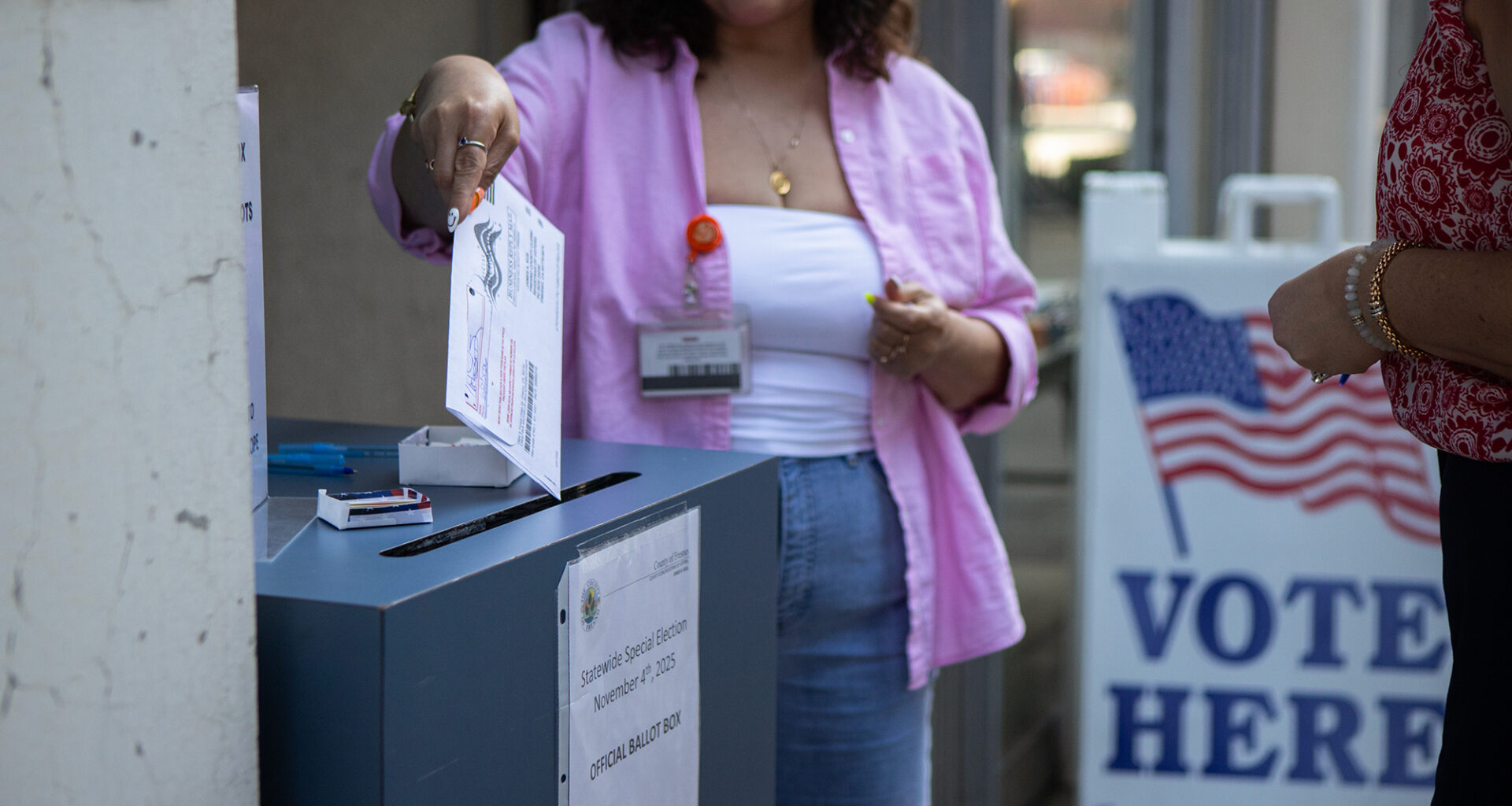
A voter casts their ballot in downtown Fresno on June 2, 2026. Voters will decide 12 statewide money issues this November. Photo by Larry Valenzuela, CalMatters
This commentary was originally published by CalMatters. Sign up for their newsletters.
California voters will pass judgment on 14 statewide ballot measures this year and all but two of them relate, in some manner, to financing public services.
Collectively they represent the latest version of what fiscal policy buffs call “ballot box budgeting” — persuading voters to prioritize or limit how funds are raised and spent rather than leaving those issues to elected officials.
This election’s most contentious measure, Proposition 40, typifies the underlying philosophical conflict that has raged ever since voters passed Proposition 13, the state’s iconic limit on property taxes, nearly a half-century ago.
Prop. 13 embodied the belief that high taxes undercut Californians’ ability to enhance the welfare of their own families. Prop. 40, which would impose a 5% tax on the wealth of California’s billionaires, reflects the counter-contention that expansive public services better serve the well-being of all Californians.
Before Prop. 13 made the June 1978 ballot, the initiative process almost never dealt with tax and spending issues, a yearly summary from the secretary of state’s office indicates. Implicitly, voters were content to leave such money matters to elected state and local officials.
Prop. 13 reduced property taxes that had been the fundamental revenue source for local governments and school systems. It also made raising taxes of all kinds more difficult.
Prop. 13’s jolting impact also encouraged the use of ballot measures process not only to affect public finance issues but policies of all kinds. Succeeding elections saw an explosion of proposals dealing with such issues as punishment for crimes, immigration, affirmative action and same-sex marriage.
The two measures on this year’s ballot that don’t deal with taxes and spending typify that trend. Proposition 39 would require voters to show identifying documents and Proposition 45 would reduce use of the California Environmental Quality Act to block projects.
However, taxes and spending continued to dominate post-Prop. 13 elections, beginning in 1979 with a special election called by then-Gov. Jerry Brown to pass Proposition 4, a cap on state spending known as the “Gann Limit” for Paul Gann, a co-author of Prop. 13 with fellow tax gadfly Howard Jarvis.
Brown had strenuously opposed Prop. 13 but after its passage declared himself to be a “born-again tax cutter” and joined with Gann to persuade voters to approve the spending limit. It continues to be a factor in fashioning an annual state budget.
A much bigger budget factor is Proposition 98, a 1988 measure sponsored by the California Teachers Association to cushion Prop. 13’s impact on school finances. Prop. 98 contains a complex formula to guarantee a certain level of state education aid that works out to about 40% of general fund revenues.
The teachers’ union is opposing this year’s Prop. 40, the wealth tax on billionaires, which designates all but a small percentage of its revenue for healthcare, excluding Prop. 98. The conflict illustrates how ballot box budgeting pits interest groups against each other, even those on the same side in their underlying battle with anti-tax forces.
Speaking of which, anti-tax groups such as the Howard Jarvis Taxpayers Association have continued to press their cause, staving off efforts to change Prop. 13 and promoting tax limits.
This year, they are pushing Proposition 43, which would increase the vote requirement to approve some local taxes. And they’re opposing the California Teachers Association’s Proposition 3, which would make permanent a temporary tax on high-income Californians that was initially passed in 2012 at Brown’s behest during his second stint as governor.
During the 17th century, a conflict known as the 30 Years War raged in Europe. Today California’s war over taxes and spending is already 48 years old and, as this year’s array of ballot measures indicates, it shows no sign of ending.
This article was originally published on CalMatters and was republished under the Creative Commons Attribution-NonCommercial-NoDerivatives license.