
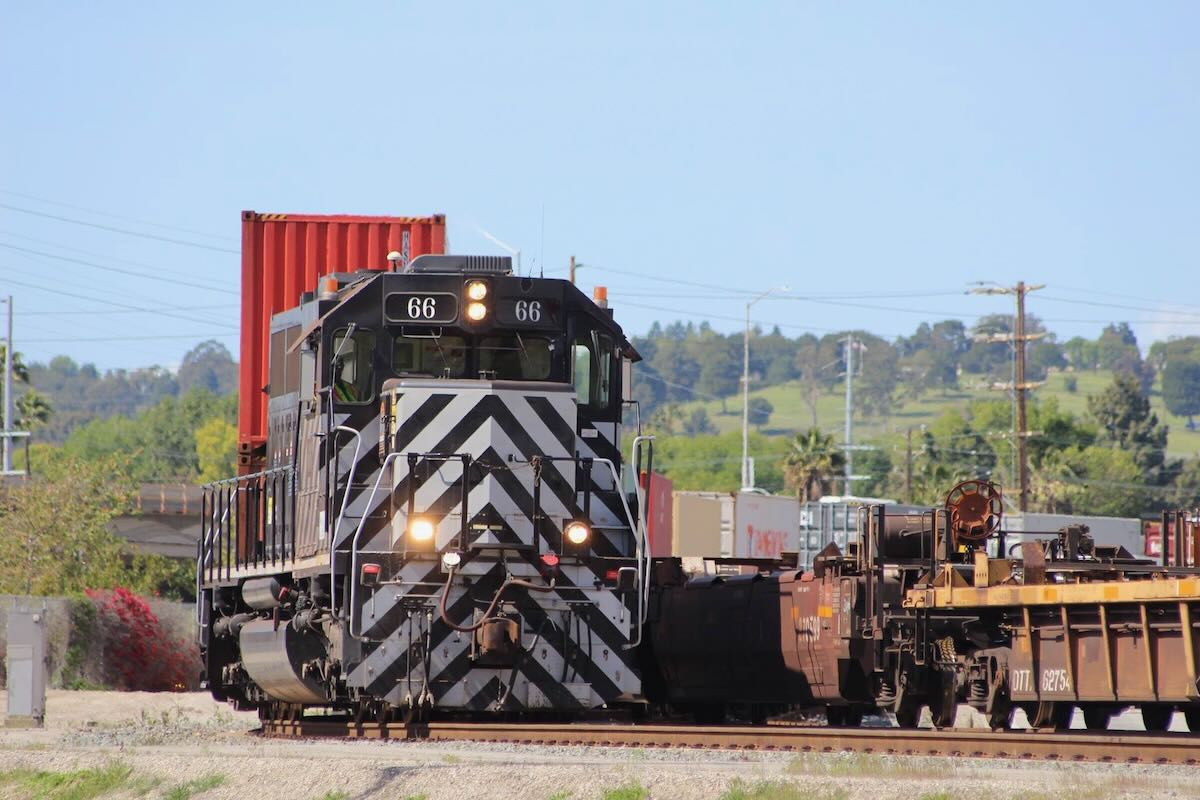
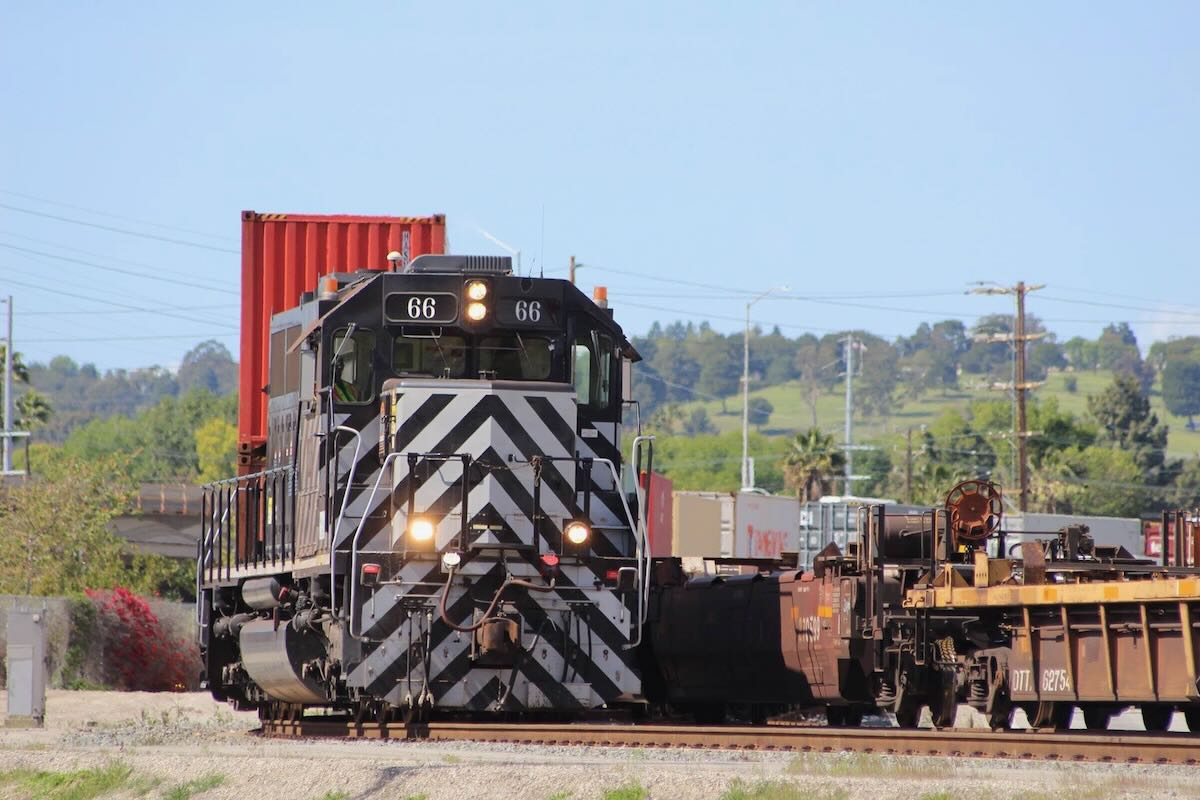
 A Pacific Harbor Line MP20C-3 shuffles a string of containers at the Port of Los Angeles.The Surface Transportation Board has placed a transfer of rail service to Alameda Belt Line on hold. David Lassen
WASHINGTON — The Surface Transportation Board today (Oct. 15) placed the transfer of rail service for the ports of Los Angeles and Long Beach on hold, delaying the effective date for an exemption that would allow Alameda Belt Line to take over common-carrier operations at the two ports.
The board’s action came just over a week after current operator Pacific Harbor Line asked the STB to issue a “housekeeping stay” on the transfer of operations, and two days after ABL said that request had no merit.
“To allow the Board sufficient time to consider the issues raised in PHL’s request and ABL’s reply,” the board said in its brief decision, “the effective date of ABL’s exemption will be postponed until further order of the Board.”
ABL — a joint operation of Union Pacific and BNSF Railway — had sought to have the exemption take effect on Friday, Oct. 16, which it had indicated was the earliest date it might have all agreements completed. Since ABL informed the board of its intent to take over operations [see “Alameda Belt Line files notice …,” Trains.com, Oct. 2, 2026], the Los Angeles Board of Harbor Commissioners havs voted to approve the tentative agreement with ABL. Long Beach commissioners are expected to vote on the deal on Oct. 26.
PHL made its request to the board on Oct. 7, saying that ABL had yet to complete the necessary agreements and had not explained how the changeover would take place without service disruptions [see “Pacific Harbor Line urges regulators …,” Trains.com, Oct. 8, 2026].
ABL’s response, filed Oct. 13, argued that the governing regulation does not require all agreements to be concluded for the company to receive the regulatory exemption it seeks. ABL said it needs only to provide “details about when an agreement will be reached,” which were included in its notice of intent to take over operations.
ABL also contended that PHL is at fault for any lack of clarity about the changeover, saying PHL in August halted meetings between the two companies over the transition because of what ABL calls “an unrelated lawsuit.” And ABL noted that its preparations to ensure a smooth transition include a Memorandum of Understanding with the Brotherhood of Locomotive Engineers and Trainmen. That agreement calls for ABL to retain current operating employees of PHL under the same terms as the existing PHL-BLET agreement. ABL also plans to employ the “relative handful” of supervisory employees who oversee those union workers.
ABL’s filing outlines its timeline for the transition. It calls for terminal maintenance, dispatching, and train control operations to transfer to ABL on Dec. 3, the day after PHL’s contract for those services expires, and for ABL to take over full operating responsibilities on Jan. 1, 2027, after the PHL contracts with the ports and Union Pacific expire on Dec. 31, 2026.
In its conclusion, ABL said, “The Ports are ready to realize the anticipated benefits and operational innovations that were central to ABL’s successful bid. The actual culmination of this extended process is ready to begin. The only obstacle to the finish line is PHL’s attempt to inject self-interested innuendo into an otherwise straightforward STB process.”
— Updated Oct. 15 at 4:50 p.m. CT with board decision. To report news or errors, contact trainsnewswire@firecrown.com.
Share this article
Facebook
Twitter
LinkedIn