
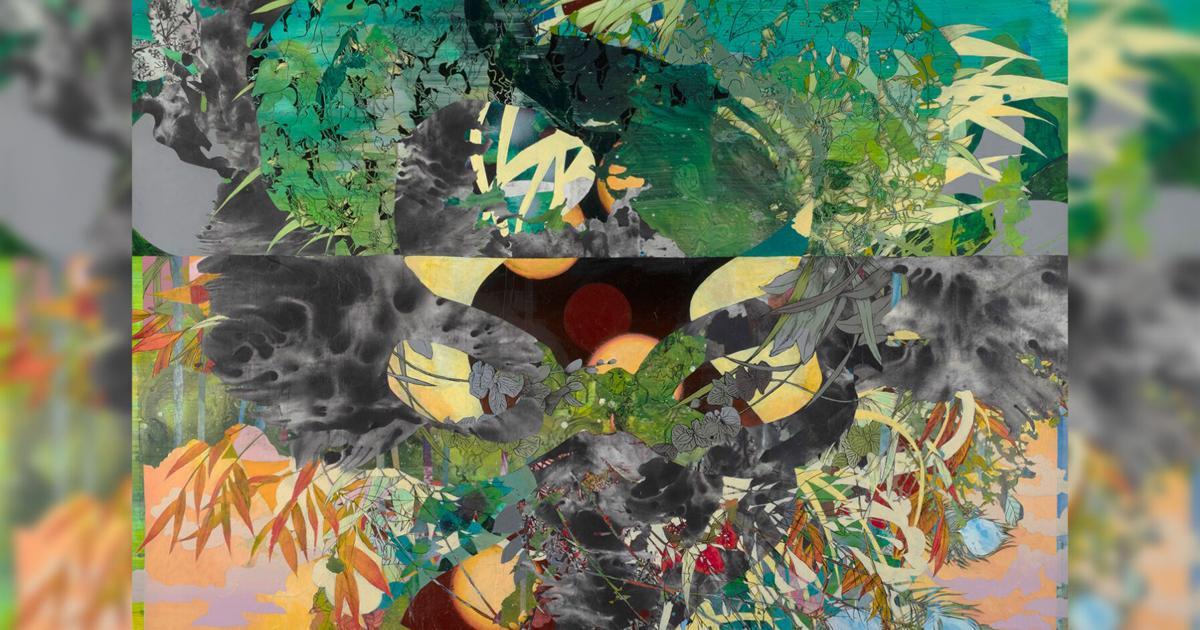
Katherine Tzu-Lan Mann’s art exhibit at Dolby Chadwick Gallery on Nov. 6 was defined by hybridity, cohesion and the art of making things fit.
Mann’s work is like a page right out of a magical realism novel, though it remains grounded in the harshness of mundane reality. At its nucleus, it is artwork that is, both physically and emotionally, a collage of Mann’s internal world. It spans from bone marrow to brain matter, from Sumi ink to wood carvings.
Mann was traditionally trained as a Chinese landscape artist and this origin is not forgotten in her present work. In fact, she likes to think of her art as “collaborations with her younger self.” Being born in Wisconsin, living all over Asia and the United States as a child and finally landing in Washington, D.C., there is breadth in her personal geographic patchwork. Wherever possible, she integrates either physical pieces of artwork from her teen years in Taiwan or implements the visual of the “Four Gentlemen” — four commonly painted plants in traditional Chinese culture.
She was educated to master the manipulation of Sumi ink, the medium that becomes the humble beginning of every piece. No matter how abstract her finished pieces grow to be, her collages remain landscapes. Only now, they are landscapes of psychological ecosystems.
Mann begins her pieces by laying white paper horizontally on the ground and splattering black Sumi ink onto the emptiness. It cascades into different life forms, orbs of new galaxies, the meandering black ink being capable of tempting imagination. Mann expressed that she often lets her kids spill the ink, which builds on her ever-growing mantra of fusion: In her art, her motherhood is indivisible from her expression. She builds, from that base, either hand-painting within vacant spaces, carving wood and then pressing in ink or collaging in work from a younger self.
Even the duration of the process is a synthesis of different waiting periods and mediums; Some sketches take minutes, while some carvings take weeks. Yet she still takes two estranged puzzle pieces and carves their shape into marriage, allowing us the privilege of insight into her past and future.
While Mann’s work can be described as chaotic, each piece is held together by a quiet centering force. They feel like portals, worlds you could almost step into. As I wandered the gallery, I felt the appetizing temptation to abandon the smug art lovers around me — those trying to equate Mann’s passion to price tags, to purchase parts of her to hang in large, hollow homes, only to resurrect dinner parties. The pieces whispered with a tantalizing invitation to step inside instead, into a world that Mann created, one not limited by rules, but elevated by boundlessness.
Mann told a tale of her own to me while describing “Double Shen,” a piece inspired by Chinese folklore. Shen is in reference to the translation of clamshell in Chinese and tells the fable that describes sailors being lost at sea and distracted and consumed by mystical clamshells. They are almost similar to a siren, but the clamshells can turn into anything they wish; they have the power to do the impossible. It was implicit, but Mann talked about them as if they were a guide for herself, a paintbrush to the unfeasible.
The exhibit’s namesake piece, “Treasured Bearing,” touches on the tension between birth and the cyclical. In the painting, leaves climb over anything with depth to cling to, tangling together to form a pelvis. It is almost unrecognizable unless you know it is there, but that is the point, and the beauty of the piece. The painting depicts a full circle, both in the bones that violently push out bloody newborns and in the glowing, planet-esque paintings nestled within the pelvis, seeming both immortal and tangible. The piece gave the impression of floating in a thick liquid.
I could imagine myself peeling back the paint and slipping into the translucent gunk, growing gills in my skin and swimming toward the glowing planets forever, though never quite arriving. But like in any womb, I would be warm and safe.
Mann has mastered the ability to spark invention from her own life. She conveys the hybridity of her life through an amalgamation of paper and brushstrokes.