
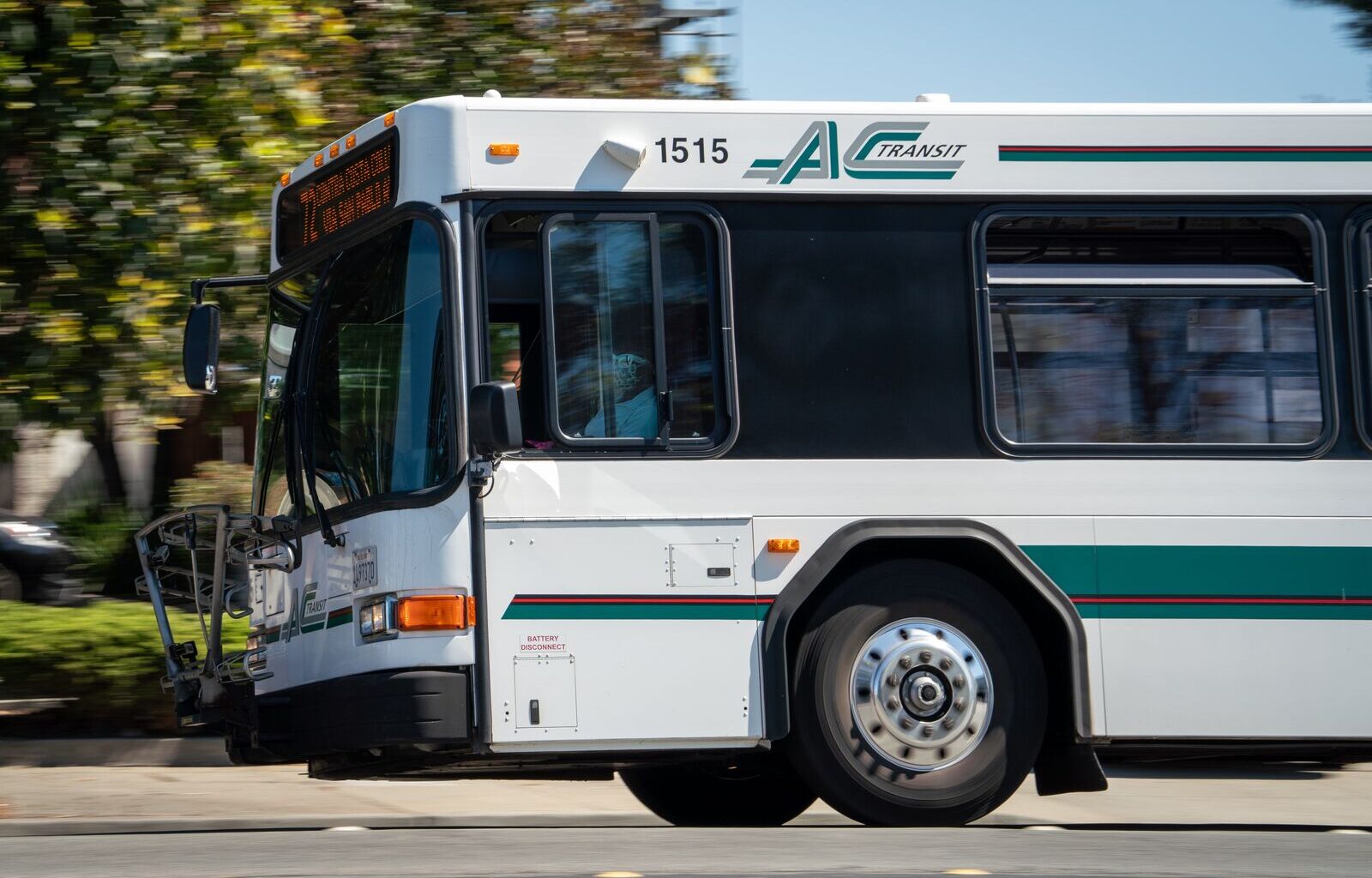
For several years, the Bay Area’s major transit systems have financially struggled. The pandemic massively cut into ridership, and as the number of fare-paying passengers declined, agencies from BART to AC Transit have relied on state and federal funding to bridge the gap.
Slowly, over the past year or two, ridership has been recovering. For example, BART, the region’s biggest train system, recently experienced double-digit percentage growth in ridership, according to the most recent data.
But the Bay’s transit systems are still not out of the financial woods — ridership still lags behind pre-pandemic levels, and big budget deficits are looming. BART; San Francisco’s MUNI bus service; AC Transit, whose buses connect Oakland, Richmond, Fremont, and everything in between; and Caltrain, which serves San Francisco and the peninsula, are projected to have a combined $800 million in operating deficits starting next year.
Measure RTM, the Regional Transit Measure also known as the Connect Bay Area Transit Initiative, would impose an additional half-cent sales tax in Alameda, Contra Costa, Santa Clara, and San Mateo counties, and an additional one-cent sales tax in San Francisco to raise roughly $1 billion each year for 14 years. This revenue would be split among the Bay Area’s biggest transit systems, with a small share used for road paving and other traffic infrastructure projects along transit routes.
An independent oversight commission of volunteers would have the authority to keep watch over how the money is spent
Measure RTM requires a simple majority within the five participating counties to pass.
Without RTM, BART and AC Transit face massive cuts, say transit leaders
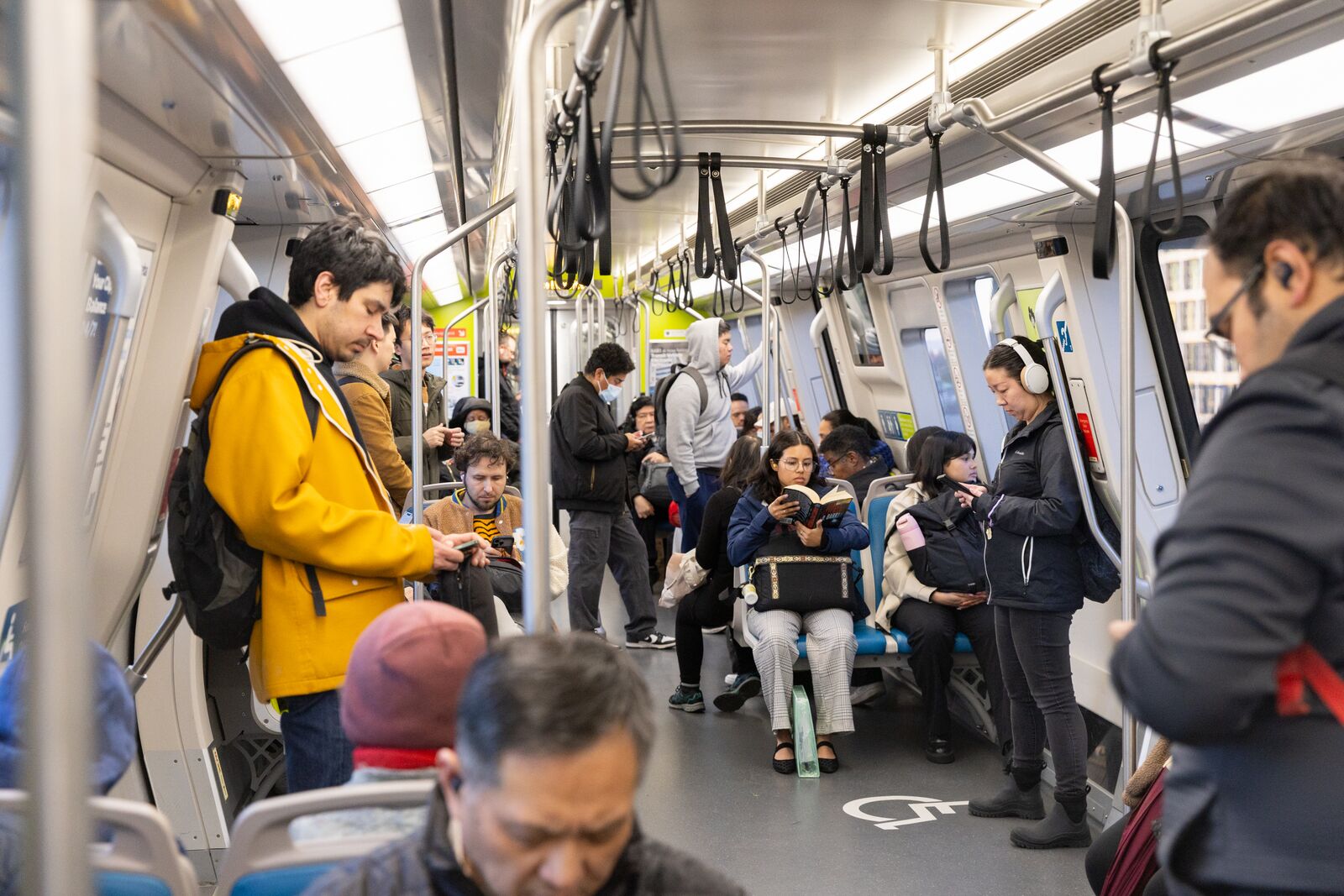 Passengers aboard a BART train read and listen to music while commuting. Credit: Estefany Gonzalez for The Oaklandside
In February, BART released a report outlining what would happen to the agency if new revenues were not raised to subsidize its costs. Without its share of the billions RTM could raise, BART would face annual budget deficits of between $376 million and $390 million each year through 2031. Agency leaders say this would force them to make dramatic cuts starting in January 2027, including closing 10 stations, slashing 63% of train hours, and implementing steep reductions in fleet maintenance, BART police and systems support.
BART officials said even these reductions wouldn’t put the train system on a path to sustainability because they would be so big that “revenue losses may equal or exceed cost savings.”
AC Transit revealed a similar plan in March, saying the agency would have trouble patching a projected $50 million annual deficit without RTM. Agency leaders say they would need to cut bus service back to two-thirds of pre-pandemic levels to achieve necessary savings.
Supporters say the whole Bay Area will suffer without strong transit
Rail and bus systems move hundreds of thousands of people around the Bay Area each day, getting them to and from work, school and other destinations. Without RTM, the region’s transit systems will be cut back in unprecedented ways, “setting us back decades,” the measure’s supporters argue.
Station closures would mean you couldn’t take BART to get to places like South Hayward and Warm Springs; every stop on the Dublin/Pleasanton line would close, including Castro Valley, and the Oakland Airport connector would be no more. “Our public transit system reduces traffic, supports the local economy, and ensures everyone has an affordable way to get where they need to go — including families, seniors, people with disabilities, students and workers,” supporters wrote in the official argument supporting RTM, which will appear in Alameda County’s voter information guide.
The ballot measure’s supporters say that even if those who don’t take transit to get around will be impacted. “Thousands of people would be forced onto our already congested roads and freeways every single day, worsening air pollution, making traffic jams start earlier and last longer,” supporters wrote.
Authors of the official argument in favor of RTM include:
Louise Rothman-Reimer, League of Women Voters Bay Area
Zac Unger, Oakland city councilmember
Xiomara Cisneros, Greenbelt Alliance
Sandra Johnson, United Seniors of Alameda County
John Pearson, ER nurse
People and organizations who’ve endorsed RTM include:
Congressmember Lateefah Simon
Nancy Pelosi, former Speaker of the House of Representatives
State Senator Jesse Arreguín
State Assemblymember Buffy Wicks
Oakland Mayor Barbara Lee
Alameda County Supervisors Nikki Fortunato Bas, Nate Miley and Elisa Márquez
The Alameda Labor Council and other major unions
The Bay Area Council and other major business groups
Opponents say RTM is a regressive tax and transit agencies can’t be trusted
Life is already expensive in the Bay Area, and a half-cent sales tax would make it even more difficult, opponents say. The increase would leave many Alameda County residents, including Oaklanders, paying an 11.25% sales tax on most purchases. The sales tax in Oakland is currently 10.75%.
“Seniors, students, the disabled and low-income neighbors are hurt the most by an increase in the Sales tax,” they argue in the official argument opposing RTM.
“Voting NO demands accountability before locking in $17 billion in new taxes,” opponents wrote on their No RTM campaign website. “Sales taxes are regressive and hurt working families the most. Bay Area transit agencies already collect over $6.2 billion every year in public subsidies, yet Measure RTM provides nonbinding oversight and locks in current inefficient operating models for 14 years.”
Opponents say they don’t trust the leadership of the region’s transit agencies to spend the money wisely. Most of the money raised by the measure would be given to BART as a “bailout,” they claim.
“BART and AC Transit are grossly mismanaged,” authors of the official argument against Measure RTM wrote. “They gave pay/benefits above $250,000 to 600 employees in 2024.”
Opponents argue that BART and the Santa Clara Valley Transportation Authority misspent $13 billion on an extension of service to downtown San Jose, which included building four new BART stations.
Authors of the official argument against RTM include:
Marcus Crawley, president of the Alameda County Taxpayers Association
Steve Kauzlerich, member of the Alameda County Taxpayers Association
Attorney Marleen Sacks
Nancy Sidebotham, a tax preparer and candidate for Oakland City Council District 6
Damian Park, former chair of the Berkeley Unified School District’s Citizens’ Bond Oversight Committee
Another major opponent is the Committee for Affordable Bay Area Transit, which includes:
Gregg Dieguez, president, a resident of Montara, in San Mateo County
Thunder Parley, a former candidate for governor
Marc Joffe, president of the Contra Costa County Taxpayers’ Association
Thomas Rubin, a transit industry consultant
“*” indicates required fields