
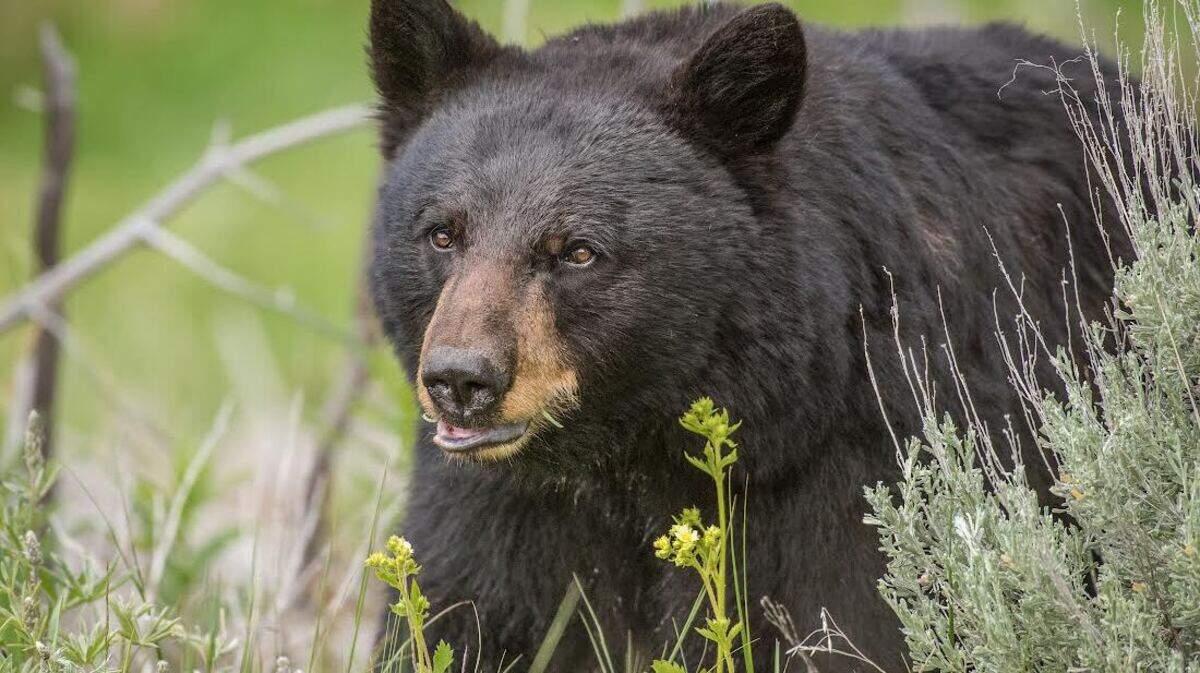
Bear behavior is changing in Sequoia and Kings Canyon National Parks as winter approaches. As winter nears, bears are actively foraging as they prepare for hibernation.
American black bears are an integral part of the Sierra ecosystem and one of many wildlife species the National Park Service is mandated to protect.
Sequoia and Kings Canyon National Parks have expanded to cover 1,353 square miles over the past 125 years and attract more than 1.5 million visitors annually.
But with more bear activity as they prepare for winter hibernation has come a sharp increase in property damage from bear incidents in the parks.
According to the National Park Service, a bear incident occurs when a bear causes monetary loss, including property damage, or successfully obtains human food.
“Black bears in our national parks are wild, beautiful animals,” said Sequoia and Kings Canyon National Park superintendent Woody Smeck. “We ask visitors to admire them from a safe distance and to secure food and other scented items.”
When are bears most active in Sequoia and Kings Canyon National Parks?
Located in the Sierra Nevada foothills, Sequoia and Kings Canyon National Parks are home to hundreds of American black bears, though official population estimates are unavailable.
Black bears in California typically enter dens between October and December, remaining inside for several weeks to months depending on climate conditions, according to the California Department of Fish and Wildlife.
These efficient hibernators seek shelter under fallen logs, in brush thickets, high in tree hollows, in rock crevices or under decks and patios.
Bears emerge in the spring, usually between March and May.
Are bear incidents on the rise in Sequoia and Kings Canyon National Park?
As of Sept. 28, bear incidents in Sequoia and Kings Canyon National Parks have increased 125% since 2020, according to data shared by the park officials with The Fresno Bee.
The total property damage values have spiked 1,800% year-to-date, reaching $17,358 compared to $898 in 2020. The bear incidents stood at 158 in 2020 before reaching 356 by late September 2026.
Over the past seven years, annual incident counts have fluctuated significantly.
The incidents nearly doubled in 2021 before peaking at 499 in 2022. The number dropped to 198 in 2023, then steadily rose to 238 in 2024 and 359 in 2025.
The property damages recorded in 2025 totaled $8,548 about half of 2026 levels so far while 2023 saw a low of $874 in damages.
The data shared by the park with The Fresno Bee show only two human injuries from bears over the last seven years. Six bears were euthanized due to conflict behavior during the same span.
As of Sept. 28, 61 bear incidents involved unsecured trash and 19 involved human food, according to the park. Bears often obtain food waste from cans, dumpsters, or litter and obtain other food from campgrounds, picnic areas, or directly from people.
The trash-related incidents peaked in 2022 along with total incidents, while human food rewards peaked in 2021 at 59 incidents. In 2025, trash accounted for 40 incidents and human food for 27.
How common are car crashes involving bears?
Giant Forest, Halstead Meadow, and Cedar Grove have recorded the highest frequency of bear-vehicle collisions in the parks over the past three years.
In 2024, park staff euthanized a bear cub after it suffered severe injuries in a vehicle strike.
18 bears were injured in vehicle collisions between 2020 and 2026, peaking at six injured bears in 2025. Two collisions have been reported so far in 2026.
Four bear fatalities from vehicle strikes were recorded from 2020 to 2026, including two in 2024 and one each in 2021 and 2025.
Park officials said that these statistics reflect only reported incidents. Officials have not determined exact numbers for year-over-year variations in incident rates.
“Visitation and access varied considerably during this period because of events including the COVID-19 pandemic, the 2020 Castle Fire, the 2021 KNP Complex Fire, and severe winter storms, flooding, and mudslides in 2022 and 2023,” according to a park statement to The Fresno Bee.
What should I do if I encounter a bear?
The National Park Service recommended these safety guidelines when encountering black bears in natural or developed areas:
Bear Encounters in natural areas
Stay together, especially with small children.If a bear changes its behavior because of your presence, you are too close.Don’t get between a female and her cubs.Don’t linger
Bear Encounters in developed areas
The park advised visitors should take steps to discourage bears from campgrounds, picnic areas and buildings in order to prevent habituation and food conditioning.
Immediately make sure that all your food and food-related items are stored properly.If you see a bear, gather your group together, especially children, to appear larger and make loud noises.Never surround a bear.Never come between a female and her cubs.If a bear does obtain your food, do not attempt to retrieve it.If a bear huffs at you and shows its profile, it may be ready to bluff charge. Stand your ground or back away slowly. Do not run.
What should I do if a bear bluff-charges me?
While bluff charges are rare, park officials advise the following measures if a bear charges:
Stand your ground, raise your arms to appear large, and yell firmly at the bear to back off.Back away slowly only after the bear backs away. The bear may be protecting food or cubs.If a bluff charge becomes a real charge and a bear makes bodily contact, tuck into a ball face down with your hands clasped behind your neck.If the bear does not immediately back off and continues in its attack, fight back hard using your fists, rocks, or whatever is available.
Loading…
The Fresno Bee
Gagandeep Singh is a service journalism reporter for The Fresno Bee. He holds a master’s degree in politics and global affairs from Columbia University. Prior to working at The Bee, he worked as a freelancer for CalMatters, BBC News and the Los Angeles Times. He focuses on migration, education, criminal justice and the South Asian diaspora in California.