
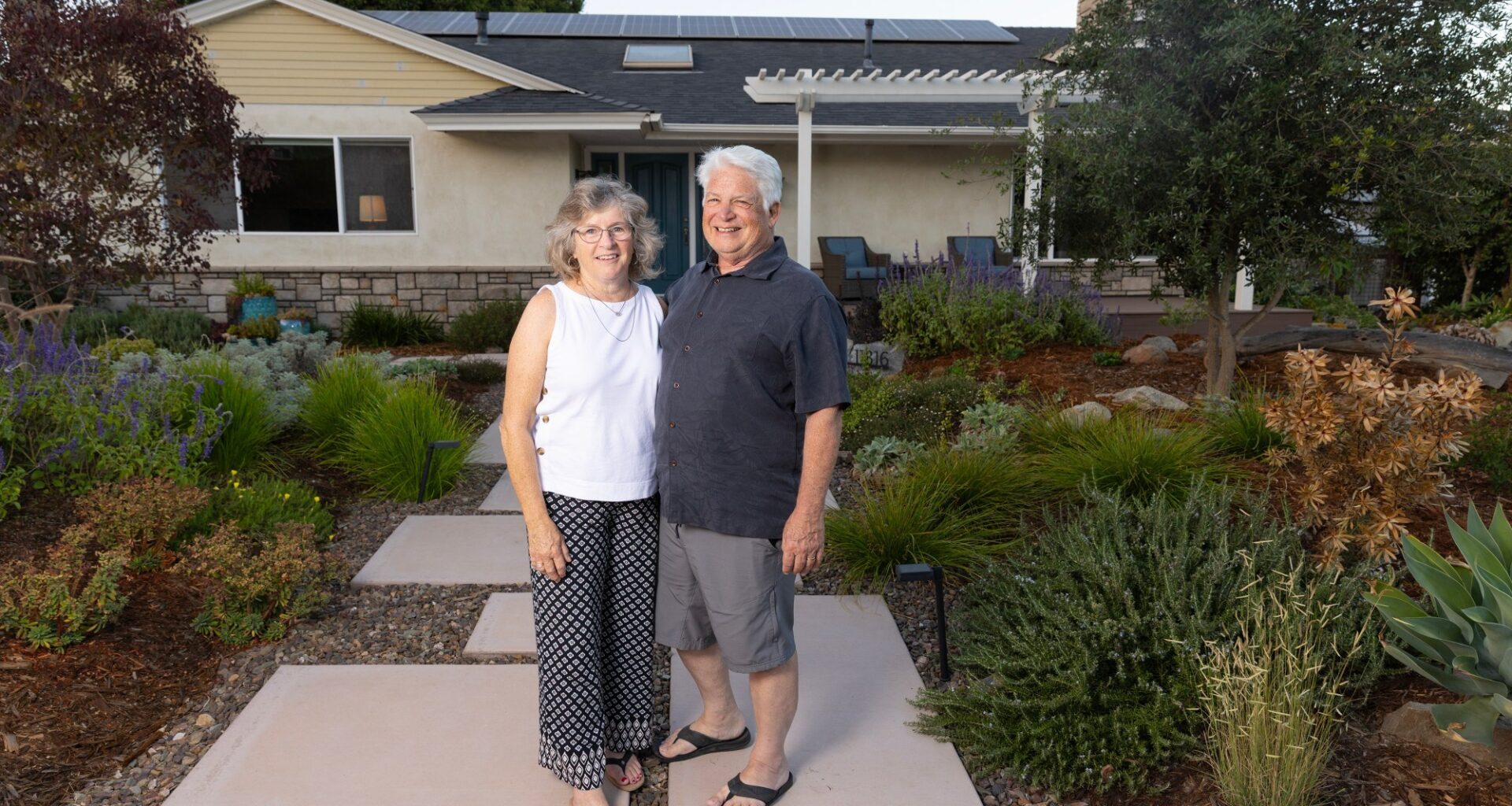
For The Union-Tribune
Like many couples with children, Mark and Terri Linman’s initial landscaping project decades ago was to create a space where their three young daughters could play. Back then, after they bought their Mount Helix home in 1997, it included a lawn, of course. But there were also a row of liquidambar trees, a couple of camphor trees and a large Shamel ash.
Those trees were a huge attraction to their oldest daughter, who was 7 at the time, said Terri Linman.
“Look at those trees!” Terri recalled her saying to her parents. “I can climb those!”
But, said Terri, the girls long ago aged out of tree climbing, and those tall features are now all gone.
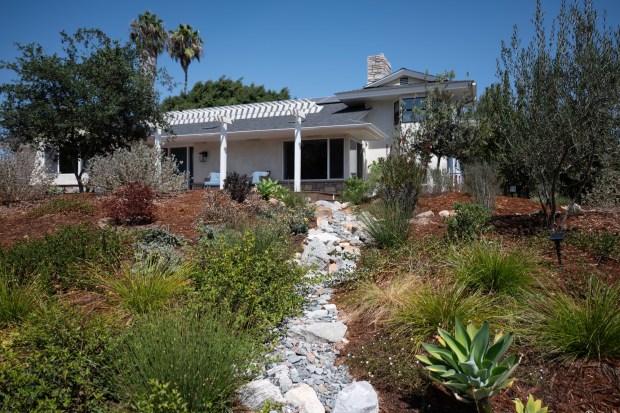 A dry rock riverbed in the Linmans’ front yard, seen in mid-September, helps collect rainwater and route it to plants nearby, rather than having it wash out to the street. (Luke Johnson / The San Diego Union-Tribune)
“Our girls are in their late 20s and 30s now, so we didn’t need the recreation area,” Mark Linman said.
That led to other recent changes. The little brick stoop at the front door was ripped out in favor of a spacious front porch. The Linmans hadn’t watered their lawn in years once water restrictions were in place, so taking it out wasn’t a hard decision. Trees that had been pulling bricks off the siding came down, while others were on their last legs. So were all the typical old hedge plantings like pittosporums and junipers. The brick retaining walls at the front of the yard along the street were falling down. They, too, were removed.

The dry rock riverbed wends its way through lush plantings in spring 2026, before the late summer heat and recent high temperatures took their toll. (Terri Linman)

The front yard in spring 2026. (Terri Linman)

A visitor in spring 2026. (Terri Linman)
Show Caption
1 of 3
The dry rock riverbed wends its way through lush plantings in spring 2026, before the late summer heat and recent high temperatures took their toll. (Terri Linman)
“It just needed a total overall update,” said Mark. “The problem was the space was so big, about 2,300 square feet. So what we ended up doing was just kind of brainstorming and we ended up dividing it into different sections.”
Mark works in real estate development for Rams Hill Golf Club in Borrego Springs, which involves dealing with new projects, approvals and permits. Terri is an instructional designer for online classes with the state of California and used to have a silk plant business.
Both have a flair for landscape design, and Mark’s years of involvement in design and planning helped them decide to lay out the landscape and hardscape design and select the plants themselves. And while they also did all the planting (with the exception of some large, boxed trees) and designed and installed the irrigation system, they hired Mauricio and Manuel Mendoza of Economical Landscape to handle demolition and earthwork and planting the boxed trees.
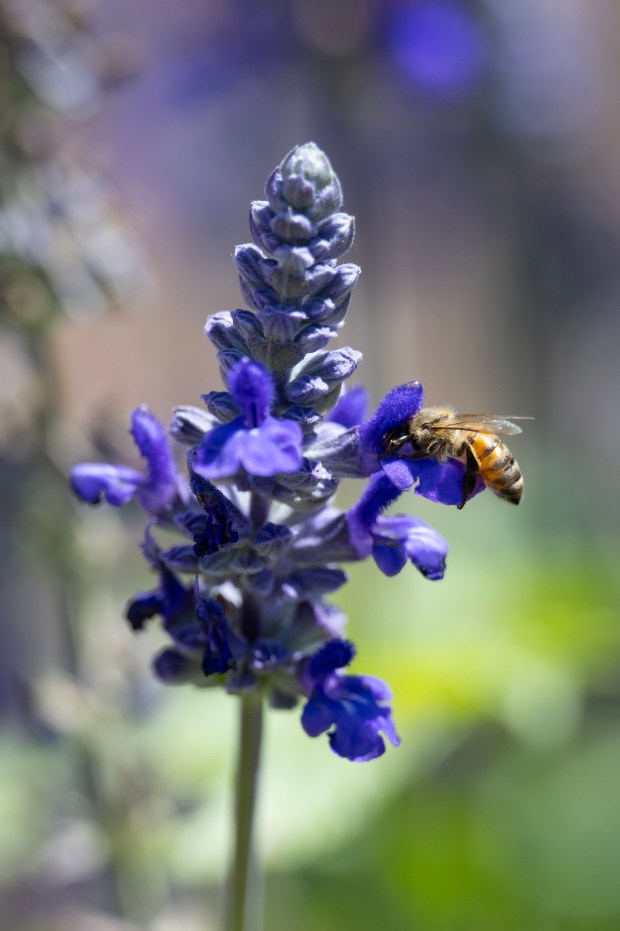 A bee dives head-first into the Salvia longispicata x farinacea, or Salvia ‘Indigo Spires’ in the front yard, which provides a feast for pollinators. (Luke Johnson / The San Diego Union-Tribune)
The couple began renovating the yard in June 2024 and it’s still a work in progress, although you’d never know to look at it. On one side of the yard, a tall round Caribbean copper tree stands near the driveway close to the front of the house, surrounded by clumps of velvety lamb’s ears, pancake-thin paddle plants, Mexican sage and red fountain grass. On the other side are both coast live oaks and Southern live oaks, along with a fruitless olive and dwarf olive trees. In between are trailing yellow lantana down by the street, stands of conebushes, a variety of sages, and jades, kalanchoe and agave — and so much more, with the ground covered with gorilla hair mulch. Concrete pads of different sizes with a variety of small rocks in between make up the two walkways, with small shrubs inserted in spaces at the edges.
In March 2025, the earthwork was completed, transforming a flat yard into one with interesting contours and slopes, and a long rock- and boulder-lined swale that leads down to a drainage pool, filled with more rocks. Most of the planting and irrigation was done between October 2025 and March 2026.
At that point, said Terri, someone from the Helix Water District drove by, saw their landscape and left a flyer for their 2026 WaterSmart Landscape Contest on the Linmans’ front door with a card, encouraging them to apply. They did. And they won. One of the prizes was a $250 gift card to the nursery of their choice.
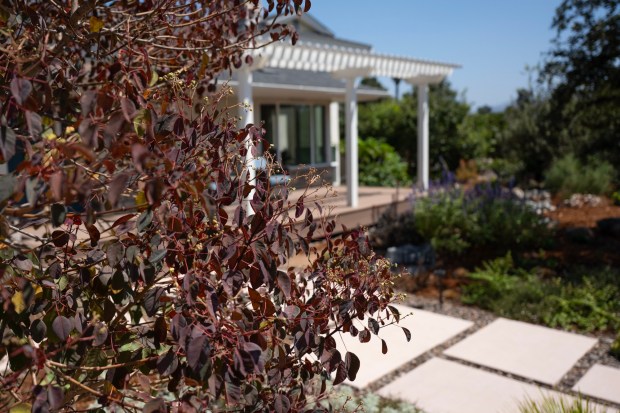 A tall Caribbean copper tree (Euphorbia cotinifolia) lends a reddish hue on one side of the driveway. (Luke Johnson / The San Diego Union-Tribune)
The inspiration
Once the Linmans decided to go forward with relandscaping, they didn’t have a specific theme in mind, but they had some thoughts and some parameters.
“Basically, we wanted something that was lower water use, that didn’t require a lot of maintenance, but didn’t look like a desert,” Mark explained. “We didn’t want (decomposed granite) and we didn’t want cactus.”
“We started driving around, seeing what was popping for us,” said Terri. “We’re like, OK, what looks good? What do we like? And there’d been a couple houses we kept going back to. ‘Look at this. This is cool how they’ve done this.’ ”
They also wanted to attract wildlife. Today, bees come around. So do lizards and geckos. And, Terri added ruefully, resident rabbits, who have been feasting on fescue.

Pathways and plantings in Terri and Mark Linman’s front yard, seen from the porch. (Luke Johnson / The San Diego Union-Tribune)

Eriophyllum confertiflorum, or yarrow. (Luke Johnson / The San Diego Union-Tribune)

Portulacaria afra, or elephant food. (Luke Johnson / The San Diego Union-Tribune)

A sea of Erigeron karvinskianus, or Santa Barbara daisies. (Luke Johnson / The San Diego Union-Tribune)

The new front porch offers a spot to relax and enjoy the views. (Luke Johnson / The San Diego Union-Tribune)
Show Caption
1 of 5
Pathways and plantings in Terri and Mark Linman’s front yard, seen from the porch. (Luke Johnson / The San Diego Union-Tribune)
But the project wasn’t just about the plants. The Linmans also were redoing the hardscape, adding a walkway from the new front porch to the sidewalk, for instance, and the foot of the house across to the driveway. They needed inspiration and ideas for those decisions, as well.
To make better selections and envision a design, they visited public gardens and exhibitions.
“We’re members of The Water Conservation Garden,” Mark said of the demonstration garden on the grounds of Cuyamaca College in El Cajon. “We probably looked at every garden display at the college. We went to the garden at the Helix Water District and the (San Diego Botanic) Garden in Encinitas. We went to the San Diego County Fair and saw all the exhibits. We just kind of started picking out things and taking pictures and putting it together.”
They also consulted the San Diego County Water Authority “Nifty 50” plant list of low- and very -low water use plants (sdcwa.org/sites/default/files/Nifty50.pdf)
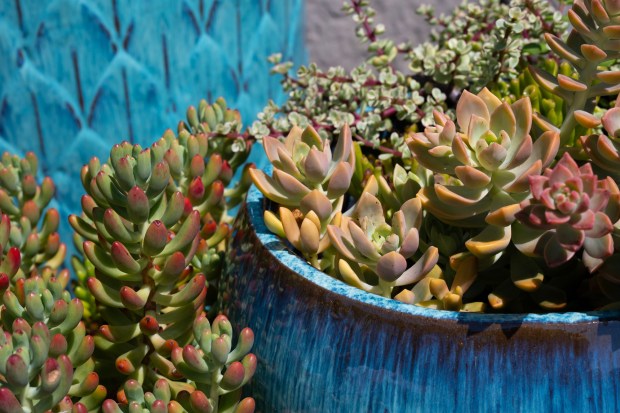 A mix of succulents contrasts with colorful blue pots. (Luke Johnson / The San Diego Union-Tribune)
The details
The couple removed the remaining grass but didn’t apply for a rebate. They needed an excavator to dig out all the stumps and tree roots.
They replaced all the irrigation, not only installing drip lines, but also replacing the waterline into the house. And, added Mark, they put in new electrical out to the posts at the foot of the driveway. And they replaced the old asphalt driveway, which had been pushed up in places by tree roots, and installed the walkways.
“We took out two truckloads of dirt, moved dirt around to make mounds and establish the drainage,” said Mark. “We even installed a French drain in front of the deck that continues all the way down to the pool at the bottom.”
They also took soil samples to City Farmers Nursery for soil testing and getting amendments.
When it came to the plants, they put their research and computer savvy to use to help them select and then decide how they’d place them. Mark used the software SketchUp to build a 3D computer model of their house that can be rotated and manipulated on screen to view from various angles.
“With that, I was able to see the shadows for various times of the day throughout the year,” he explained. “We were able to use that information to see the hours of sunlight in different areas.”
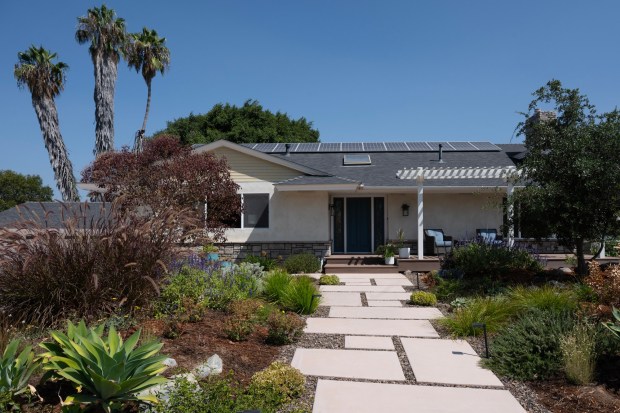 Mark Linman used 3D modeling software to create a replica of their house and predict sunlight and shadows in areas around the structure. (Luke Johnson / The San Diego Union-Tribune)
He also shared with me a spreadsheet he’d created with columns that included the type of plant (grass, groundcover, perennial, shrub, succulent or tree), the botanical and common names, the size (both height and width), spacing and water zone.
They purchased plants from Waterwise Botanicals, Terra Bella Nursery, Cuyamaca College Nursery, Rancho Valhalla Nursery, Rancho San Diego Nursery and Plant House Nursery.
“We created lists and I’d send them to the nurseries and ask ‘What do you guys have and how much is it going to cost us?’ ” said Mark. “And when we’d pick them up, everything was pulled for us.”
They bought over 200 plants.
Once they divided the yard into zones and contoured the ground as well as installed the swale, they decided they wanted to go with flows, not straight lines in the placement.
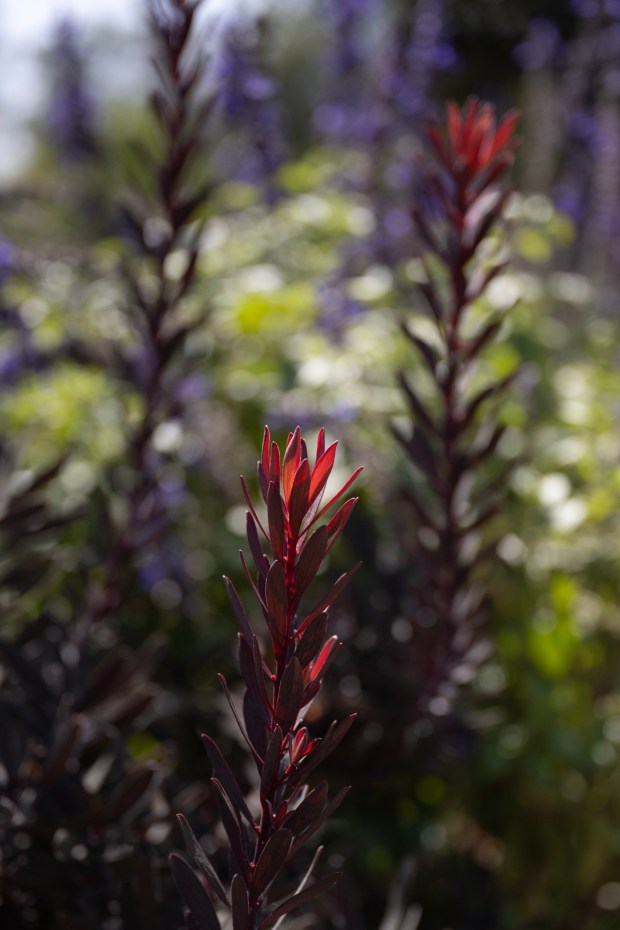 Leucadendron ‘Ebony’ in the front yard of Terri and Mark Linman’s Mount Helix home. (Luke Johnson / The San Diego Union-Tribune)
“We made an intentional point of grouping in odd numbers — threes and fives — and not doing them in straight lines,” said Terri. “We watched color — deep greens going into light greens and a little color pop. And with contouring, you’ve got something sitting higher, so you need tall things in the background, then medium size and low in front. You need variation — color and shape — to mix it up.”
Then came the actual planting. The Linmans started with the base plants, like the trees, as well as the grasses that would be planted on either side of the swale and shrubs. Then the smaller ones, planting 10 plants a day and on weekends, 30.
 Agave attenuata, or foxtail agave. (Luke Johnson / The San Diego Union-Tribune)
The Linmans said they still have more planting to do. Sadly, the crushing heat wave in September killed off several of their plants, including a cherished conebush, that they plan to replace, but there are also other spots they want to fill in.
In the meantime, not only is the couple thrilled with their work, but so are the neighbors. Most important, though, is the approval of the older of their two grandsons. At 5 years old, he’s been eyeing the trees — specifically one of the oak trees — and asking his grandparents, “Can I climb it yet?”
Costs
Given the length of time it took the couple to work on the project, they only have an estimate of the costs, noting that the plant materials were $15,000; the concrete work, done by Campos Concrete Company, was $28,000; and the earthwork/demo/trees cost $20,000. They bought some rocks and mulch at San Diego Rock Supply but found other rocks and boulders for free on Craigslist.
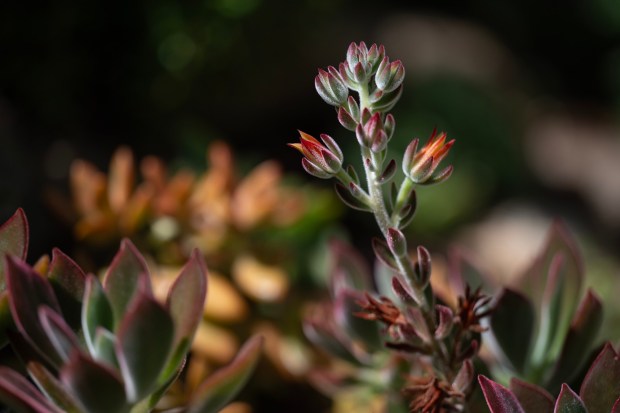 Echeveria harmsii, aka ‘Ruby Slippers.’ (Luke Johnson / The San Diego Union-Tribune)
A closer look: Mark and Terri Linman
Plants used: ‘Blonde Ambition’ blue grama grass (Bouteloua gracilis), small cape rush (Chondropetalum tectorum), ‘Elijah Blue’ fescue (Festuca glauca ‘Elijah Blue’), ‘Lime Tuff’ mat rush (Lomandra ‘Lime Tuff’), dwarf mat rush (Lomandra longifolia ‘Breeze’), red fountain grass (Pennisetum x advena ‘Rubrum’), trailing buttercups (Calylophus hartwegii), ‘Ruby Slippers’ (Echeveria harmsii), Santa Barbara daisy (Erigeron karvinskianus), dwarf elephant food (Portulacaria afra ‘Prostrate Form’), trailing blue rosemary (Rosmarinus officinalis), ‘Bee’s Bliss’ sage (Salvia ‘Bee’s Bliss’), blue chalksticks (Senecio serpens), lamb’s ears (Stachys byzantina), common yarrow (Achillea millefolium), Agapanthus ‘Storm Cloud’, Peruvian lily (Alstroemeria), kangaroo paw (Anigozanthos), sea holly ‘Blue Glitter’ (Eryngium planum), Mediterranean spurge (Euphorbia martini), gaura (Gaura lindheimeri), Spanish lavender (Lavandula stoechas), pentas (Pentas lanceolata ‘White’), Germander sage (Salvia chamaedryoides), Salvia ‘Mystic Spires’ (Salvia longispicata x farinacea), Manzanita ‘Howard McMinn’ (Arctostaphylos ‘Howard McMinn’), wormwood (Artemisia ‘Powis Castle’), Yankee Point ceanothus (Ceanothus griseus horizontalis), orchid rockrose (Cistus x purpureus), trailing yellow lantana (Lantana camara), conebush (Leucadendron ‘Ebony,’ ‘Jester’ and ‘Safari Sunset’), pincushion (Protea) (Leucospermum), Cleveland sage (Salvia clevelandii), Mexican bush sage (Salvia leucantha), Arabian lilac (Vitex trifolia), pinwheel aeonium (Aeonium haworthii), foxtail agave (Agave attenuata), climbing aloe (Aloe ciliaris), ripple jade (Crassula arborescens ssp. Undulatifolia), ‘Gollum’ jade (Crassula ovata), miniature pine tree (Crassula tetragona), Echeveria ‘Autumn Flame,’ Graptosedum ‘California Sunset,’ ‘Autumn Joy’ sedum (Hylotelephium), pink ice plant (Oscularia deltoides), ruby necklace (Othonna capensis), golden sedum (Sedum nussbaumerianum), jelly bean sedum (Sedum pachyphyllum), ‘Sunsparkler Wildfire’ sedum, hens and chicks (Sempervivum), Vicks plant (Plectranthus tomentosa), Caribbean copper tree (Euphorbia cotinifolia), fruitless olive (Olea europaea), Little Ollie dwarf olive (Olea europaea ‘Montra’), plumeria, coast live oak (Quercus agrifolia)
Estimated costs and any rebates: The couple didn’t keep precise records of what they spent, especially since it was over a long period, but they estimate that the plant materials were $15,000, the concrete work was $28,000 and the earthwork/demo/trees cost $20,000.
Who did the work: Mauricio and Manuel Mendoza of Economical Landscape did the demolition and earthwork. William Campos of Campos Concrete Company did the concrete. The Linmans installed all the plant materials and irrigation system with the exception of the large, boxed trees, which Mauricio Mendoza installed.
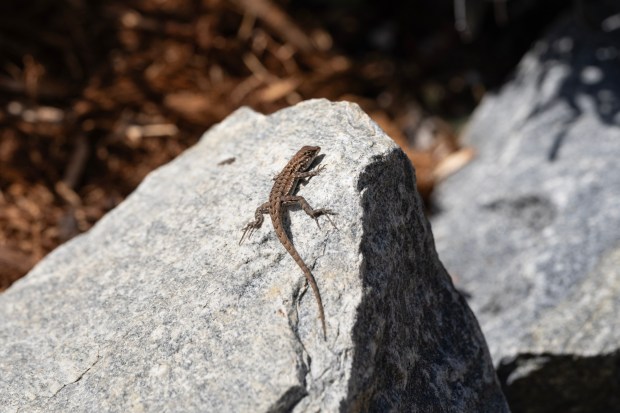 A lizard basks in the sun on a rock, part of a stream of wildlife visitors. (Luke Johnson / The San Diego Union-Tribune)
How long it took: The Linmans began the renovation of the yard in June 2024 and are still in the process of completing it. The earthwork was completed, and the trees were installed in March 2025. The concrete work was done in May 2025. Most of the planting and irrigation was done between October 2025 and March 2026.
Water savings: The couple estimates that their water usage for the front yard has been reduced by about 40% to 50% from the original plantings and lawn.
Advice:
• Group plants with similar sun and water requirements.
• Vary shapes, colors and heights for interest.
• We avoided geometric planting in favor of more organic groups and flows.
• We divided the large space using the walkways, pathways and the dry streambed to break the space into more manageable areas.
• Use a variety of rock sizes and shapes to create a natural-looking drainage.
• Incorporate flowering plants and water features to support wildlife.
About the series
This is the second this year in an occasional series on 2026 winners of the annual WaterSmart Landscape Contest, conducted in partnership with the San Diego County Water Authority. To learn about entering the next contest, visit landscapecontest.com.
For details on classes and resources through the WaterSmart Landscape Makeover Program, visit watersmartsd.org. Landscape rebates are available through the Socal WaterSmart Turf Replacement Program at socalwatersmart.com.