
Nobody likes to think about what happens after we flush, but it all has to go somewhere. For decades, a lot of what is technically called digested sludge — feel free to insert your own term — ended up on 500 acres of drying beds and open-air lagoons in North San Jose. There, nature would take its course and dry out the biosolids in a process that could take up to four years.
And you cannot even imagine the smell.
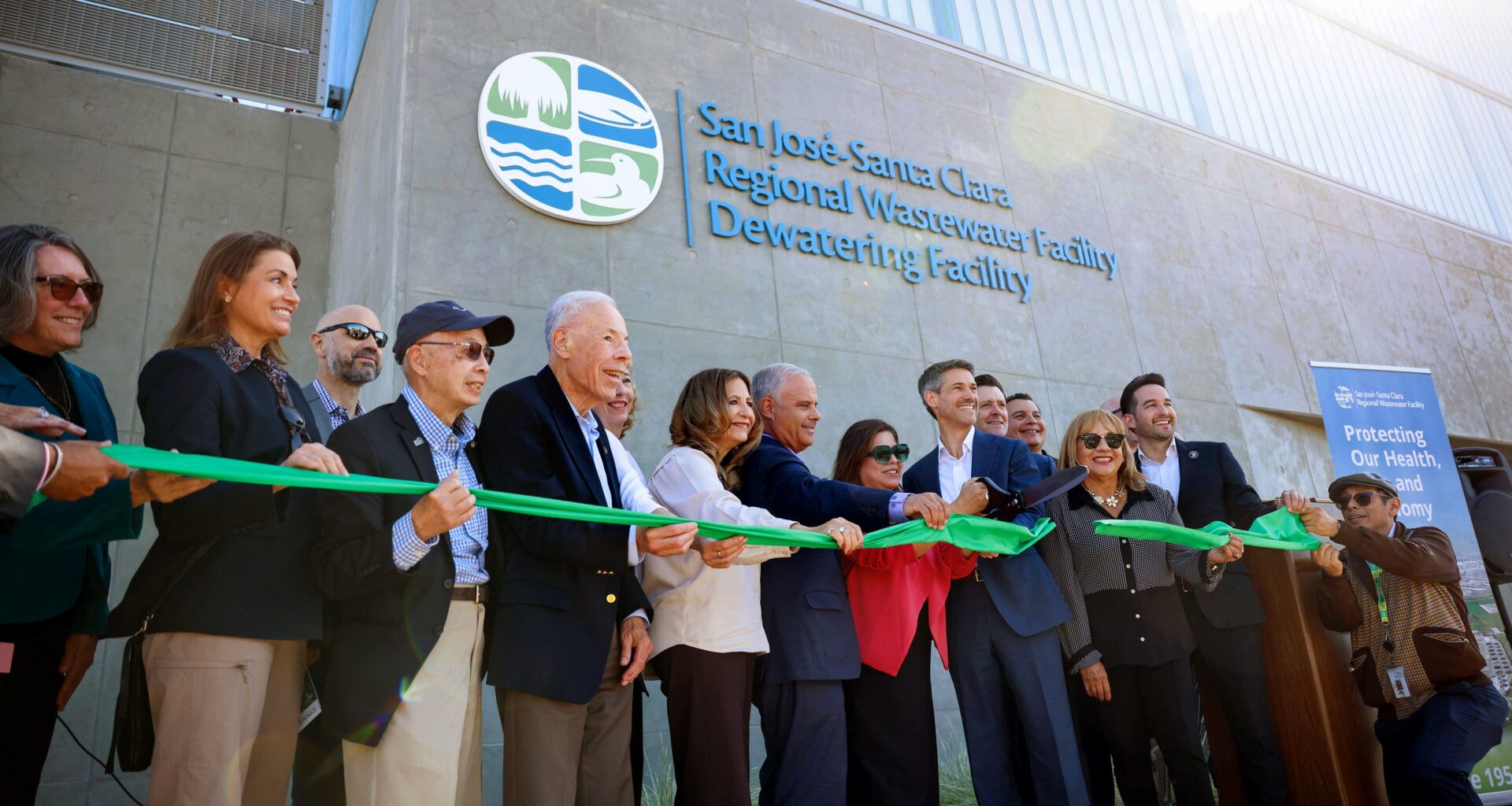
On Thursday, though, San Jose made that job stink a lot less, cutting the ribbon on a $177 million dewatering facility at the San Jose-Santa Clara Regional Wastewater Facility off Zanker Road.
 Milpitas Mayor Carmen Montano, San Jose Mayor Matt Mahan, and Santa Clara Councilmember Karen Hardy are guided on a tour by Mark Wilson, design manager, at San José –Santa Clara Regional Wastewater Facility in San Jose, Calif., on Thursday, Oct. 15, 2026. (Shae Hammond/Bay Area News Group)
It uses centrifuges and an odor control system to remove the liquid from the sludge, which is piped over from the main facility, and makes the resulting biosolids ready for use as compost or fertilizer in a day instead of years. An odor-control system captures and treats the foul air in pipes with carbon and ammonia scrubbers instead of letting it waft over to Alviso and Milpitas.
“It means we’re a better neighbor, with fewer odors and a cleaner process for the communities closest to the plant,” San Jose Mayor Matt Mahan said. “It means reliability, because a system that doesn’t depend on the vicissitudes of weather is one residents and businesses can count on. It means we’re protecting the bay for the next generation.”
San Jose City Councilmember David Cohen, whose district includes the wastewater facility, said just decommissioning the drying beds offers a once-in-a-lifetime opportunity to convert that acreage back to open space along the bay next to the Don Edwards National Wildlife Refuge. “I look forward to seeing how that is given back to the environment in the years ahead,” Cohen said.
You’ve got to imagine any use would be an improvement over acres of crap drying in the sun for years.
The Regional Wastewater Facility has been operating 24 hours a day, 365 days a year since 1956. According to city data, it treats an average of 110 million gallons per day and serves about 1.5 million residents and more than 17,000 businesses in eight South Bay cities. The dewatering facility’s four centrifuges are capable of processing up to 4,100 pounds of biosolids every hour, though only two are used for the current needs.

Workers work on the Cake Bins at San José –Santa Clara Regional Wastewater Facility in San Jose, Calif., on Thursday, Oct. 15, 2026. Cake bins hold 300 tons of solidified sludge, or sludge cake, and drop it into trucks to be transported. (Shae Hammond/Bay Area News Group)

San Jose Mayor Matt Mahan speaks during the opening ceremony of the San Jose –Santa Clara Regional Wastewater Facility in San Jose, Calif., on Thursday, Oct. 15, 2026. (Shae Hammond/Bay Area News Group)

Milpitas Mayor Carmen Montano takes a picture on top of the Cake Bins at San José –Santa Clara Regional Wastewater Facility in San Jose, Calif., on Thursday, Oct. 15, 2026. Cake bins hold 300 tons of solidified sludge, or sludge cake, and drop it into trucks to be transported. (Shae Hammond/Bay Area News Group)

A tour is guided to the top of the Cake Bins at San José –Santa Clara Regional Wastewater Facility in San Jose, Calif., on Thursday, Oct. 15, 2026. Cake bins hold 300 tons of solidified sludge, or sludge cake, and drop it into trucks to be transported. (Shae Hammond/Bay Area News Group)

San Jose Councilmember David Cohen explores the Cake Bins where trucks will be picking up dewatered sludge cake at the San José –Santa Clara Regional Wastewater Facility in San Jose, Calif., on Thursday, Oct. 15, 2026. (Shae Hammond/Bay Area News Group)

A foul air pipe at San José –Santa Clara Regional Wastewater Facility in San Jose, Calif., on Thursday, Oct. 15, 2026. (Shae Hammond/Bay Area News Group)

A tour explores the centrifuge at San José –Santa Clara Regional Wastewater Facility in San Jose, Calif., on Thursday, Oct. 15, 2026. (Shae Hammond/Bay Area News Group)
Show Caption
1 of 7
Workers work on the Cake Bins at San José –Santa Clara Regional Wastewater Facility in San Jose, Calif., on Thursday, Oct. 15, 2026. Cake bins hold 300 tons of solidified sludge, or sludge cake, and drop it into trucks to be transported. (Shae Hammond/Bay Area News Group)
Seven decades will wear down any facility, which is why San Jose’s Environmental Services Department has invested about $1.2 billion and completed 31 projects through a capital improvement project in the past decade. To celebrate its 70th anniversary, the Wastewater Treatment Facility will be open for public tours for the first time in years on Nov. 7 and 14.
Santa Clara City Councilmember Karen Hardy chairs the San Jose/Santa Clara Treatment Plant Advisory Committee and is also a chemical engineer, so she was particularly excited about the opening of the new facility after four years of construction and all the other upgrades.
“The reality is when the power goes out, you’re annoyed,” she said. “But if the water — both the supply or the sewer — goes out, that’s an emergency.”
MOVIE BONANZA: The San Jose International Short Film Festival has really gotten big since festival founders Bill Hargreaves and Sinohui Hinojosa came up with the plan while drinking a coffee at Philz and launched with a single screening in 2009. Now, as the 18th annual festival rolls out Oct. 22 through Oct. 25 at Cinemark’s CineArts theater at Santana Row, the Best of the Fest winner will be eligible for consideration at the Academy Awards next year.
That film will be one of the 150-plus shorts from more than 24 countries the festival has programmed this year, arranged, as usual, into screening blocks. And while the running times may be short, the films are long on recognizable talent. The opening night features Oscar nominee Cyrus Neshvad’s “I Will Be Alright” and the documentary short “Panther Pat,” which won the 2026 Slamdance Grand Jury Prize.
There are so many films on the slate this year that the official Opening Night screening block at 7:30 p.m. is preceded by three other blocks earlier in the day. Do those count as Opening Day screenings? Either way, you can get tickets and passes — as well as find out more about the films — at sjsff.com.
MOVIE BONANZA, PART II: If short films aren’t your taste, the Silicon Valley Asian Pacific Film Festival is also getting bigger — expanding to a fourth day in its 12th year. The festival, presented by Contemporary Asian Theater Scene, has the theme “The Connecting Power of Film,” featuring 80 films on Oct. 22-25.
Thursday’s opening night film is the documentary “The Rose: Come Back to Me,” which follows a Korean indie rock band as it returns from a three-year hiatus. After the 6:30 p.m. screening, NBC Bay Area anchor Janelle Wang and reporter Robert Handa will moderate a post-screening discussion with director Eugene Yi and producer Diane Moy Quon. The opening-night festivities include access to the Euphrat Museum of Art’s new exhibition, “Threads of Resilience,” which explores art, well-being and healing.
That film will screen at the Visual and Performing Arts Center at De Anza College in Cupertino. The rest of the festival, including panel discussions with filmmakers, will take place at the AMC Sunnyvale 12 starting Oct. 23. Get tickets and more information at svapfilmfest.org.
SCARING UP SOME BLOOD: TheatreWorks Silicon Valley came up with a great way to celebrate its current production of “Dracula” and do some good by hosting a blood drive Oct. 25 at the Mountain View Center for the Performing Arts. No need to fear, vampires won’t be involved in the blood drawing; TheatreWorks instead has partnered with the Stanford Blood Center, which will have its mobile bloodmobile out. You can get more information or register to donate at sbcdonor.org/donor/schedules/drive_schedule/16762.
Donors also will get a discount to purchase “Dracula” tickets for $20 each during Halloween week, Oct. 28-Nov. 1. And that’s an offer that certainly doesn’t suck.