
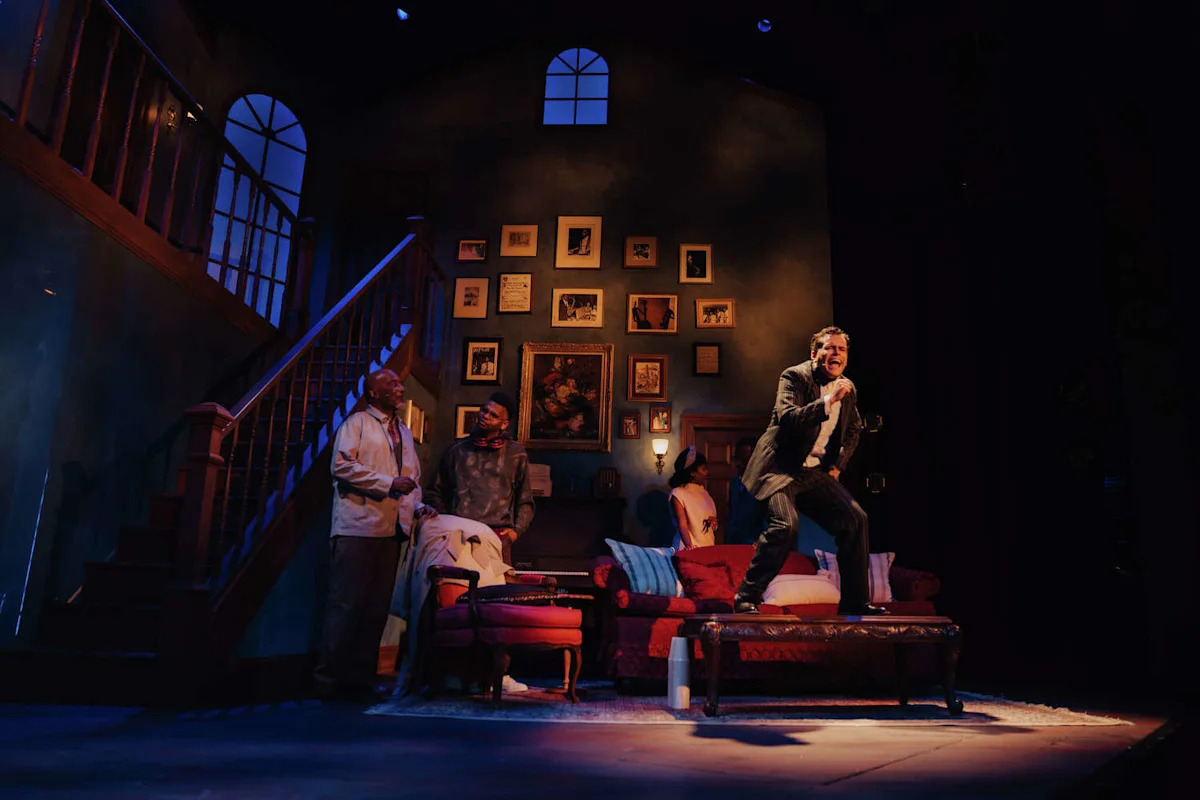
For Danny Duncan, one hopes, the experience of watching “Every Saturday Night (A Harlem of the West Musical)” was amazing.
He co-wrote it. His former theater student produced it. And it’s based on his life in the Fillmore district – both in the 1950s, when he helped his mother run an after-hours joint out of her home, and today.
More Information

1 star
“Every Saturday Night (A Harlem of the West Musical)”: Written by Danny Duncan and Michael Gene Sullivan. Directed by AeJay Antonis Marquis. Through Nov. 1. Two hours, 50 minutes. $25-$59. Strand Theater, 1127 Market St., S.F. 415-484-8566. www.sfbatco.org
Other audiences, too, might get plenty out of San Francisco Bay Area Theatre Company’s production, which I saw Friday, Oct. 16, at the Strand Theater. It connects current battles over the neighborhood’s gentrification to past fights against redevelopment. In each era, it finds a beam of hope in an adolescent boy’s artistic inclinations. And it leads a contemporary, affluent Black family to ask honestly, uncomfortably, whether they’d be part of the problem if they moved into the neighborhood.
But then, as in every other storyline in a musical that’s at once overstuffed, thinly sketched and under-rehearsed, they get an easy out in a hunky-dory ending straight out of a children’s book.
One might argue that fairy-tale endings in Black stories help counter all the trauma porn out there. To stanch the exodus of the city’s Black population – from a peak of 13.4% of residents in 1970 to 5.4% in 2020 – San Francisco needs more revolutionary imagination, not less.
But “Every Saturday Night,” which is co-written by Michael Gene Sullivan, comes off as timid, like it’s afraid of surprise or of anything that might complicate its main characters’ virtue or Duncan’s childhood memories.

Donte (Darryl V. Jones, left) tells Adarè (Trevor Miller) about growing up in the Fillmore in San Francisco Bay Area Theatre Company’s “Every Saturday Night.” (Alexa LexMex Treviño/San Francisco Bay Area Theatre Company)
Young Donte (Jacob Henrie-Naffaa) is a hardworking boy who yes-ma’ams his hardworking mother, Ardella (Cathleen Riddley), and dreams of becoming an actor; he has attitude only when his absent father, Bobby Joe (RJ Wayne), appears for the first time in five years, and even then the man probably deserves worse than a few moments of sullenness that evaporate the instant Bobby Joe expresses interest in his son’s acting. Decades later, Adarè (Trevor Miller) is being a brat while his parents, Joanelle (Janelle LaSalle) and Samuel (Jon-David Randle), tour a Victorian for sale in the Fillmore – until its owner, Donte (Darryl V. Jones), shares childhood memories via song, and magically the lad is all smiles.
Young Donte learns it’s OK to be himself. Ardella has a political awakening. Donte gains strength from reminiscences to make a decision about his future. It’s all so simple and tidy it could have been written in a board book.
One reason the show’s nearly three hours is the amount of time the playwrights spend establishing the chores necessary for Ardella to throw her party. Tablecloths get so much air time as to inspire thoughts of one’s own laundry waiting at home. Another reason is the clunky exposition: “Doris, how long you been rentin’ that room upstairs?”

Bobby Joe (RJ Wayne, center) proclaims his love of jazz in San Francisco Bay Area Theatre Company’s “Every Saturday Night.” (Alexa LexMex Treviño/San Francisco Bay Area Theatre Company)
Occasionally, singing is quite fine, as when Wayne scats “sha ba da de-da-dai” with a voice as warm and textured as fresh toast. But more often squawking and shrieking prevail. If music director Othello Jefferson gives a sumptuous, affectionate account of Duncan’s jazz score, at least one number ends so abruptly it’s as if something fell kersplat.
Acting, under the direction of AeJay Antonis Marquis, is likewise a cascade of dropped balls. The play’s final scenes interweave dialogue between the two eras, but even after opening night, these exchanges gaped with pauses. Would someone, anyone, remember a line?
“Every Saturday Night” was clearly meant as a tribute to Duncan. It feels mean to critique a gift sincerely given, with such lofty progressive ideals, to someone else.
But most gifts don’t charge admission to the rest of the public.
Subscribe
There’s more to San Francisco with the Chronicle. Subscribe today for just 25¢.
This article originally published at This S.F. musical is a gift to a beloved teacher. For the rest of us, not so much.