
Watch out — it’s a giant octopus attack! A towering inferno! A talking ape uprising! Or is it a drag Scottish nanny?
The dangers of life in San Francisco have, over the past century of film representation, been highly exaggerated. But so have the pleasures. The city seems, more than most, to be a screen for the projection of America’s hopes and fears, from Gold Rush fortunes and hippie-era liberation to nightmares of crime and technology. It’s both the utopian setting of Starfleet Academy in the 1990s-era “Star Trek: The Next Generation” and the more paranoiac one of 1978’s “Invasion of the Body Snatchers.”
I am a San Franciscan. That is: I’ve lived here for 30 years, long enough to laugh at the nightmarish playground in the Michael Douglas movie “The Game” (1997), directed by David Fincher, and cringe at the “horrors” of tenants’ rights as presented in the Michael Keaton-Melanie Griffith vehicle John Schlesinger’s “Pacific Heights” (1990). I’ve attended a screening of Alfred Hitchcock’s “Vertigo” (1958) most years at the Castro Theatre, where I’ve also sung along as the organist played the title song of “San Francisco” (1936) and chuckled with the crowd when Jimmy Stewart complains about the eyesore that is Coit Tower, the columnar concrete landmark rising up from Telegraph Hill. “Vertigo” perfectly captures the way the past haunts the present in San Francisco, with the Spanish colonial spirit of Carlotta Valdes possessing a 1950s-gray-clad, perfectly coiffed Kim Novak. Another of my favorites, Peter Bogdanovich’s “What’s Up, Doc?” (1972), feels both like a wacky postcard of the city (with gorgeous views and car chases up and down hilly streets) and a dead-on portrayal of the kind of free-spirited San Franciscan (Barbra Streisand) who can bring down a deadly boring musicology convention. These films depict the city as mysterious, chaotic, freewheeling, beautiful and able to laugh at itself. Which is how I see it myself.
But I’m baffled by how the rest of the country sees us now — apparently, as a dumpster fire robotic tech guild on ketamine. In “Rise of the Planet of the Apes” (2011), for example, a formula developed in a San Francisco pharmaceutical lab both enhances the intelligence of apes and spreads a human pandemic. In “The Invisible Man” (2020), Elisabeth Moss is menaced by a tech bro ex-boyfriend who wears an optically invisible suit of his own invention. Last year’s “M3GAN 2.0,” an even campier sequel to the original, revived the android doll of its title to save humanity in a San Francisco of tech billionaires, cloud computing and AI. Where’s Barbra Streisand when you need her?
San Francisco has become conflated with a region that, while technically still part of the Bay Area, is in fact an hour’s drive south of here: Silicon Valley. Aaron Sorkin’s “The Social Reckoning,” which is about the Facebook whistle-blower and comes out tomorrow, and “Artificial” (2026), Luca Guadagnino’s forthcoming film about Sam Altman, the CEO of OpenAI, promise a more realistic take on that world but wouldn’t be considered San Francisco movies by locals. This is not just because they aren’t set here but because, while many envision a city overrun with tech guys and overlords, these people are not part of the daily life of the city. Each morning of their six-day workweeks, many rank-and-file tech workers board buses with smoked-glass windows bound for the Valley. They return at night and are rarely seen. The tech titans are never seen, nor do they participate in arts and culture as former generations of wealthy San Franciscans have done. So it can be frustrating to see films portray the city only as it exists in the broader public’s imagination, which is utterly at odds with our reality.
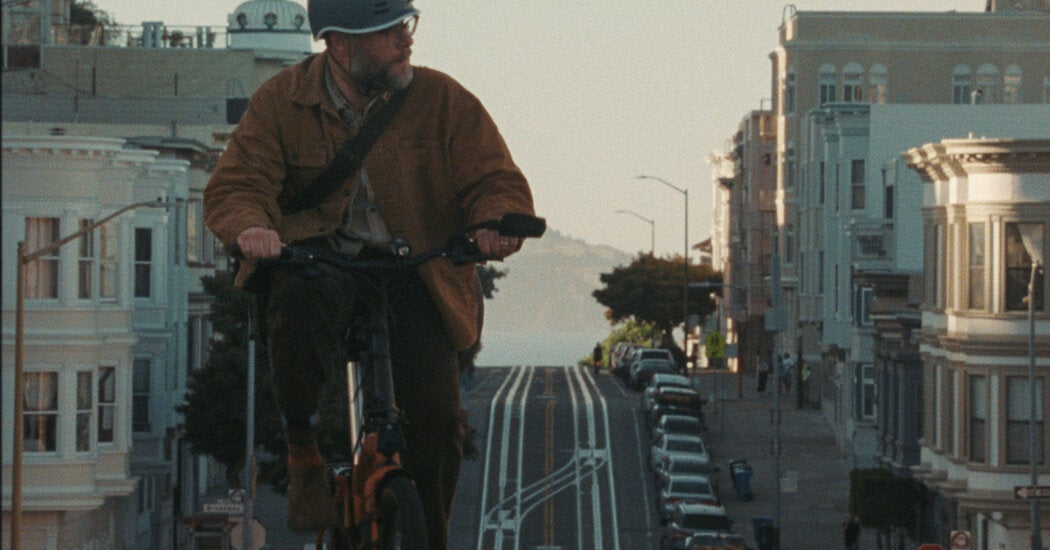
Luckily, that seems to be changing. Olivia Wilde’s “The Invite” (2026) presents, in its opening scenes, a classic version of San Francisco, complete with cable cars, dusk-lit city views and absolutely unbikeable hills. Not an ape or a robot in sight! And yet, it is essential that this version of the movie (a remake of the 2020 Spanish film “Sentimental”) is set in San Francisco. It is the story of an upper-middle-class couple (Seth Rogen and Olivia Wilde) whose invitation of their more sexually liberated neighbors (Penélope Cruz and Ed Norton) to dinner upends their own relationship. Even in 2026, San Francisco remains a place of sexual and political freedom that can both liberate and destroy.
Another 2026 film, “Josephine,” feels even truer to life in the city — perhaps because it was made by a San Francisco native, Beth de Araújo, who insisted on shooting here. In this complex, disturbing tale of a young girl who’s witnessed a terrible crime, the city is not paradise or hellscape but, in a sense, a place utterly indifferent to her fate. The movie takes place in the Richmond District, where de Araújo grew up, and doesn’t pander to clichés or media narratives while giving us a singular setting, pylons rising from the mist accompanied by the baleful moans of foghorns. The Golden Gate Bridge is visible, but only as locals tend to see it: from below, when visiting Fort Point. A child’s-eye view. Like Joe Talbot’s moving “The Last Black Man in San Francisco” (2019), then, the sense of tension amid all this moody beauty comes not from technological or drug-crazed dangers but simply from sharing a world with others. And this, too, I recognize.
These human stories are especially poignant, I think, for unfolding in a place so associated, recently, with technology. If we’re headed for some kind of real-life showdown between humanity and machine, the films’ mere existence feels like a point in our favor. But while I appreciate the realism of these movies, I, like most moviegoers, am not immune to fantasy and excess. I understand that the hippie Edens and tech nightmares are untrue, but even I enjoy them.
Wasn’t it the overheated, murderous, bisexual Sharon Stone driving up Route 1 in Paul Verhoeven’s “Basic Instinct” (1992) that made me want to move to San Francisco in the first place? Or was it “Vertigo”’s Novak throwing herself into the San Francisco Bay? Why is the city so susceptible to projection, even for those of us who live here? Is it the id to New York City’s superego? The madwoman in America’s attic? Perhaps it comes down to the city’s founding mythology: a sleepy Spanish peninsula stolen from the Ohlone people, suddenly overrun by miners hearing tales of gold. You think prices are high in San Francisco now? In 1850, a dozen eggs cost the equivalent of around $500 in the city and well over $1,000 in more remote gold-mining camps. A century later, after World War II, sailors were dropped off in San Francisco and helped start a gay community. So it’s always been a city of dreams and outrageous fortune, desire and nonconformity. Terrifying to the rest of the country. Titillating, as well. And one day, an earthquake might bring the whole Gomorrah tumbling down. I’m sure they’ll make a movie about that, too.