
Jeremy Meigs, a legend in the Northern California climbing community, has been a regular at Castle Rock State Park since 1984, when he was 9. By high school, he was spending weekends there with friends, and over the next 20 years, he developed many of the climbs in the area.
For Meigs, who has climbed in major bouldering areas from Fontainebleau, France, to Squamish, Canada, the 5,242-acre park will always be special. Because Castle Rock is where it all began. “It’s small,” he says, “but there are dozens of amazing [climbing] problems right in the Bay Area.”
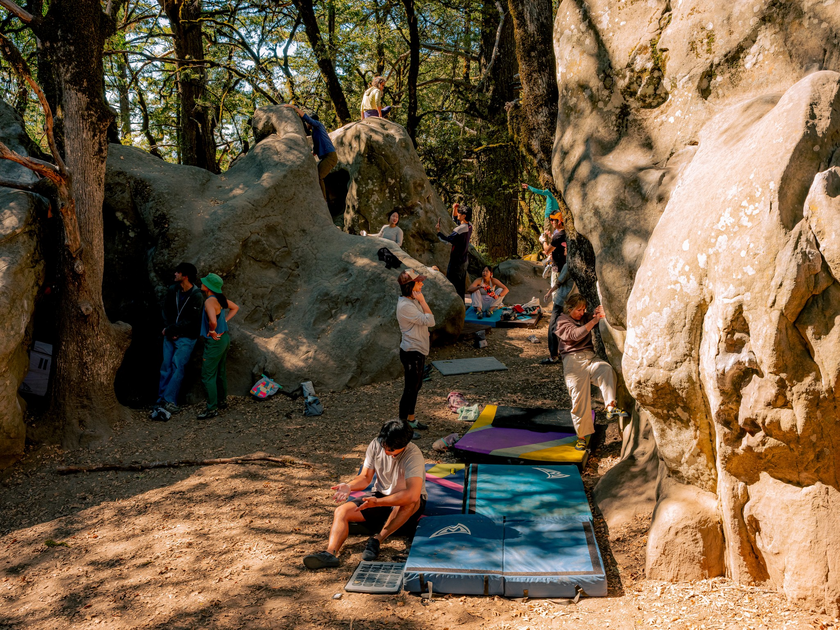
 Climbers surround the Mr. Magoo boulder, watching someone climb Magoo Face.
Castle Rock State Park, tucked between Santa Cruz and San Jose, about 53 miles south of San Francisco, is the best bouldering destination in the Bay Area. The park sees about 150,000 visitors a year, including hikers, backpackers, and mountain bikers. The bulbous sandstone boulders that dot the landscape attract hordes of climbers on weekends, particularly during peak season, which runs from late October through April, before it gets too hot and mosquito-y.
It’s worth stating: If you’re completely new to climbing, you might want to take a bouldering class before setting out for the park. Most San Francisco climbing gyms offer intro classes for $30 to $40. For gym climbers looking to get outside or frequent outdoor climbers who want to know where to start in the Bay Area, here’s a guide to bouldering in Castle Rock State Park.
How to prepare for the day trip
Before you head out, make sure you have the necessary equipment: climbing shoes, chalk, crash pads (the thick foam pads used to soften falls), water, snacks, and at least one or two spotters — people who will stand below to guide you to a pad if you take a tumble. If you don’t own a crash pad, you can rent one for $30 a day at Sports Basement (opens in new tab).
Use the free Mountain Project (opens in new tab) app to navigate the park and figure out which route is which on the rock once you’re there. You’ll be able to download area maps and access them even if you’re offline, which is likely to be the case since cell service is pretty much nonexistent in the state park. If you prefer to go analog, there are two guidebooks: “San Francisco Bay Area Bouldering (opens in new tab)” and “Golden State Bouldering (opens in new tab).”
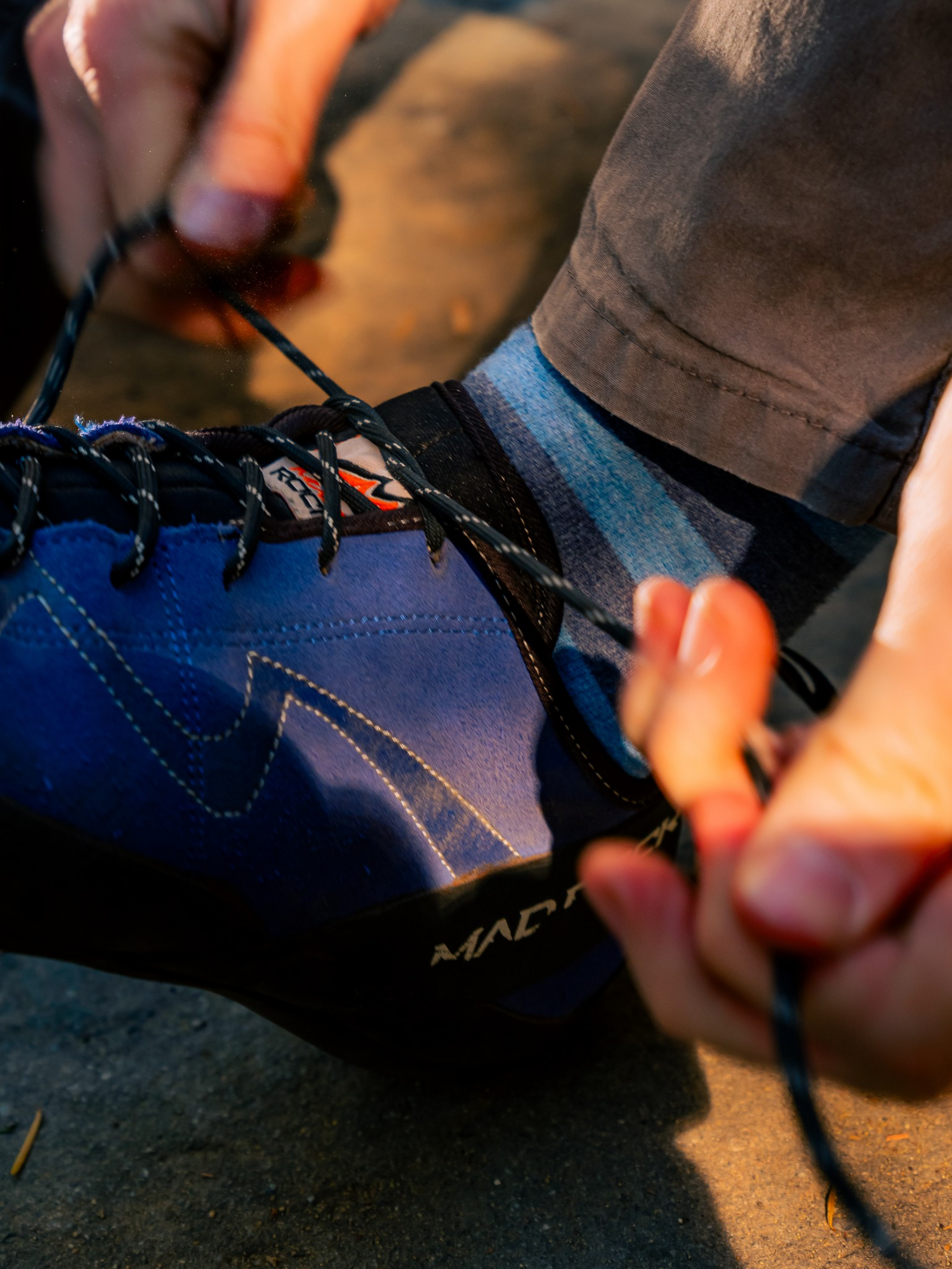 Climber tying his shoe before getting on the rock.
 Climbers start the ten-minute hike to the boulders.
California State Parks spokesperson Patrick Rosso emphasizes the lack of both cell service and water inside the park. “We always just want people going there to make sure they’re prepared for a full day of adventure, both with a way to communicate and a way to drink water,” he says.
There are a couple of important things to keep in mind about this climbing area in particular. First, the sandstone boulders are more fragile than some other rock types and can break if you attempt to climb them while they’re wet. If it has rained (opens in new tab), do not climb for a minimum of 72 hours. Also, stay on the hiking trails — regardless of the weather — to minimize erosion.
Pick up breakfast and lunch in Woodside
The drive to Castle Rock from the city takes about 1 hour and 20 minutes, so leaving around 8:30 a.m. should give you ample time to climb before the park closes at sunset. If you don’t have a car, I recommend renting one since you won’t be able to call an Uber, Lyft, or Waymo without cell service once you’re there. There are multiple ways to get to the park, but for a scenic drive, take 280 and turn onto CA-84 at Woodside Road for a quick detour to fuel up and grab sandwiches for lunch.
If you left early enough to enjoy a sit-down breakfast, stop at the Little Store Woodside (opens in new tab), (opens in new tab)a charming cafe that has a full coffee bar. For a hearty meal, the biscuit breakfast sandwich, overnight oats, and breakfast burrito are popular options. The cafe also stocks pastries from Manresa Bread (opens in new tab), including sweet, flaky kouign-amann, a perfect light treat.
You’ll also want to grab something to eat later in the day. Woodside Deli (opens in new tab), about seven minutes away, has a long menu of specialty sandwiches. The most popular are the Avogobble ($16.50) and Godfather ($19), which stacks mortadella, salame, coppa, prosciutto, provolone, artichoke hearts, and pepperoncini on a Boudin sourdough roll.
 The breakfast sandwich at Bob’s Country Corner is $11.99 and available until 10:30 a.m..
Alternatively, if you’re open to making a 10-minute detour to Menlo Park, family-owned Bob’s Country Corner (opens in new tab) has been open since horse-drawn carriages were rumbling around, and the current owners have operated it since the ’90s. It’s a great spot to grab water, a sugar-free version of Gatorade called SaltyWater, and snacks. The only option is to build your own sandwich, selecting from the likes of roast beef, pastrami, mortadella, and home-cooked roasted turkey. Owner Issa Wehab recommends a two-hands-required turkey club with bacon, avocado, and cheese on a sourdough roll. Opt to get the sandwich cold so it’s not soggy after sitting in your bag for a couple hours. For snacks, Wehab suggests a bag of the new layered gummy candy called Peelerz and kettle jalapeno chips.
From Woodside, it’s 40 minutes to the park on CA-35, or Skyline Boulevard. After about 20 miles, you’ll see a gated parking lot on your right with a sign for the park. Just past this, on either side of the road, you can park for free. But these spots fill up on weekends, so be prepared to pay $10 to use the official parking lot (opens in new tab). Cards are accepted, so don’t stress if you don’t have cash. There are bathrooms both at the parking lot and at the top of the trail.
Bouldering in Castle Rock State Park
Once you’ve parked, get your pads strapped to your back and sandwiches tucked away in your bag. Then it’s a 10-minute approach to the boulders on Castle Rock Trail.
Directly across Skyline Boulevard from Castle Rock is Indian Rock, which is technically part of Sanborn County Park and also a popular bouldering spot. But if it’s your first time in Castle Rock, the Magoo Boulders (opens in new tab) are a great place to start. To get there from the parking lot, go right on Castle Rock Trail for about 10 minutes. The area has a couple of boulders, but start at Mr. Magoo (opens in new tab) with Magoo Warm Up (opens in new tab), a V0. With big holds and a good height, this is a great climb to get you moving and learn a bit about the area’s style. Mr. Magoo boulder has a few other V0s and 1s, the easiest rating for climbs.
Castle Rock is “slopey madness,” as Meigs describes it, and also known for mantles. Slopers are smooth, rounded climbing holds that don’t have an edge — meaning they require your entire hand for friction and getting your weight correct beneath the holds. A mantle is a move in which you pull up and then push yourself over the top of the rock, like getting out of a pool without a ladder.
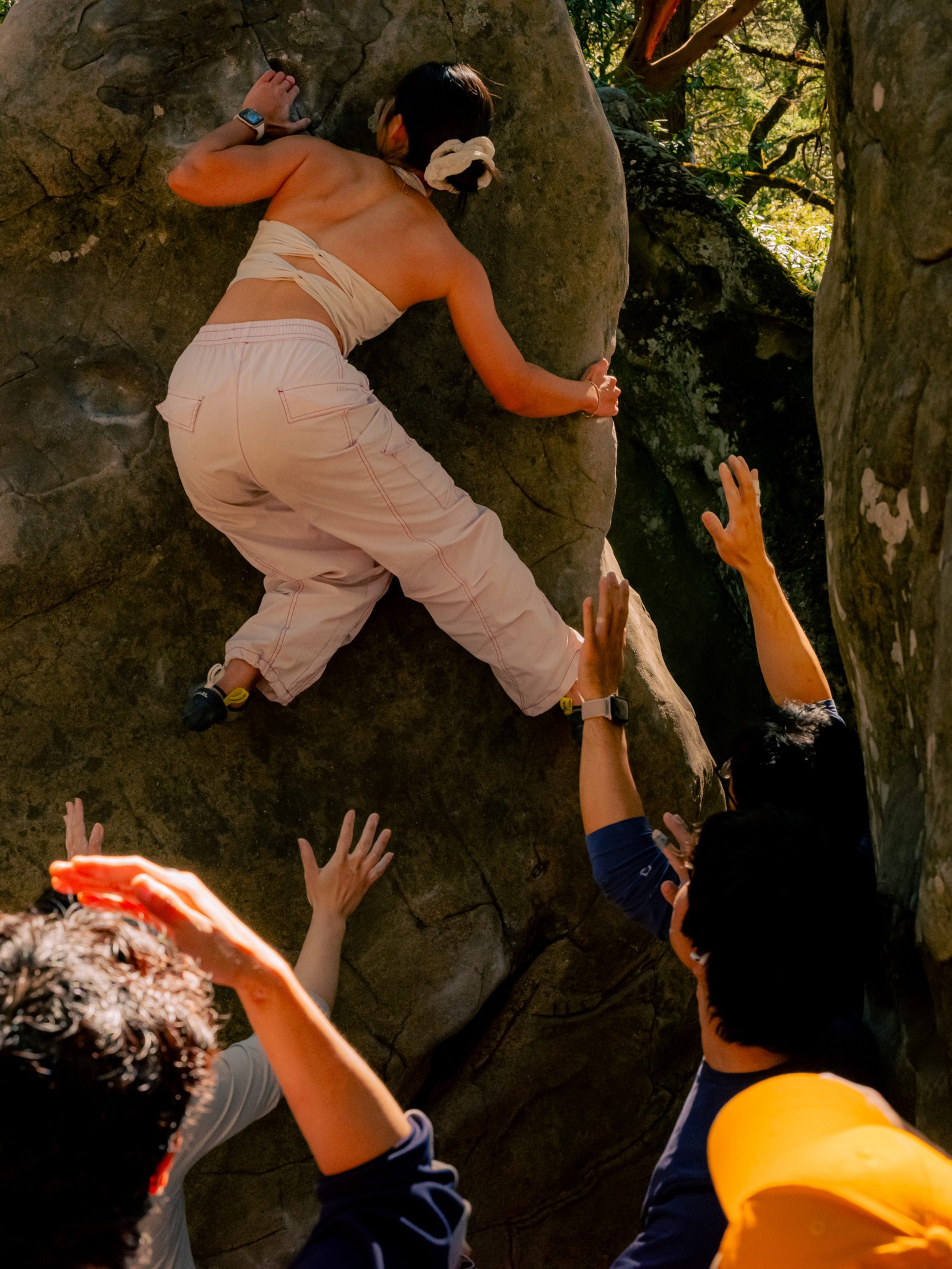 Beverly and friends at The Warmup V1.
 Climber warming up his wrists and forearms.
Beyond these, there are more than a dozen other climbs within a 10-minute walk of Magoo. Here’s a curated list if you’re new to the area, though it’s by no means comprehensive:
Magoo Warm Up V0 (opens in new tab)The Groove V1 (opens in new tab)Mr. Magoo V1/2 (opens in new tab)Magoo Face V2 (opens in new tab)The Spoon V2 (opens in new tab) — Don’t be tricked by the lower grade, the top of this climb is hard. Make sure the ground is well padded and your spotters are ready to catch. The Swim V3 (opens in new tab) — Don’t be afraid to “beach whale” the top, which just means rolling your body onto the top of the rock.The Beak Traverse V3 (opens in new tab) — This is one of the favorite climbs in the park. It has fun movement and offers a challenge but is close to the ground. An easy top out makes it less scary.Hueco Slap V4 (opens in new tab)The Clam V4 (opens in new tab)Mrs. Magoo Traverse V3/4 (opens in new tab)
Climbing outdoors is challenging, and Castle Rock’s slick sandstone boulders with minimal foot holds offer a technical challenge even for the strongest climbers. If you climb V4 in the gym, it doesn’t mean you’ll be able to climb V4 outside. “Don’t get discouraged — climbing the sandstone slopers and tiny feet is tricky. Just stick with it,” Meigs says.
Where to grab a post-climb pint
The park closes at sunset, so be prepared to head out before then — though your daytrip isn’t quite over. Your next stop should be the charming town of Saratoga, half an hour east of the park on Highway 9. A couple of restaurants there are a bit too fancy for sweaty climbers in chalked-up pants, but Bai Tong Thai Bistro (opens in new tab) is both casual and well-priced. The pad khee mao and green curry are great post-climb orders, as are specialty dishes such as pra ram with a protein of your choice, served on spinach and topped with peanut sauce.
 View of the Valley near Castle Rock State Park.
If it’s before 7 p.m., or 6 p.m. on Sundays, head to Big Basin Cafe (opens in new tab) just up the block for pie, cake, or cookies. The lemon meringue hand pie hits the spot after a day of wrestling rocks. This cafe is low-key, with ample seating inside and out. If a cold beer is more your style, Many Friends Brewing (opens in new tab), a homey spot just across the street, makes all its beer on-site. The “dirty” blond ale is light and refreshing.
Then blast your favorite tunes or climbing podcast and meander back to San Francisco for a good night’s sleep.
Outdoor bouldering basics: Crash-pad placement is important. You want the landing as flat as possible without any gaps between pads.When spotting, watch and communicate with the climber so you can guide them to a safe landing if they fall. If you’re new to climbing, start with easier and lower climbs such as Magoo Warm Up V0 or the Warm Up V1.Walk around the boulder to check for an easy way to climb down before you climb up. Sometimes the only way down is the way you’re going up!Clean your climbing shoes on your pants or pad before getting on the rock. Dirt on your shoes can polish and ruin the climbs over time. If you make marks on the rock with chalk, be sure to brush them off.