
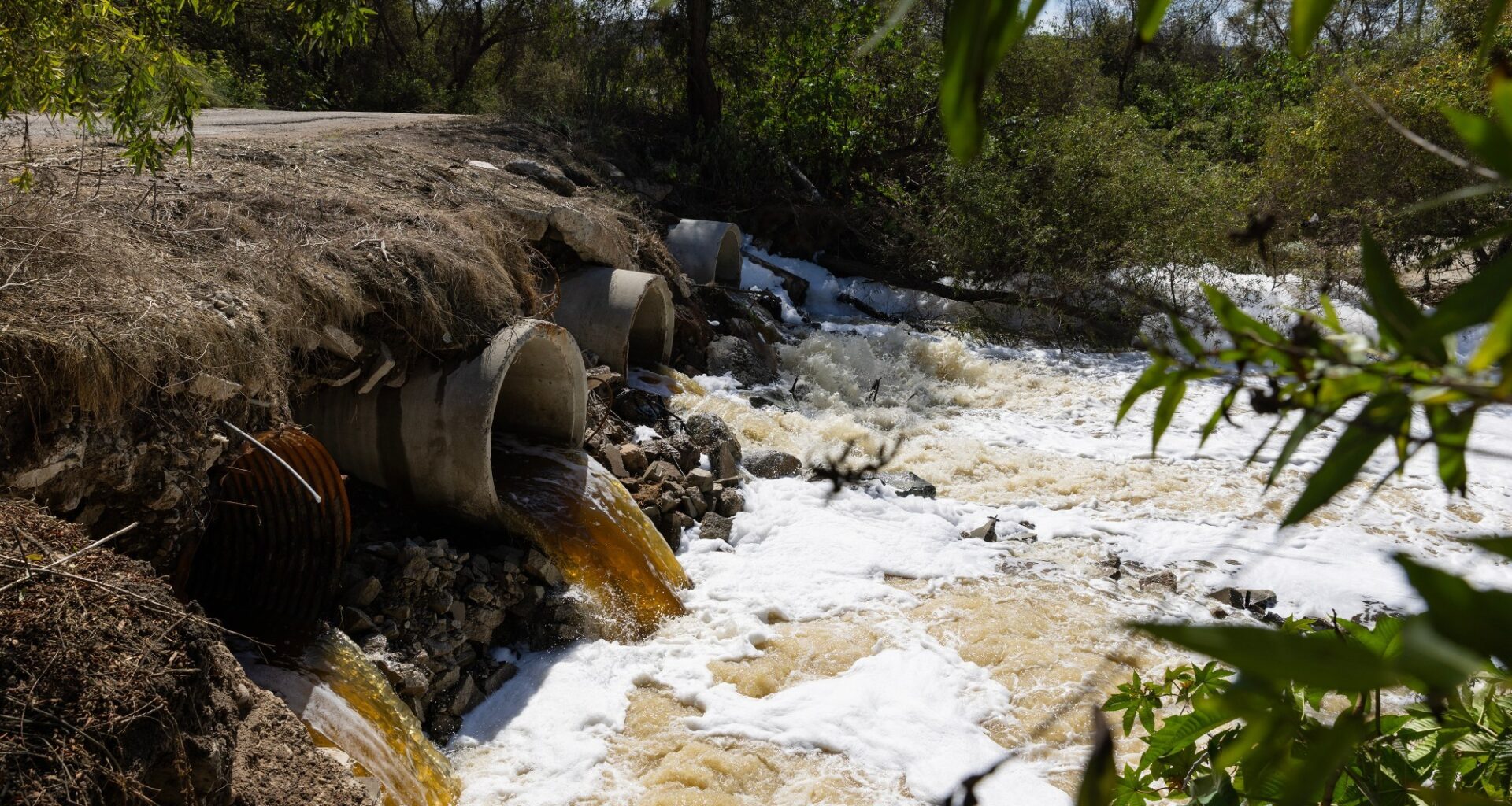
When Tropical Storm Rachel slammed the region last weekend, brown, sewage-tainted water once again flowed across the U.S.-Mexico border into southern San Diego.
Such scenes are not new. Cross-border pollution has long impacted the Tijuana River Valley and beyond. So, when it became apparent that the region was in for a potentially wild El Niño winter, pressure mounted to extend preparation efforts south of the border.
Conversations between U.S. and Mexican agencies have been ongoing, even before the region was hit by heavier-than-expected rainfall days ago. And the recent storm might be a test of what’s to come in the months ahead, as risks of flooding and landslides increase.
“It’s an opportunity to get everyone around the table to talk about preparedness gaps and take a look at opportunities to strengthen communication so that if one of these severe events does occur, there will be a protocol in place,” Michael Martucci, regional administrator for the U.S. Environmental Protection Agency’s Pacific Southwest region, said in an interview.
Nonprofit organizations have also joined the efforts. Earlier this month, crews and heavy machinery cleared piles of trash, debris and discarded tires from a section of the Tijuana River canal in Mexico. Led by the binational nonprofit Wildcoast, the work was expected to continue for weeks. The goal is to remove as much as possible before it has the chance to flow across the border into the U.S.
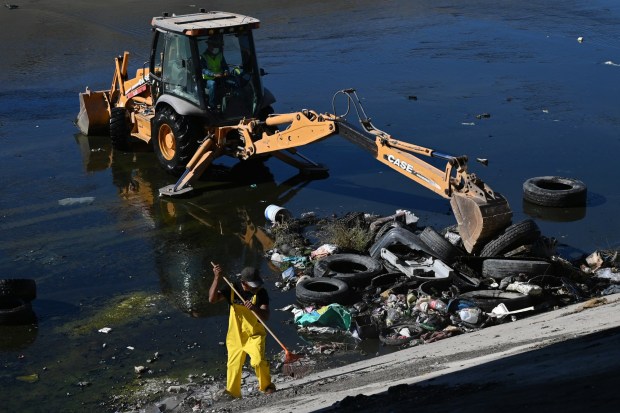 Wildcoast and Baja California environmental groups with university organizations and state authorities organized to remove trash and old tires from the Tijuana River channel in Tijuana, on Oct. 2. (Carlos Moreno / For The San Diego Union-Tribune)
“It’s one river, two countries, and this affects us on both sides,” said Fay Crevoshay, communications and policy director at Wildcoast. “We have to work together.”
The International Boundary and Water Commission, an international body comprised of U.S. and Mexican representatives, performed maintenance work on both sides of the Tijuana River channel, including removing vegetation, mowing, repairing erosion and reshaping embankments, according to a quarterly report by the EPA.
“For us, really at the center of this effort, is focusing on protecting human health, human safety and certainly the environment,” said Martucci.
Efforts are also focused on protecting crucial infrastructure in the area, including wastewater and conveyance systems.
“It is an all-hands-in approach,” he said. “Taking these proactive steps both on the Mexican and on the U.S. side of the border to make sure that Mexico is prepared, as is the U.S., because at the end of the day, all of this water is going to flow to the same place — to that critical infrastructure.”
A week ago Sunday, as Tropical Storm Rachel lashed the region, the IBWC said on social media that, despite “significant Tijuana River flows,” there were no reported issues at the South Bay International Wastewater Treatment Plant in San Diego, which treats sewage flows coming from Tijuana, or at canyon collectors, levees or dams in Mexico.
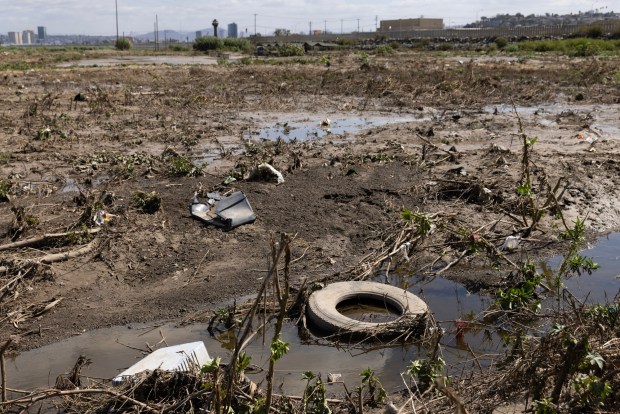 Trash clumps along the bank of the Tijuana River in the Tijuana River Valley on Tuesday in Imperial Beach. (Luke Johnson / The San Diego Union-Tribune)
Baja California officials have said that there’s been coordination with their counterparts in the U.S.
Earlier this month, Baja California Gov. Marina del Pilar Ávila announced plans to clean up the Mexican side of the Tijuana River channel. State officials said then that work had begun on the first 2.5 miles from the international border.
Oscar Romo, director of the binational nonprofit Alter Terra, said Mexico should maintain and clean the area year-round. “It’s their obligation,” he said, noting international agreements.
The nonprofit manages a trash boom system that was set up on the U.S. side of the Tijuana River canal two years ago as part of a state-funded pilot project to intercept as much trash, plastic, tires and other debris flowing from Mexico. Romo, who leads the project, said the system underwent maintenance to brace for El Niño weather.
The project was launched as a two-year pilot program, but Romo said it recently secured funding for an additional year. Once access to the area is possible after a storm, crews quickly remove the trash, vegetation and debris caught by the trash boom.
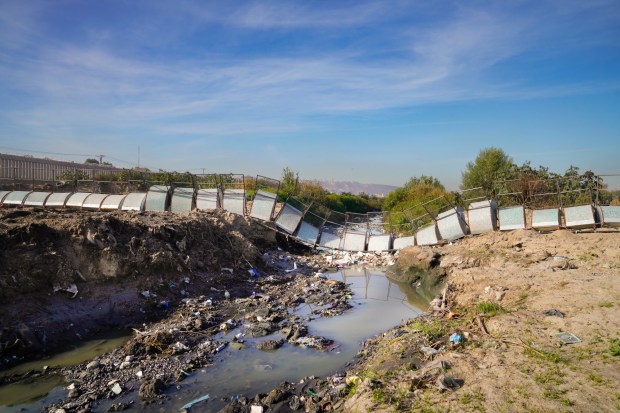 A trash boom that stretches across a galvanized steel cable with 150 rigging attachments to catch floating debris in the Tijuana River Valley before it reaches the thick vegetation and the ocean. (Nelvin C. Cepeda / The San Diego Union-Tribune)
Similar systems, which serve as a layer of defense, have been installed in Goat Canyon and Smuggler’s Gulch along the border in San Diego. Wildcoast has also set up a couple more in Tijuana.
Romo said on Monday that the early preparations seemed to have worked, but the rains revealed that a significant amount of trash and vegetation still flows from Mexico. He estimated that the trash boom caught about 80 tons of trash and debris last weekend, though he noted that the exact volume would be confirmed later.
What’s next?
While both countries said they are working to find long-term solutions to the issue of cross-border pollution, the EPA said it remains committed to supporting Mexico’s infrastructure with the coming El Niño threat — namely “as they assess their needs and their ability to respond and protect the integrity of their drinking water and wastewater systems,” Martucci said.
“We are very much in this together,” he said.
“For us, these efforts have involved sharing historic rainfall data, discussing plans for emergency pumping and emergency equipment,” he added. “The coming weeks are also going to involve us working through the details of communication plans, emergency supplies, ensuring that we are ready for anything that Mother Nature might throw at us.”
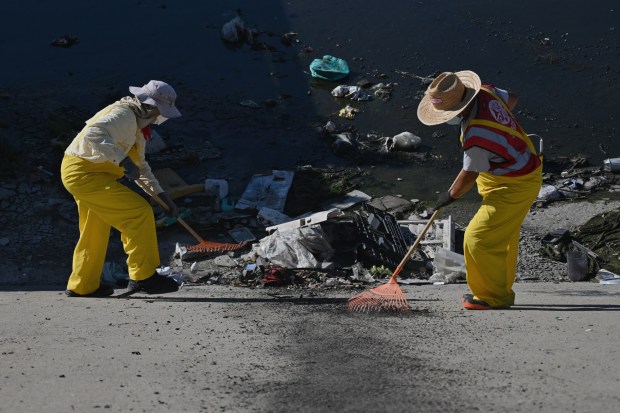 Wildcoast and Baja California environmental groups help remove trash and old tires from the Tijuana River channel in Tijuana. (Carlos Moreno / For The San Diego Union-Tribune)
The coming winter rains will also test new infrastructure built into the border wall, including a bridge with vertical lift gates.
In 2024, U.S. Customs and Border Protection told the Union-Tribune that the new barrier built at the Tijuana River channel met the requirements of the U.S. IBWC for construction within the waterway and that the vertical lift gates ensure that the structure “does not impede flows within the Tijuana River channel during weather events.”
Martucci said that, at Mexico’s request, the IBWC has confirmed with CBP and its Mexican partners that during rainy weather the border barrier’s gates will be raised “to maximize flows and mitigate any additional damming that might happen if those gates were closed.” Border Patrol agents strictly monitor the area at all times.
CBP did not respond to questions related to their protocols in rainy weather.
Landslides and flooding
Tijuana faces its own unique challenges when it comes to emergency preparedness amid its continually growing population.
Homes are built — sometimes without solid foundations — on hillsides throughout the city and its outskirts, and many roads are unpaved. Some areas lack suitable sewage and drainage infrastructure when heavy rains hit.
Before Tropical Storm Rachel, the Tijuana City Council passed a state of pre-alert declaration to ensure that local agencies were prepared and coordinated to respond quickly to any emergency resulting from the forecasted weather.
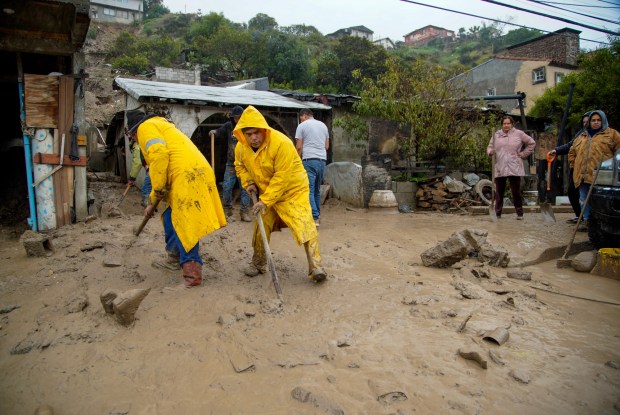 Two homes were partially destroyed after a hillside collapsed due to the heavy rains in Colonia Artesanal on Feb. 6, 2024, in Tijuana. (Alejandro Tamayo / U-T file)
During the recent storm, some Tijuana areas experienced flooding, landslides, sinkholes and power outages. Tijuana Mayor Ismael Burgueño recently announced plans to further clean storm drains to strengthen the city’s infrastructure and prevent damage by upcoming rains.
Burgueño also asked the community for help maintaining a clean environment, as large amounts of trash were found in storm drains that had already been cleaned.
One of the city’s biggest concerns during intense rainfall is the potential for landslides in hillside neighborhoods. Tijuana’s director of civil protection, Jesús Páez, said this month the department was planning to go door-to-door in high-risk areas to notify residents ahead of more rains.
During her weekly news conference on Wednesday, Ávila, the state’s governor, urged residents to remain vigilant and stay informed. As of Wednesday, nine people had been reported dead in southern Ensenada due to the storms, including family members who sought shelter in a vehicle that was swept away by a stream’s current.
Ávila asked those living in high-risk areas to follow recommendations to evacuate.
“We can’t let our guard down,” she said. “This is just the beginning.”