
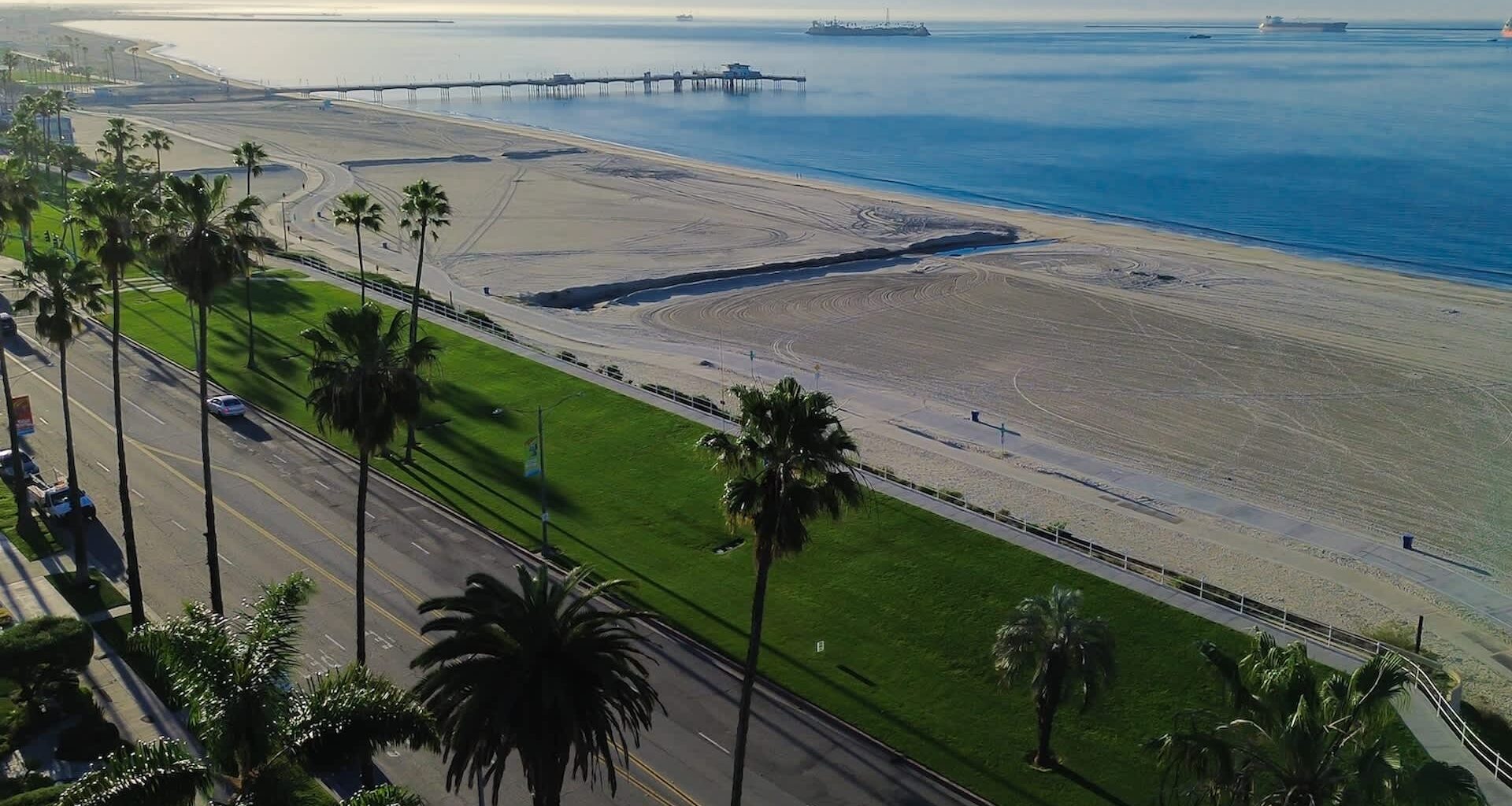
After three major storms tore away sections of Long Beach’s historic Peninsula boardwalk and bulkhead, the city said repairs could cost as much as $3.6 million.
Here’s what to know
Along Seaside Walk between 64th Place and 66th Place, repeated wave hits during Tropical Storm Rachel heavily damaged the bulkhead and left some sections of the boardwalk completely gone, according to city officials.
Rex Richardson, the mayor of Long Beach, said during a press conference that the city would keep crews on a low-tide schedule and pause work unless conditions were safe, the Press-Telegram reported. The job was expected to continue until repairs were finished, with equipment staged near 54th Place and 64th Place.
The estimated price tag for the repairs has increased dramatically. Initial estimates had the project costing up to $1.5 million, while a revised calculation had those expenses rising as high as $3.6 million, per the Press-Telegram.
Laath Martin, a city spokesperson, said the higher estimate reflected emergency repairs completed during Tropical Storm Rachel and the added cost of materials. The repairs were being paid for through the Tidelands Emergency Reserve rather than the city’s general fund or emergency reserves.
More background
Tropical Storm Rachel struck the Long Beach coast in mid-October. Officials issued evacuation orders for homes on Seaside Walk from the 64th block through the 66th block.
Long Beach inspection teams red-tagged eight buildings containing 13 residences, while one additional building was yellow-tagged. A broader evacuation warning also covered 64th, 65th, and 66th places south of Ocean Boulevard, along with several nearby blocks on Seaside Walk, according to the Press-Telegram.
As part of flood-control efforts, the city distributed about 19,000 sandbags. Portable pumps were used in Naples Island and on the Peninsula to handle street flooding and ponding during high tide.
When will access be restored?
According to city officials, access to the damaged areas will depend on safety reviews, tide windows, and the condition of nearby red-tagged buildings.
“Crews will continue to work during low tide and safe conditions in coordination with building and safety,” said Richardson, according to the Press-Telegram.
The damage occurred as city leaders have been implementing a seven-point coastal protection plan. A major piece of that effort is the Alamitos Bay dredging and beach replenishment project, which was scheduled to begin around the same time the tropical storm hit the region.
The coastal-protection project was planned to restore safe, navigable depths in the Alamitos Bay entrance channel by removing 415,000 cubic yards of beach-ready sand from bay floors and placing it along the Peninsula. The effort carried an $11.4 million price tag, with funding through the Marina Fund and the Tidelands Fund.
Before dredging began, the city also planned a roughly $230,000 back-passing project to move another 50,000 to 100,000 cubic yards of sand onto the Peninsula. This initial layer of sand was intended to rebuild the beach and improve the effectiveness of the larger replenishment project.
“We’ll repair the boardwalk, but this is about making sure that we’re taking the steps to have a more resilient coastline in the years ahead for generations to come,” Richardson said, per the Press-Telegram.
Where can I learn more?
Elsewhere, coastal communities and public agencies are facing similar storm damage, flooding and steep repair bills.
• In Bristol, Maine, storm damage at Pemaquid Point left residents stunned at the lighthouse.
• Across the U.S., public infrastructure buckled as extreme weather drove up repair costs.
• Along Australia’s coast, severe coastal conditions worsened erosion, collapses, and community disruptions.
• In South Florida, rising sea levels and flooding damaged roads, homes, and budgets.
• In western North Carolina, flood danger returned to communities still recovering from past disasters.
Get TCD’s free newsletters for easy tips, smart advice, and a chance to earn $5,000 toward home upgrades. To see more stories like this one, change your Google preferences here.
