
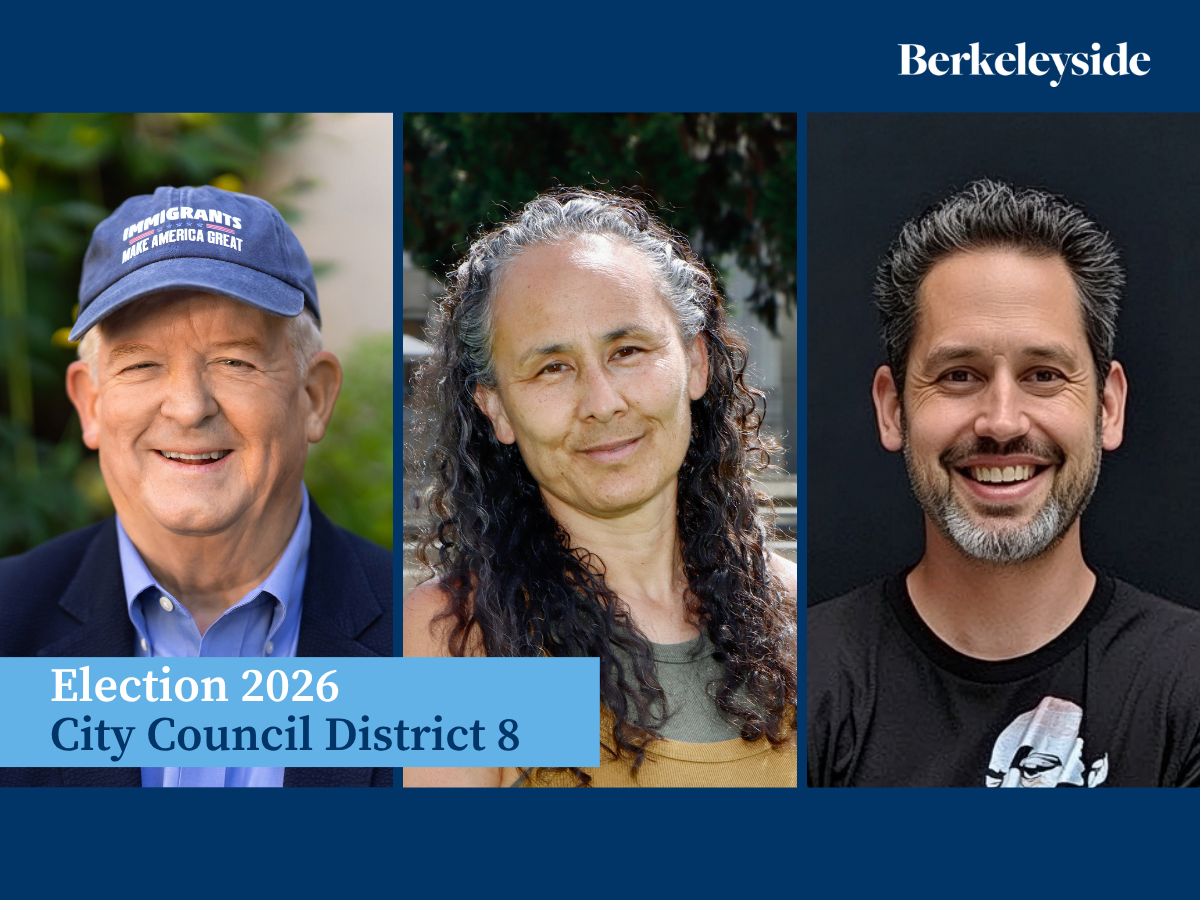
 The three candidates running to represent District 8 on the Berkeley City Council are (from left) Councilmember Mark Humbert, Mari Mendonca and Michael Wallman. Credit: Submitted photos
A proposal to allow bigger housing developments on parts of College Avenue and two other popular retail corridors has taken center stage in the race for the City Council seat representing the Elmwood District and other parts of Southeast Berkeley.
Incumbent Councilmember Mark Humbert, a backer of efforts to encourage new housing in Berkeley who was elected in 2022, supports a narrowed version of the zoning changes that would raise height limits only on specific properties viewed as prime candidates for development.
All of our coverage: Meet the candidates running for city council, rent board, school board and more. And learn about local ballot measures and how to vote.
Two challengers for the District 8 seat, artificial intelligence engineer Michael Wallman and Mari Mendonca, a former Rent Stabilization Board member who ran unsuccessfully against Humbert in 2022, both contend the city should scrap the rezoning plan altogether. They share concerns voiced by some merchants and neighbors that new development could force local businesses out of the popular College Avenue commercial strip.
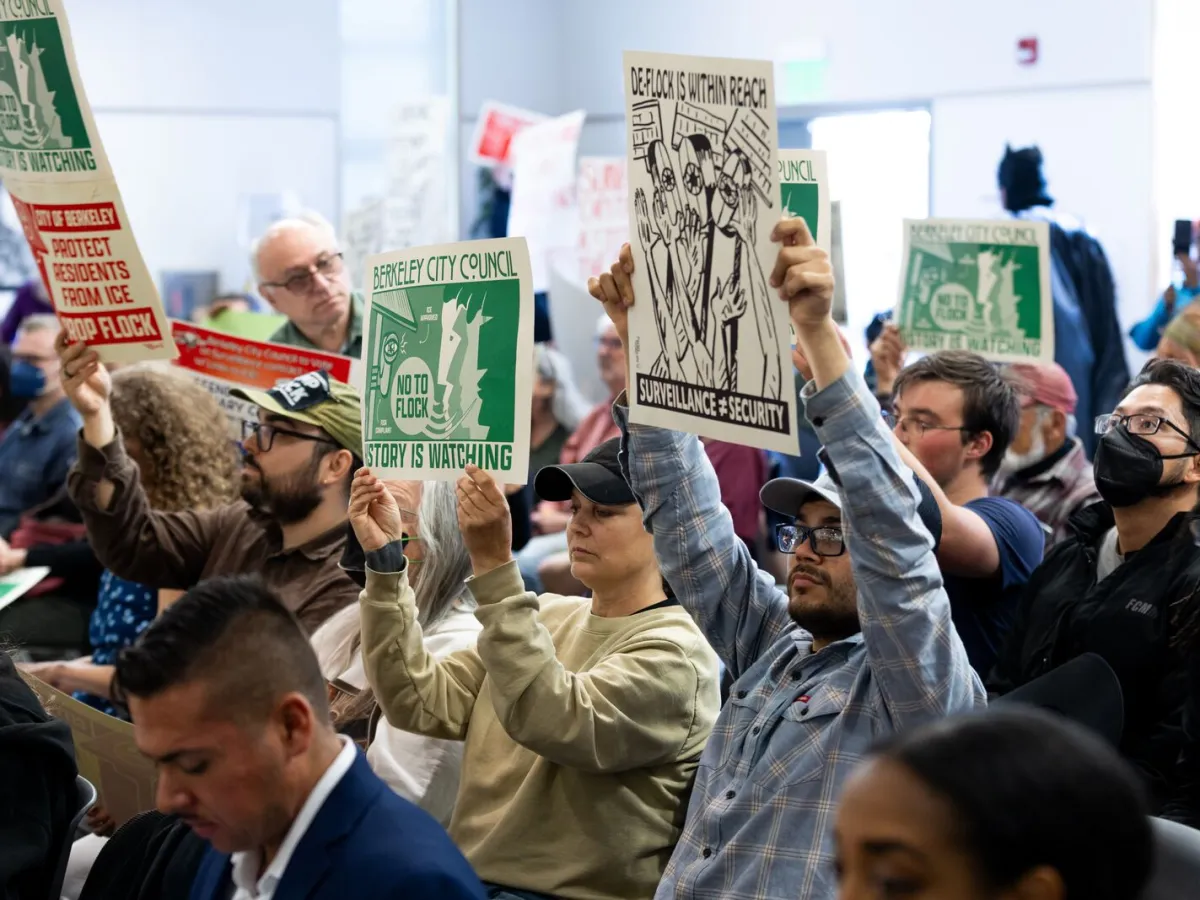
Mendonca and Wallman also differ from Humbert on police surveillance. The two challengers want Berkeley to end its contract with the company Flock Safety and criticized technology such as automated license plate readers, while Humbert has voted to continue working with the Georgia firm and contends its readers are a valuable crime-fighting tool.
Humbert has substantial advantages in terms of fundraising and endorsements, with the backing of nearly every member of the Berkeley City Council and several influential local groups. Wallman and Mendonca, meanwhile, are running as outsiders looking to bring change.
Berkeleyside held in-depth interviews with Humbert and Wallman about their positions; Mendonca declined an interview request, and instead responded to questions sent by email. A fourth candidate, Fred Feller, will appear on the ballot but dropped out of the race in August.
With three candidates, the District 8 race could come down to ranked choice voting. Read our explanation of how the process works here. A partial list of the candidates’ endorsements is near the bottom of this story.
How would they handle zoning changes in the Elmwood?
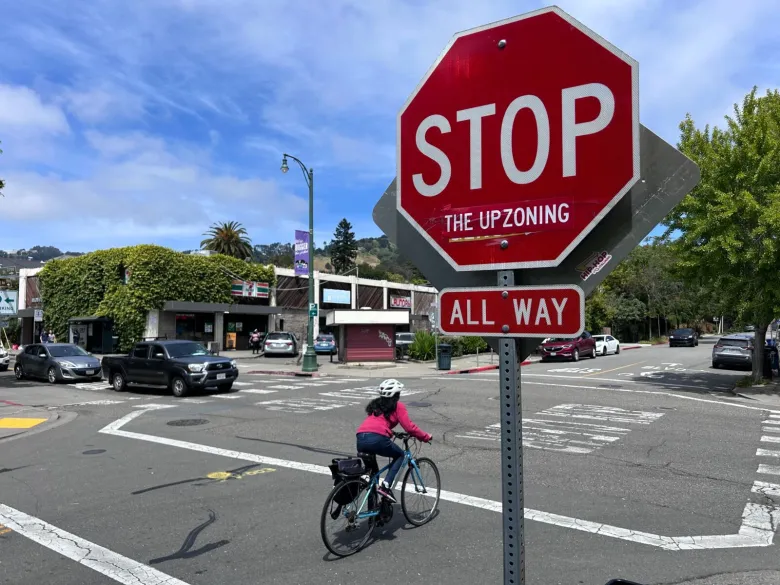 Someone earlier this year added stickers protesting a plan that would zone portions of College Avenue for larger housing to several stop signs in the Elmwood district. Credit: Nico Savidge/Berkeleyside
Let’s start with a quick refresher on how the “Corridors Zoning Update,” as officials have dubbed the proposal to allow denser housing in the Elmwood and North Berkeley, became the latest front in Berkeley’s long-running debate over development.
Back in 2023, the Berkeley City Council pledged to rewrite zoning rules for portions of College, Solano and northern Shattuck avenues as part of the city’s eight-year housing plan, vowing to encourage new construction in the sought-after but historically exclusive neighborhoods that have seen little new development for decades.
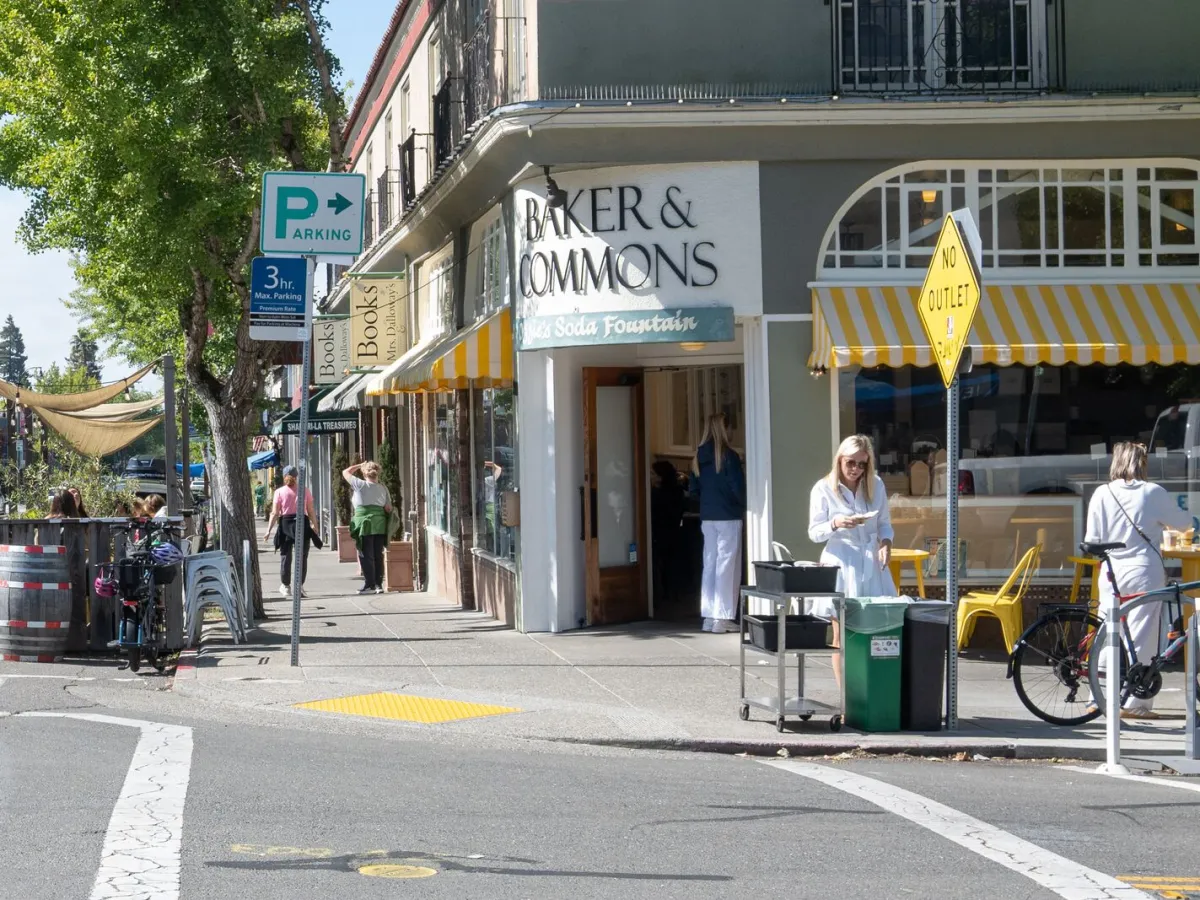
Drafts of the proposal released last year sparked opposition that coalesced into a new advocacy group, Save Berkeley Shops, which argued the new rules could lead to developers buying up Elmwood District properties, kicking out popular businesses and replacing them with new apartment buildings. Housing advocates aligned with the “Yes in My Backyard” movement, meanwhile, contend wealthy areas like the Elmwood should take on more development, and the zoning plan is a modest step toward doing that. Planning officials estimate the zoning change could bring as many as 130 new homes to the neighborhood, the fewest of the three avenues, but it has been the epicenter of resistance to the plan.
Humbert last fall proposed the city limit the potential zoning changes only to certain properties, rather than applying the new standards throughout the corridors. Along College Avenue in the Elmwood, for example, he wants three parcels to be subject to taller height limits: a strip mall anchored by a 7-Eleven at Russell Street, a parking lot behind the Wells Fargo bank branch and a post office at Webster Street. The Berkeley Planning Commission endorsed a similarly limited version of the zoning changes in the spring that called for a five-story height cap on College; the package is expected to come back before the City Council for final approval sometime after the election.
Humbert argues the tailored zoning changes would allow developers to build new housing on lots that could be put to better use, while ensuring the districts’ most-cherished shops don’t become targets.
“I think that it threads the needle,” he said. “We have a lot of people in this district who are pro-housing, and who love the Elmwood and appreciate my nuanced approach to development.”
But his proposal has not quelled opposition to the rezoning plan. Save Berkeley Shops’ yard signs, which warn that the City Council could “destroy Berkeley’s small businesses,” have been planted around the Elmwood District, North Berkeley and elsewhere; many of them in District 8 are now joined by campaign signs for Wallman or Mendonca.
Wallman says the changes would strip the city of potential leverage to negotiate with developers for benefits in exchange for letting them build taller projects, and would eliminate the incentive for projects to include on-site affordable units so they can take advantage of California’s “density bonus” law.
He took issue with two of the three Elmwood District sites Humbert identified, saying Berkeley shouldn’t encourage a project at the 7-Eleven property because construction there could impede access to a fire station across the street, and that the city shouldn’t take steps that might lead to the closure of a post office. Wallman also backed a proposal brought by preservationists and critics of the rezoning to designate the core of the Elmwood a historic district; Berkeley’s Landmarks Preservation Commission narrowly rejected that effort in June.
 Competing crops of yard signs have sprung up around the Elmwood District to oppose a plan to allow larger apartment buildings in the area (left) and support it. Credit: Tracey Taylor/Berkeleyside
“I don’t think anybody is against housing per se, it’s just how we build housing, what type of housing,” Wallman said. “Squeezing it in [on] a two-lane road that should be a historic district just doesn’t seem right to me.”
Mendonca similarly does not believe zoning regulations for the Elmwood District should be changed, saying the density bonus law already allows for enough housing in the area.
“The statewide push for mass density is a strategy for real estate investors and developers to gain assets under the guise of ‘caring’ about housing,” Mendonca wrote in her emailed statement. “It is not necessary to force added density in our thriving small business districts nor on small municipalities like Berkeley in general.”
What’s their approach to housing more broadly?
Mendonca contends Berkeley needs to shift away from what she described on her website as “a global push to commodify housing” by imposing new regulations that “stop the inflation of market rates and end density bonuses and extractive giveaways to developers.” Her platform calls for supporting Berkeley’s “Small Sites” program, in which the city partners with land trusts to buy privately owned apartment buildings with low rents and preserve them as dedicated affordable housing. (Humbert’s record on the Small Sites program is mixed: He abstained from a budget vote in June that would have eliminated $1.3 million in proposed new funding for the program, which helped to defeat that effort, but a year earlier he voted to cut $1.4 million from the initiative.)
She also wants to institute a rent freeze and repeal the Costa-Hawkins Rental Housing Act, a 1995 state law limiting local rent control ordinances. Asked how she would accomplish those goals as a councilmember, Mendonca told Berkeleyside that doing so would involve working with state legislators and studying what avenues in the law could allow for a rent freeze.
“Unfortunately, we are in a tight trap here: the players that are positioned to control this sector and their powerful lobbies, along with their politician partners, have got most of us living per their will,” Mendonca wrote.
Humbert embraces the view that new construction is critical to easing the housing crisis. He introduced a referral to Berkeley planning staff earlier this year asking them to develop another rezoning plan aimed at bringing more housing to District 8 — this one targeting portions of Telegraph Avenue south of Parker street, as well as several properties around the intersection of Ashby and Claremont avenues.
His proposal estimates the changes could create thousands of new apartments on those blocks. Humbert argues that would fulfill the city’s goal of creating more opportunities for people to live in the pricey Elmwood District, while also helping make the southern blocks of Telegraph more vibrant.
“I want to bring people into these high-resource, high-amenity neighborhoods — it would be lovely to have middle-class families be able to live in District 8 again,” he said. “Right now it’s virtually impossible.”
Wallman derides zoning changes as a “lazy approach” to encouraging housing. He contends Berkeley could use “creative solutions” to make it easier to build what he terms “human-scale” developments that are three or four stories tall, such as pursuing a bond measure that would allow the city to invest in projects along with for-profit developers.
Wallman also suggested the city reconsider its development fees and shorten the time it takes to approve permits, though he did not specify what fees he would cut or how he would speed up the process.
“I want to remove a lot of those roadblocks to bring the cost of development down,” he said.
What do they think about Flock and policing?
 A Flock Safety license plate reader. Credit: David Goldman/AP
Wallman and Mendonca both oppose the use of police surveillance technology such as automated license plate readers, though they differ in their prescriptions for how the city should address public safety.
Wallman said he does not believe Berkeley can safeguard data collected by the readers, and worries about how those systems could one day be combined with emerging technologies such as AI and facial recognition. He called for the city to redirect the money it spends on surveillance to pay raises for officers and recruitment efforts to hire more police, and suggested Berkeley use AI to reduce officers “busy work” and allow them to spend more time in the field.
“I’m just against mass surveillance,” he said. “Especially in the age of AI, it’s extremely dangerous.”
“Let’s get a cop out there on patrol,” he added. “I’d rather invest in solutions like that.”
Mendonca, on the other hand, contends on her website that Berkeley is “overspending” on its police department and should “invest in community services, not over-policing and intrusive surveillance.” Asked how she would look to cut spending in the department, Mendonca wrote that she would need to undertake more analysis before recommending specific cuts.
“Surveillance is not a strategy; it’s surveillance,” she wrote. “In our current national political climate, these unprotected and invasive technologies are an unsafe option, which can potentially pose more harm on communities than good.”
Humbert says he shares the concern that data collected by license plate readers could be accessed by federal immigration authorities. But he contends the city has been able to safeguard its information and that the readers help make Berkeley safer — he was part of the 5-4 council majority that voted in May to extend Berkeley’s contract with Flock, over objections from critics of the technology.
“So far, we haven’t seen any sharing of information from our ALPRs with Customs and Border [Protection], or ICE, or any of the bad actors at the federal level,” Humbert said. The readers, he added, “have been really useful in solving some really serious crimes.”
What do they say sets them apart?
Humbert argues he has been a pragmatic and effective representative in his first term, saying he works productively with city staff and other councilmembers to deliver accomplishments like a set of “quick build” safety measures on Claremont Avenue in the wake of a crash that killed a pedestrian in 2025.
“I can get things done,” he said.
Wallman, meanwhile, pointed to his background in engineering, saying he approaches issues with a “technical and analytical perspective.” The Google employee peppers his public statements with the language of the tech industry — the planning department should redefine its “service level objectives,” he told Berkeleyside, while his website lists several “moonshots,” such as providing universal after-school care and reintroducing trade programs at Berkeley High School.
“I know that generally it’s out of [the] scope of the City Council,” he said of those ideas, “but my vision of the City Council is councilmembers who care about all aspects of the city, and promote a better life for people living in Berkeley.”
Mendonca wrote that she would bring “energy, passion, intelligence and natural leadership skills” to leading the district.
“I’m an active listener and make it a point to hear and engage with those who agree and disagree in order to collaborate and discover solutions on issues that affect everyone in our community,” she said.
Who’s endorsing them?
Humbert’s campaign is backed by Mayor Adena Ishii and six of the seven other members of the Berkeley City Council (Councilmember Cecilia Lunaparra has not made an endorsement in the race), plus Assemblymember Buffy Wicks and former mayor and state Sen. Jesse Arreguin, among others. Organizations supporting Humbert include the Berkeley Democratic Club, the unions that represent Berkeley police officers and firefighters, and the housing advocacy groups YIMBY Action, East Bay for Everyone and Berkeley Neighbors for Housing and Climate Action.
Mendonca’s list of endorsers includes rent board Commissioner Xavier Johnson and former Councilmember Cheryl Davila, as well as the organizations Our Revolution East Bay, Friends of Adeline and Flip the Berkeley City Council, a newly formed coalition of progressive groups that includes the organizations Berkeley CopWatch and Berkeley Network for Palestine.
Wallman has also been backed by Flip the Berkeley City Council; his website mainly lists endorsements from community members, including John Gage, a co-founder of the tech firm Sun Microsystems, and Phil Bokovoy, the neighborhood activist who drew national attention for his lawsuit over UC Berkeley’s enrollment growth.
How much money have they raised?
All three of the candidates are taking part in Berkeley’s public financing program, which caps donations at $60 and provides a 6-to-1 match for contributions from Berkeley residents. Mendonca and Wallman did not report receiving city funding as of last month, however.
Humbert had raised $7,555 from contributors as of the end of the most recent campaign finance filing period on Sept. 19. His list of donors includes El Cerrito Councilmember and former BART Director Rebecca Saltzman, bike advocate Karen Parolek and Ruben Lizardo, UC Berkeley’s director of local government and community relations. Humbert ended the filing period with $17,109 in the bank.
Wallman raised $4,310 from contributors over the same time, and ended the period with $1,334 on hand. He received contributions from former Councilmember Kate Harrison and several prominent development critics, including Save Berkeley Shops president Donald Simon and Lisa Bruce of the group Berkeley Together.
Mendonca took in $1,868 from donors as of Sept. 19 and her campaign ended the period $538 in the red, according to its filing. She received donations from former rent board chair Paola Laverde and activist Elana Auerbach, among others.
Related stories
Hotly debated plans to add housing in the Elmwood and North Berkeley are a step closer to approval
May 13, 2026May 13, 2026, 11:57 a.m.
Push to make Elmwood a ‘historic district’ rejected
June 5, 2026June 5, 2026, 4:23 p.m.
Berkeley rejects police surveillance expansion, will keep Flock plate readers
May 8, 2026May 8, 2026, 5:09 p.m.
“*” indicates required fields